
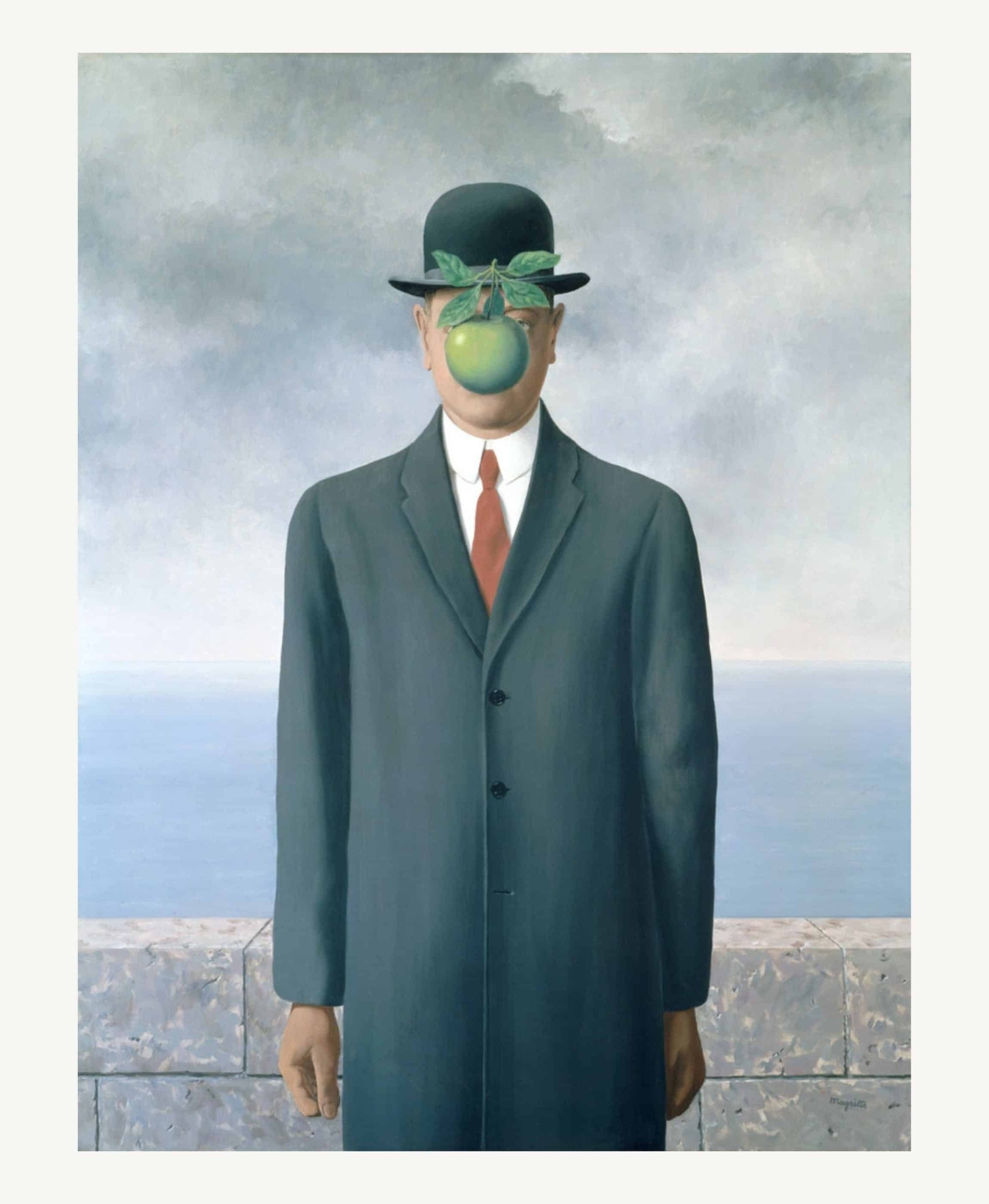
When René Magritte painted The Son of Man in 1964, he offered the world an image that feels both familiar and enigmatic. A man in a bowler hat stands before us, his face obscured by a floating green apple. The painting invites us to look deeper—not only at the man but at ourselves. What are we hiding? What blinds us from seeing clearly? And, perhaps most importantly, how do we find our way back to what is true?
In Romans 3:9-24, Paul delivers a stark diagnosis of humanity. His words are uncomfortable: “There is no one righteous, not even one; there is no one who understands; there is no one who seeks God” (v. 10-11). It’s a blunt statement about the human condition, one that contrasts sharply with the belief that people are “basically good.” Like Magritte’s obscured figure, Paul suggests our vision of ourselves is clouded by sin.
The Obscured Identity of Humanity
Magritte’s painting holds layers of symbolism that resonate deeply with this biblical text. The title, The Son of Man, evokes two powerful images: humanity as a whole and the figure described in Daniel 7 as the one who will come to judge the world. In Magritte’s work, however, the man’s identity is hidden, his face lost behind an apple. The apple—a symbol of temptation and the fall in Genesis—acts as both a barrier and a reminder. It points to the idea that sin doesn’t just obscure our vision of the world; it obscures our understanding of ourselves.
The painting’s muted sky and formal figure suggest conformity, a life drained of the vibrancy and individuality intended by God. The gray sky echoes the darkness that covered the earth at Christ’s death. It’s as if Magritte is pointing to the tragedy of a world bound by sin: humanity reduced to faceless figures, losing the essence of who we are meant to be.
The Diagnosis of Paul: Our Shared Brokenness
Paul’s words in Romans 3 cut through any illusions of human righteousness. He builds his argument by weaving together Old Testament passages, emphasizing that both Jews and Gentiles are equally under sin’s power. His conclusion? No one escapes this reality.
This theological perspective has been debated throughout history. Augustine believed humanity was so corrupt that it couldn’t choose good without divine intervention. John Calvin pushed this further, describing total depravity—sin touching every part of human existence. It’s a heavy message, one that might make us squirm. After all, who wants to admit that even our best actions are tainted by selfishness?
The Way Forward: Trust in the Savior
Paul doesn’t leave us in despair. He points to a better way, one that transcends our failed attempts at self-righteousness. In verses 21-24, he declares that righteousness comes “through faith in Jesus Christ to all who believe.” Here, the Greek word for “faith,” pistis, carries the idea of trust—a deep reliance on God’s grace rather than our own efforts.
This trust is counter-instinctive. Like leaning into a downhill ski to maintain balance, it requires us to go against our natural inclinations. We must surrender control, placing our full weight on Jesus rather than relying on our own strength. It’s counterintuitive, too. The gospel calls us to give our lives away in love, to forgive, to care for the vulnerable, and to resist the lure of wealth and power. And it’s countercultural, offering a peace and freedom that stand in stark contrast to the anxiety and striving of the world around us.
The Christian Life: An Invitation to Redemption
Magritte’s apple may hide the man’s face, but the gospel reveals what sin obscures. In Dietrich Bonhoeffer’s words, the Christian life should be like an apple, held out as a tempting alternative to the brokenness of the world—a life marked by love, joy, and peace. This is the hope Paul proclaims: despite our sin, we are justified freely by God’s grace.
Faith in Jesus doesn’t just restore our relationship with God; it restores our humanity. It opens our eyes to see clearly, to step out of conformity, and to live with purpose and hope. In Christ, we are no longer lost in the shadows of sin. Instead, we are invited into the light, our true identity as children of God fully revealed.
So the question is this: will we put our trust in Him? Will we dare to lean into the truth of His love, even when it feels counter-instinctive, counterintuitive, and countercultural? The Son of Man came to redeem what was lost. Through Him, our vision is restored, and our lives are made new.
 Hardwired