By now everyone has had the opportunity to see the irony of the American Left, champions of compassion, responding to the assassination of Christian martyr Charlie Kirk with ridicule and condemnation. We’re also seeing the bizarre claims of the American Right – in whose CV are abortion clinic bombings and anti-LGBT violence – that only the Left is like this. Let’s not miss the meta-conversation about human nature here. This says something profound about the species.
Two recent developments are shaping the human psyche. First, the advent of social media (Instagram in 2010 being the watershed), and second, the pandemic of 2020. Ten years apart, but in the span of world history, adjacent. Social media allowed us to zoom in on each other’s minutae – what we had for breakfast, how we look in the bathroom mirror, what we brag about, and what inflames us. “Comments” sections are a Pandora’s Box of pettiness.
A comedian recently observed: social media has allowed us to see how dumb everyone is. We all had our suspicions, but now we have proof.
A moment later, the pandemic allowed us to see everyone at their worst and most destructive. We all saw, writ large, the power of deception and lies, slander and hate, cancel culture and power mongering. And blame, blame, blame.
I’m not hearing much talk about it, but at the heart of all of this is a longing for character. No political party can claim better standing here. We are, all of us, a greedy, dishonest, murderous, self-righteous lot. We destroy over a disagreement and feign offense over slight infractions. We don’t mourn with those who mourn; we shame them for it.
Character and its target, virtue, are notoriously hard to define, but by it, I mean that self-reflective, self-disciplined attempt to align one’s values with the divine order and hold to them consistently. The divine order is the nature of creation and God’s intention for human nature. We see it most clearly in the life of Jesus of Nazareth. That’s the target; a virtuous life is a life that seeks to imitate Jesus. Character is the self-disciplined attempt to constantly refine one’s self in humility to achieve that target. For a secular person, character is an attempt to align one’s self consistently and repeatedly with an ephemeral goodness (though I don’t see how that can be concretely grounded in anything).
What the ideological extremes in American culture lack is character. Neither one has it because neither one deems it necessary. This is where the mighty middle is so vital. People with character tend to be humble enough to allow others space to be. Character is only forged over long time and through repeated effort. It is the thousand strokes of a chisel before a statue starts to take shape. It is the long work of a soldier, when no enemy is in sight, to throw up a fortress that will stand when the enemy bears down upon them, according to Seneca (Letter 18).
For those who desire to seek character, I can share a few maxims I’ve found as a starting point. You can do your own research to find out where they come from.
“Love your neighbor.
Love your enemy.
If someone strikes you on one cheek, turn the other cheek to them as well.
Don’t repay evil with evil; answer it with good.
Judge other people the way you want to be judged.
Do not let unwholesome talk come out of your mouths.
Be kind, compassionate, and forgiving of one another.
Put the needs of others above your own.
Only three things are going to last – faith, hope, and love. The greatest one is love.”
Without a renewed pursuit of character, I’m afraid we stay where we are. Stuck.
There’s something a bit off about the way the media headlines are reporting on the assassination of Charlie Kirk. They are calling him a “conservative activist” (CNN), a “right-wing activist” (BBC), an “influential figure on the right” (WSJ), a “conservative influencer” (NYT), and a “fearless patriot” (Fox).
It feels to me like they are all dancing around the thing that preceded and grounded all of Kirk’s beliefs.
He was a Christian.
He was a Jesus-follower, a believer, a man of faith. This is not determined or affected by the positions he took on various social and political issues. It was determined by the position he took on the nature of Jesus of Nazareth. Charlie unambiguously called Jesus Lord and Savior.
He was a Christian.
Pretending his faith was irrelevant to his moral viewpoints is like pretending the sun is irrelevant to daylight. Given that it appears that the murderer’s motive was objection to Kirk’s moral views, this was not merely a political act; it was the religious persecution of a Christian who outspokenly preached the message of the gospel. As such, when he was killed for his beliefs, he became a martyr. He is a martyr who died on American soil in a public and grisly way.
So I don’t want us also dancing around two consequences, the way we’re dancing around who he was.
A Consequence For Christians
First, the martyrdom of a Christian on American soil is de facto an attack on all Christians. We are one body. If one part suffers, every part suffers with it (1st Cor. 12:26). We can no longer charge Christians with paranoia when they talk about being persecuted for their faith in America.
Christians around the world suffer persecution to an extent that most Americans do not imagine. Estimates from the UK Parliament suggest that 1 in every 7 Christians in the world endures some kind of persecution, defining persecution as hostility directed at the target because of their identification with Jesus Christ. The Pew Research Center reports that Christians experience harassment in nearly 75% of countries worldwide. In some countries, they are murdered for their faith or face discrimination that is legally protected.
In America, Christians have enjoyed the status of a majority – influencing laws, education, and culture. Anxiety about persecution among well-to-do, comfortable Christians has largely seemed laughable. Harassment has typically been little more than social bristling.
But now that is not the case. A scale tipped. This is not mockery from the stage or condescension from the university lectern, which Christians have endured for decades. This is murder for faith.
Christians should be aware that we stand on new ground. We are not relieved of Jesus’ command to love our enemies and pray for those who persecute us, to repay evil with good and bless rather than curse. We are to double down on these things. We also can’t be naive about where we are. More clearly than ever, this is not the Promised Land. This is Babylon. Practice the faith so as to keep it alive in a foreign land.
A Consequence for America
Secondly, there are spiritual consequences for the making of martyrs. It is the cry of the saints that brought down God’s wrath on Pharaoh in the book of Exodus, on Haman in the book of Esther, on Saul when he went after David, on David when he murdered Uriah, on the ruling class when they oppressed the poor, and on Rome when they began martyring Christians.
“The martyrs’ blood is the seed of the church,” said the 2nd century church leader, Tertullian. He knew; he had witnessed the martyrdoms in Carthage. He’s not being poetic when he says this. He’s talking about a spiritual reality that when blood is shed, it calls out from the ground to God, and God gets angry. And God responds.
Secularism in America has taken an evil turn. It is no longer merely the intellectual skepticism of well-mannered agnostics. It has a wing that is seething with hatred and callous towards goodness and towards life.
So let’s be clear. Faith matters when you choose how to conduct your daily life. Faith matters to what you do behind closed doors. Faith matters when you choose who to vote for and when you choose who to date. Faith matters when you decide what to do with your money. It matters to how you form your moral commitments and to what you tell your friends. People of faith can live with deep peace, but we cannot relax. Faith needs to matter in everything we do in Babylon.
Faith must shape our identity, our families, our calling, and our citizenship. Let the people of faith stand up and be counted, unashamed and unafraid, doing everything in the name of Jesus Christ, our Lord.
We live in a culture addicted to blame. It happened this summer when floods in central Texas killed over two dozen children. Questions began before the waters receded about whether the owners of the camp were negligent. Once upon a time, such natural disasters were written off as “acts of God,” presuming no human liability (though still strangely blaming the Big Guy). We now seem bent on finding fault.
Recently, I’ve watched blame be cast like a net over whatever group an individual might represent – a political party, the mentally ill, a gender, a race, an ideology, or a religion. We used to call this prejudice and bigotry. An intelligent person could distinguish an individual from a group. Pointing to the worst case was understood to be a straw man that was avoiding dealing with the best case, or even the average case. For some reason, a cross-section of Americans now defend broad-brush demonizing.
The History of Blame
It didn’t used to be like this. About a lifetime ago, there was a dramatic shift in the way legal cases placed culpability. Through the 1800s, if you were hurt by a product or service, it was generally your problem. The policy of caveat emptor reigned – buyer beware. In the wake of the Industrial Revolution, a suspicious eye turned towards companies and their wealthy magnates. A decisive case was the 1916 MacPherson vs. Buick Motor Company, where the New York Court of Appeals allowed a man who had been injured by a defective wheel to hold the company liable. Thereafter, contracts were no longer required to prove culpability.
A court ruling in the 1960s then declared that companies could be held liable for defective products even if they hadn’t been negligent.
By the late 20th century, lawsuits abounded – asbestos, medical malpractice, tobacco, and even spilt hot coffee. Blame snowballed. Blame was a multi-billion dollar industry.
Modern neo-liberal, post-civil-rights-era activists and thinkers, particularly in elite universities, have advanced blame to the ideological realm. The recognition of ancestral land ownership, the tracing of longstanding structural inequities to a modern beneficiary, the attribution of explanation for crime to structures rather than individuals, the attribution of health issues to a food industry rather than choice – all of these are modern manifestations of a blame culture stretched to ambiguous ideological grounds. They bring out the wounded and the disingenuous capitalizers alike.
The Spirituality of Blame
Jesus said, “What you loose on earth, you loose in heaven.” When we loose a culture of blame on the earth, we invite a spirit of blame to take spiritual power over our society. I believe we are there.
In the wake of the assassination of Charlie Kirk, blame is an odd thing. The person who shot him was clearly responsible. Given a cogent, functioning mind, that person’s ideology must have been the motive. The culture that created his ideology seems to be the garden that grew it. There must have been gardeners.
But the eagerness to blame Democrats, liberals, or what have you for a violent culture will only go so far. Who murdered Democratic Representative Melissa Hortman? What motivated the shooter in the Buffalo shopping mart? Who has been responsible for abortion clinic bombings and LGBTQ-directed violence in America? The extreme right blames the extreme left and vice versa. The common thread is extremism.
A Way Out
Today, I’m inclined to turn the spirit of this age back on itself. The blame goes to a seething culture of blame. Polarization is a product of the extremes pulling us away from the middle, pulling us away from dialogue and communication. In this landscape, the enemy is clearly “over there” with the guilty and can be attacked from a distance. We need not find common ground – we retreat and leave scorched earth behind us.
One of the things I like best about Jesus of Nazareth is that he was always on the bad guys’ side. When the religious right formed a rock-throwing hoard, Jesus went and stood by the woman caught in adultery. When the nationalists gathered to evaluate Jesus’ loyalty, he went and had lunch with the traitorous tax collector, Zacchaeus. When zealots sought to kill Roman sympathizers and Romans sought to kill rebels, Jesus put Matthew the Roman-employed tax collector and Simon the Zealot in his inner circle of twelve. When he could have been a member of the Sanhedrin, Jesus was counted among sinners. When Creation staged a rebellion against its Creator, Jesus incarnated among the Creation.
Jesus of Nazareth didn’t seek to destroy us when we became his enemies. He sought to win us back. When we crucified him, he did not flood the earth and wash us away. He began, one by one, to win us over to his side. He also didn’t tell us to destroy our enemies. He showed us how to convert them. When I realize what he did for me when I hated him, I can do little more than bow and submit to his Way. It is the way of acknowledging my own guilt rather than finding a group to scapegoat. And rather than throwing rocks, I seek to stand alongside the sinful and broken the way he stood alongside me, with the hope we will forsake sin.
America has submitted itself to a spirit of blame, and we are spiraling in it. Peace will not be found by finally driving out one end of the political spectrum. It will be found by exorcising the spirit of the age and choosing grace instead.
Where are you right now? Sitting quietly in a church? Residing peacefully in the San Gabriel Valley or thereabouts. Where you are is a matter of perspective. The earth rotates on its axis, spinning a circumference of 25,000 miles every 24 hours. Meaning that you’re travelling over 1000 miles per hour. We’re going that way (east). You guys are headed right for me. Additionally, the earth is orbiting the sun, so even if you sit right there until tomorrow, you’ll be somewhere else. And if you follow these thoughts out, you’ll come to discover that time isn’t going at the same speed for every place in the universe. I learned all this from Einstein, who, as far as I can tell, makes more sense to artists than engineers. All that to say, you’re not where you think you are.
Now figure this in. Psychology is a science that is still in its infancy. We’re still exploring all of what psychology has to reveal. But one of the big milestones in our self-understanding as the human animal came when Freud and his ilk showed us that our deepest motivations can be shaped by things our parents did, repressed memories, biochemistry, drives and desires that we don’t have complete control over. Where you are right now, in the more subjective sense, is in part determined by things you’re not even aware of.
Plus, things happen in your life before you know they’re going on. You don’t find out someone has lied to you the minute it happens, only later. Someone may have lied to you already, and that lie may be damaging you right now, and you don’t know it. We don’t find out we’re sick the minute the cells mutate, only later. You could be sick right now.
Spiritually, Jesus would say that we are in motion as well. He says that many, many people are headed through a wide door that leads to destruction, and only a few are headed through a door that leads to life. We right now are most likely growing closer to or further away from God, even as we sit quietly and still.
Where are you? Do you even know?
Here I am, we say confidently. I am educated or employed or married or befriended. But the truth is that we don’t always know where we are.
I remember visiting a man in the hospital when I was a chaplain, many years ago. He was weeping. He told me he had lost his Corvette, and then his house, and then his wife, and of course his insurance, and now his health. Everything was spiraling. And there was a time in his life when we was saying, “Here I am. I’ve done it exactly the way I wanted. Made the money, got the girl, built my empire.” But where he was going was not in his control.
Here I am, we say, but we don’t know where we are. Confidence is always a game.
Some people say faith begins when you decide you believe in Jesus. Some people say it begins when before you even know God is there, because he chooses you before you choose him. I think true faith begins when we admit to God that we don’t know where we are.
Genesis 22: 1 Some time later God tested Abraham. He said to him, “Abraham!”
“Here I am,” he replied.
2 Then God said, “Take your son, your only son, whom you love—Isaac—and go to the region of Moriah. Sacrifice him there as a burnt offering on a mountain I will show you.”
3 Early the next morning Abraham got up and loaded his donkey. He took with him two of his servants and his son Isaac. When he had cut enough wood for the burnt offering, he set out for the place God had told him about. 4 On the third day Abraham looked up and saw the place in the distance. 5 He said to his servants, “Stay here with the donkey while I and the boy go over there. We will worship and then we will come back to you.”
6 Abraham took the wood for the burnt offering and placed it on his son Isaac, and he himself carried the fire and the knife. As the two of them went on together, 7 Isaac spoke up and said to his father Abraham, “Father?”
“Yes, my son?” Abraham replied.
“The fire and wood are here,” Isaac said, “but where is the lamb for the burnt offering?”
8 Abraham answered, “God himself will provide the lamb for the burnt offering, my son.” And the two of them went on together.
9 When they reached the place God had told him about, Abraham built an altar there and arranged the wood on it. He bound his son Isaac and laid him on the altar, on top of the wood. 10 Then he reached out his hand and took the knife to slay his son. 11 But the angel of the Lord called out to him from heaven, “Abraham! Abraham!”
“Here I am,” he replied.
12 “Do not lay a hand on the boy,” he said. “Do not do anything to him. Now I know that you fear God, because you have not withheld from me your son, your only son.”
13 Abraham looked up and there in a thicket he saw a ram caught by its horns. He went over and took the ram and sacrificed it as a burnt offering instead of his son. 14 So Abraham called that place The Lord Will Provide. And to this day it is said, “On the mountain of the Lord it will be provided.”
15 The angel of the Lord called to Abraham from heaven a second time 16 and said, “I swear by myself, declares the Lord, that because you have done this and have not withheld your son, your only son, 17 I will surely bless you and make your descendants as numerous as the stars in the sky and as the sand on the seashore. Your descendants will take possession of the cities of their enemies, 18 and through your offspring all nations on earth will be blessed, because you have obeyed me.”
Abraham was a man surrounded by pagan religions and false gods. Widely worshipped in the ancient Mediterranean world was a god known as Molech, the god of fire, often pictured as a bull. Molech was an angry god, and it was believed that he had to be appeased with sacrifices to stop him from sending droughts on the crops or storms on the seas. Huge shrines were built to Molech, statues, with a fire at their base. In the chest were built seven doors, ovens into which were placed offerings: a goat, a bull, a bag of grain, a dove, a sheep, a ram, and a human child. Molech demanded everything. They believed that in giving up their own they would be forgiven for whatever they had done. They would stand around the burning statue and chant, “We are not men, we are oxen!” In 1921, a cemetery was uncovered in Carthage Greece, which had an inscription that read MLK, Molech, and in the cemetery were found the remains of animals and children by the thousands. Abraham would have seen these worship services.
But Abraham had a different God. His God called him to a new home and promised him that he would one day have as many children as there are stars in the sky. The Hebrew Bible is clear, “Do not give any of your children to be sacrificed to Molech, for you must not profane the name of your God. I am the LORD.” (Lev. 18:21) For the rest of the Bible Molech is referred to as the detestable god.
Abraham followed God’s call. And everywhere he went, he profited. He stopped one place and someone gave him flocks. He stopped somewhere else and someone gave him land. Abraham was getting rich. And he must have thought, “Here I am. I’ve got it all together. God is on my side, I’ve got it made, maybe it’s time for a Corvette.”
And Abraham had a son, a son that he loved, Isaac. Isaac was the miracle child. He would have been so proud. In the community you can imagine that they stopped calling him Abraham and started calling him “Isaac’s dad,” which he would have loved.
Then one day Abraham was living in the hill country, in the lands that would one day be called Israel and belong to one of his descendants. And God called and said, “Give me your son.” And you can imagine the agony of a father betrayed by a god who had seemed so good. And everything in him must have reeled. This God who had given him everything would now take it away. “Go to Mt. Moriah and sacrifice your son to me.”
And Abraham gave up everything. He gave up his will to decide for God. He surrendered everything to the god who had seemed to be so good, believing that God must somehow know what he was doing, despite the horrible call.
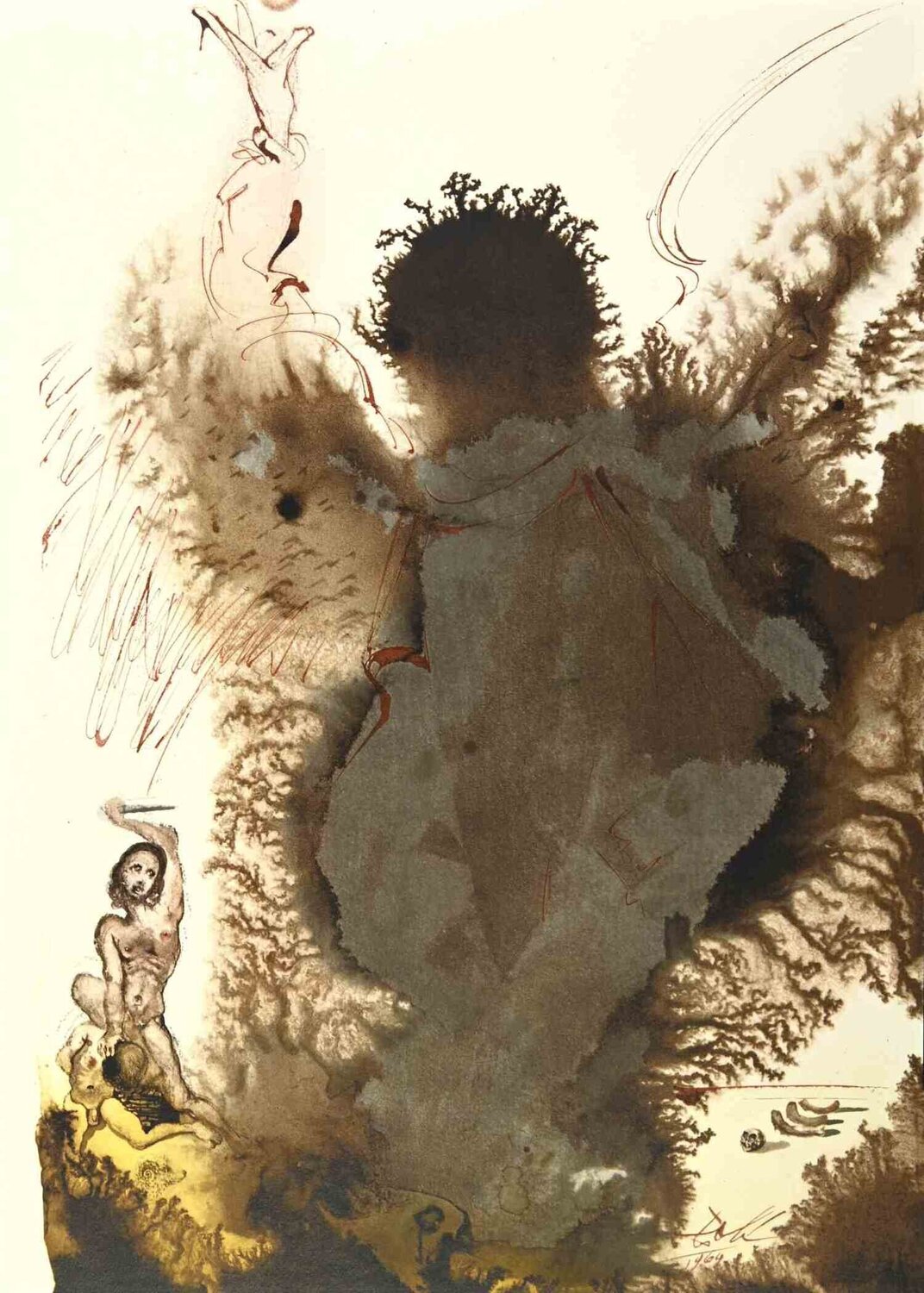
My favorite artistic rendering of this story comes from Salvador Dali, in a painting entitled “Abraham, Abraham!” Because Abraham is not the center of the picture. Abraham is small, distant, and decentered. The back of the angels overwhelms the center of the page. The story is not about Abraham. The story is about God. God who steps into the middle of Abraham’s life, knocks him out of the center, disorients him. Dali understood the story.
This God, we find, is a good God. A God who passionately loves Abraham. He will even show Abraham that he will never take from him what he has promised.
Abraham says in verse 1, “Here I am.”
And God says, “No you’re not! Get out of the center of your life! Never rely only on yourself. You cannot make it in this world without me. You would have nothing without me! But see who I am! I am the god who loves you! I am not Molech and I will not take your children!”
But only when Abraham has experienced the sacrifice of his own will, has experienced this God for who he is, can he say rightfully, in verse 11 “Here I am.”
After that, Abraham was not known as the father of Isaac. He was known as the father of faith.
God has to disorient us to set us straight.
Only when we give up our wills for his do we know where we really stand in the universe.
As my kids would lie in their crib, they learned that they could cry out, and mom and dad would come running, and faces would appear above and around the crib, looking down at them. And from where they lay, they must have felt like the center of the universe.
As they got older, they found friends. But if you read Piaget’s descriptions of children’s conversations, you will learn that when children talk, they don’t primarily talk to share communication, they primarily talk just to be heard. Because they believe themselves to be the center of the universe.
There are adults who have never stepped out of that worldview. “Here I am,” we can say confidently, “I’ve made myself who I am.”
Faith begins at that moment when we surrender the center of the universe to God. We can’t go there, our families can’t go there, our work can’t go there. If you want to live life right, you have to put God in the center.
You know, there’s a funny thing about that hill country in which Abraham lived. No one knows exactly where it was, but it is believed to have been somewhere outside of modern day Jerusalem. There’s another hill there, called “The place of the skull,” because there appears to be a skull in the side of the hill. It would not at all surprise me if, in the poetry of God, it was the same hill.
Because there another son was called to be sacrificed, bound and surrendered. But this time, God himself would take the place of humanity’s sacrifices. God himself would put himself in the place of people who could not be forgiven without sacrifice for all that they had done wrong. In that moment, humanity would decenter God. Humanity would refuse to let God walk among them or lead them. Humanity would reject God and instead have him tortured and killed. And God, hidden quietly in human form, would go willingingly. It is at this moment that God would say, “I am the God of love! I will not require sacrifice from you! I will spare your children and take their place in the fire. If only you will believe in me.”
We have to be disoriented in order to be set straight.
Our sins decentered God. Your decision to surrender to Jesus puts him back.
Christians sometimes act like all we have to do is sign on the dotted line that we believe and then back to life as usual. “Here I am,” we say. “I’ve got life all figured out now, and I’m going to heaven, so off I go to spend my life making money and being comfortable.”
Don’t go on with life. Make him the center.
I talk to college students who go off to school and tell me they don’t go to church anymore because they can’t find one they like. And I tell them, “Then you chose the wrong school! Because the most important thing that happens to you in college is not that you get a degree so that you can get a job, the most important thing that happens to you is that your faith matures into adulthood!” We don’t know where we are until we surrender to God.
I talk to people with busy and important jobs who get a lot done and who don’t have time for church. And I ask them, What will it profit you if you gain the whole world and lose your soul? Because we don’t even know where we are until we surrender to God.
I knew a man who sat in church and week after week with tears quietly rolling down his face. And when the Pastor finally asked what was wrong, he said, “All the wasted years.”
Step out of the center of your life! Because the God of love has walked among us. He has died for us. He will never take away our children the way the office god does in late night hours and weeks away. How could we not have the humility to surrender the center of our lives to the one who really belongs there.
This is Jesus. Believe. And don’t just believe. Surrender. Because only when you do can you know yourself well enough to say, “Here I am.”
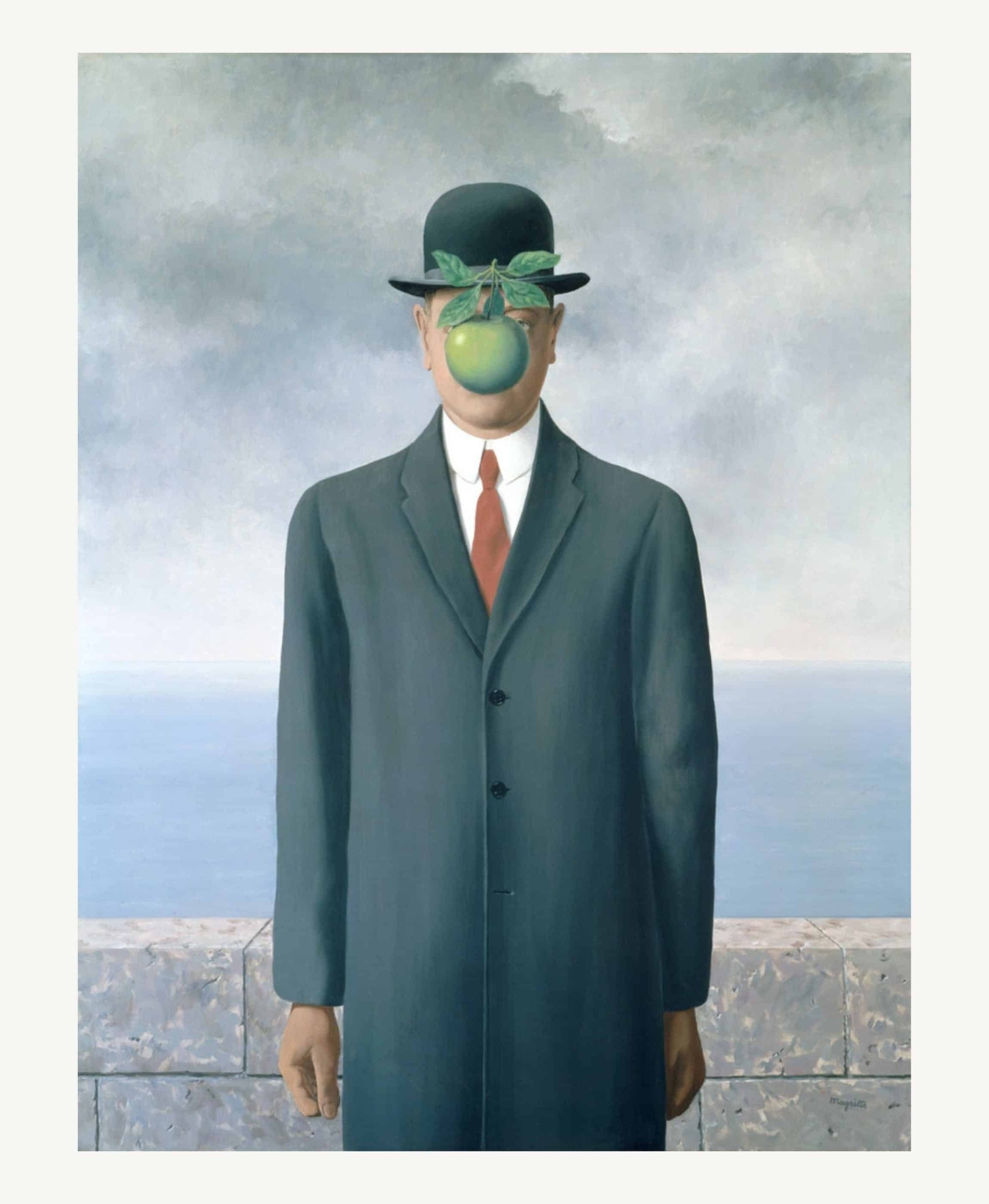
When René Magritte painted The Son of Man in 1964, he offered the world an image that feels both familiar and enigmatic. A man in a bowler hat stands before us, his face obscured by a floating green apple. The painting invites us to look deeper—not only at the man but at ourselves. What are we hiding? What blinds us from seeing clearly? And, perhaps most importantly, how do we find our way back to what is true?
In Romans 3:9-24, Paul delivers a stark diagnosis of humanity. His words are uncomfortable: “There is no one righteous, not even one; there is no one who understands; there is no one who seeks God” (v. 10-11). It’s a blunt statement about the human condition, one that contrasts sharply with the belief that people are “basically good.” Like Magritte’s obscured figure, Paul suggests our vision of ourselves is clouded by sin.
The Obscured Identity of Humanity
Magritte’s painting holds layers of symbolism that resonate deeply with this biblical text. The title, The Son of Man, evokes two powerful images: humanity as a whole and the figure described in Daniel 7 as the one who will come to judge the world. In Magritte’s work, however, the man’s identity is hidden, his face lost behind an apple. The apple—a symbol of temptation and the fall in Genesis—acts as both a barrier and a reminder. It points to the idea that sin doesn’t just obscure our vision of the world; it obscures our understanding of ourselves.
The painting’s muted sky and formal figure suggest conformity, a life drained of the vibrancy and individuality intended by God. The gray sky echoes the darkness that covered the earth at Christ’s death. It’s as if Magritte is pointing to the tragedy of a world bound by sin: humanity reduced to faceless figures, losing the essence of who we are meant to be.
The Diagnosis of Paul: Our Shared Brokenness
Paul’s words in Romans 3 cut through any illusions of human righteousness. He builds his argument by weaving together Old Testament passages, emphasizing that both Jews and Gentiles are equally under sin’s power. His conclusion? No one escapes this reality.
This theological perspective has been debated throughout history. Augustine believed humanity was so corrupt that it couldn’t choose good without divine intervention. John Calvin pushed this further, describing total depravity—sin touching every part of human existence. It’s a heavy message, one that might make us squirm. After all, who wants to admit that even our best actions are tainted by selfishness?
The Way Forward: Trust in the Savior
Paul doesn’t leave us in despair. He points to a better way, one that transcends our failed attempts at self-righteousness. In verses 21-24, he declares that righteousness comes “through faith in Jesus Christ to all who believe.” Here, the Greek word for “faith,” pistis, carries the idea of trust—a deep reliance on God’s grace rather than our own efforts.
This trust is counter-instinctive. Like leaning into a downhill ski to maintain balance, it requires us to go against our natural inclinations. We must surrender control, placing our full weight on Jesus rather than relying on our own strength. It’s counterintuitive, too. The gospel calls us to give our lives away in love, to forgive, to care for the vulnerable, and to resist the lure of wealth and power. And it’s countercultural, offering a peace and freedom that stand in stark contrast to the anxiety and striving of the world around us.
The Christian Life: An Invitation to Redemption
Magritte’s apple may hide the man’s face, but the gospel reveals what sin obscures. In Dietrich Bonhoeffer’s words, the Christian life should be like an apple, held out as a tempting alternative to the brokenness of the world—a life marked by love, joy, and peace. This is the hope Paul proclaims: despite our sin, we are justified freely by God’s grace.
Faith in Jesus doesn’t just restore our relationship with God; it restores our humanity. It opens our eyes to see clearly, to step out of conformity, and to live with purpose and hope. In Christ, we are no longer lost in the shadows of sin. Instead, we are invited into the light, our true identity as children of God fully revealed.
So the question is this: will we put our trust in Him? Will we dare to lean into the truth of His love, even when it feels counter-instinctive, counterintuitive, and countercultural? The Son of Man came to redeem what was lost. Through Him, our vision is restored, and our lives are made new.
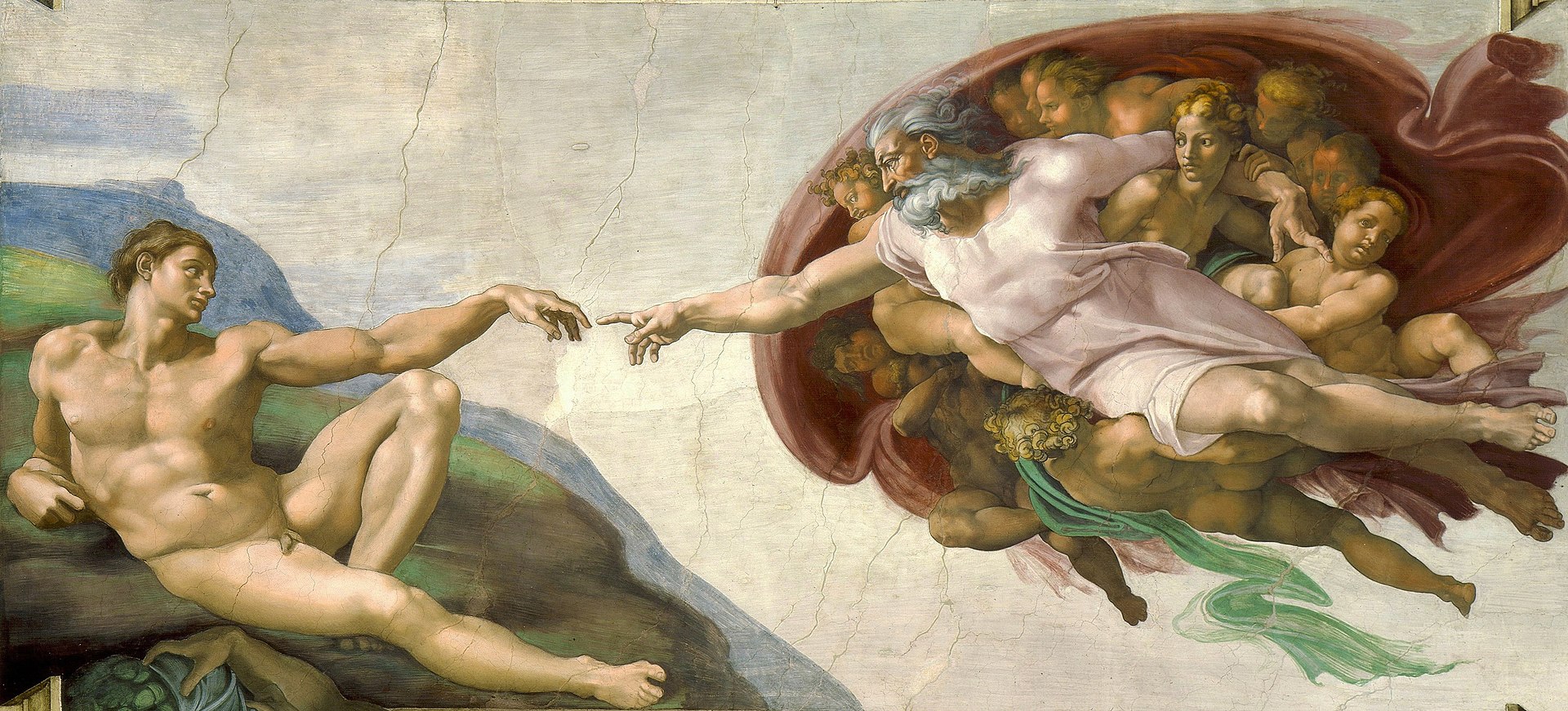
This very familiar painting, The Creation of Adam, by Michelangelo, has a fascinating history behind it and a deep theological revelation within it.
The Sistine Chapel, in Vatican City, was completed in 1483, and since has been used as the chapel for the Pope to hold special worship services. We are most familiar with one of the scenes from the ceiling, depicting the Creation of Adam. What’s first and most significant about the painting was that it was without precedent. No one had done anything on this scale before. This is to painting what the first TV was to video. The ceiling was commissioned by Pope Julius 2 in 1508, and the Pope made certain specifications about what he wanted – originally the 12 apostles. But Michelangelo demanded freedom to do what he wanted, and instead painted a story of salvation, from Creation to the fall to Noah and the flood. Around those are the story of the Old Testament and the prophets, because they forecast the coming of the Messiah, leading to the Last Judgment. Around the lower tier are a series of tapestries of New Testament figures created by the legendary painter Raphael. Botticelli did one of the scenes as well.
Now what’s most engaging about this particular panel of the ceiling (I mean, after Adam says, “Hey, eyes up here”), is the musculature of the hands and the expressions on the faces. God’s hand is stretched, extended. He is leaning forward. God is desperate for this connection. God wants to reach to Adam. Adam is leaning backwards as casually as if he were watching YouTube. And yes, he may have stopped on the 700 Club channel for a minute, but he doesn’t seem that interested. His hand is extended a little, but it’s dropping. He’s unconcerned. This is not critical for him. Do you see what Michelangelo is telling us theologically? Our relationship with God is his doing, not ours. It is by grace because he loved us, and not because we deserved it, and not because I was a generally good person in this life, and not because I made the right decision. Dead is dead.
Ephesians 2 tells us that we are “dead in our transgressions and sins.” But verses 4 and 5 give us the great promise: “But because of his great love for us, God, who is rich in mercy, made us alive with Christ even when we were dead in transgressions—it is by grace you have been saved.”
Michelangelo teaches us that without God’s activity, we are lost, not in malice and rage, but in apathy and lifelessness. All the energy of Creation and salvation are God’s work.
We are then set free to life, to real life, to life on Jesus’ terms. We rise from apathy to adventure.
I once knew a guy who said that he wasn’t going to donate to charity until he was older and got rich. He told me, “I can give so much more if I wait until I have a lot.” You know what’s going to happen? That guy’s never going to give anything. He won’t develop the musculature for it. He’s just going to atrophy. That’s like saying, “I’m going to go to the gym when I retire. Right now I’m too busy with work and kids and stuff. But when I finally retire, then I’m going to get in shape.” You’ll be lucky if you make it to retirement like that.
When we set out to follow Jesus, it is to join the passion of a life lived in love, in self-sacrifice, in generosity, in care for the desperate. We move from spectator to player. When we follow Jesus, we leave behind stale religious attendance, and we become the priests and missionaries. With Jesus, the call is not to complacent intellectual assent. When we follow Jesus, we rise to life.
Almost everyone has seen Van Gogh’s The Starry Night on t-shirts, coffee mugs, and college dorm room posters. Not everyone knows that it was painted by a man in an explicit, desperate search for God. Not everyone realizes that there is a hidden message in the painting.
In his younger years, Van Gogh, son of a minister, attended a Christian school and became quite religious. He once said that it was his goal to preach the gospel everywhere. So at the age of 24, his parents sent him to study theology in Amsterdam. Unfortunately, he failed the entrance exam. Undeterred, he became a pastor’s assistant. He went to work in a coal mining village where he dressed like and lived among the poor. For this, in less than a year, the religious organization for which he worked dismissed him for “undermining the dignity of the priesthood.”
At 27, he entered art school, again with a theological purpose. He wrote to his brother, Theo, that he wanted “to try to understand the real significance of what the great artists, the serious masters, tell us in their masterpieces, that leads to God.”
However, conflicts with his family, especially his father, led him to denounce his family’s religion as hypocritical. At its peak, he refused to go to church with them on Christmas, leading to a break in their relationship. From there, things would deteriorate, and he would go on to marry a prostitute, have a child with her, abandon them both, battle disease, and eventually be put in a mental asylum. The Starry Night was the view from his window in 1889.
It is an intentionally theological painting. He wrote to Theo that he had a “tremendous need for, shall I say the word—for religion—so I go outside at night to paint the stars.”
Van Gogh was an Impressionist. The Impressionists tried to capture light in the abstract, and this painting is certainly all about the lights. The first lights that catch our eyes are of course the stars – playful and extravagant, impossibly large and strangely in motion, blown about by the wind. Two spires point our attention towards the sky – the cypress tree in front that burns like a black fire and the church steeple sitting quietly in the background.
Now hone in on that steeple. Notice that all the houses have their lights on, warm, cozy little abodes. The only building that is dark is the church. Here is Van Gogh’s secret message, hiding in plain sight like a magician’s sleight-of-hand. Mystery, wonder, and spirituality are to be found in nature. The institutional church is dead and lifeless. This was the conclusion that this once fervently religious man came to, son of a stern pastor, rejected by seminary and ministry. The church had not shown him grace, and so he went looking elsewhere.
He considered the work a failure. He wrote to Theo, “once again I allowed myself to be led astray into reaching for stars that are too big—another failure—and I have had my fill of that.” He left behind some 2000 paintings and 600 letters to his brother. At 37, Van Gogh took his own life. The God of the stars made him wonder but could not heal the wounds of his heart and the troubles of his mind.
Read Psalm 19. David walks us through the spiritual journey that everyone must take. David discovers the God of nature who provides wonder and warmth, but it is in the written word of God that he discovers God’s identity. Without that, the God of nature is a fierce and unfamiliar thing, bringer of forest fires, earthquakes, and floods. The God of the Scriptures reveals himself as one who does not want the world broken, but rather seeks to heal it and to restore life. That God ultimately revealed himself by walking among us in the flesh and in humility – Jesus of Nazareth. From there, David falls to his knees in confession.
C.S. Lewis would point to the importance of God’s self-revelation over and above our intuitions from God we get from nature. In Mere Christianity, he writes, “In fact, that is just why a vague religion – all about feeling God in nature, and so on – is so attractive. It is all thrills and no work; like watching the waves from the beach. But you will not get to Newfoundland by studying the Atlantic that way, and you will not get eternal life by simply feeling the presence of God in flowers or music.”
The Starry Night tells the sad story of a young man on a passionate search for God, yet the church, instead of offering grace, became a darkened building to him. Nature whispered of God’s majesty, but it did not speak of His love. Without the church to carry the name of Jesus, Van Gogh was left with a silent, untamed presence—a God who seemed distant and indifferent.
Yet, the God who scattered stars across the heavens did not remain distant. Through Jesus, He entered our broken world, bringing light to dark places and healing to wounded hearts. Like a masterpiece explained by its painter, God’s self-revelation in Scripture shows us the purpose and love behind the creation. Only by letting the Great Artist interpret His work can we find our place in the beauty He designed.
Paul, imprisoned and facing martyrdom, looks back over his life to give us that which is most important. He writes, “In the presence of God and of Christ Jesus, who will judge the living and the dead, and in view of his appearing and his kingdom, I give you this charge:” (2nd Timothy 4)
Paul is employing a courtroom vocabulary. He’s making it clear: in light of God’s ultimate judgment and the revealing of His eternal kingdom, we’re given a charge. It’s serious. It’s life-defining. But here’s the good news—we don’t have to figure it all out alone. God’s word provides the blueprint.
Paul’s charge to Timothy, and to us, is straightforward. Just like a vineyard owner who plants a vineyard according to his design, sends his son to check in on the laborers, and returns in the end to pay what is do, so we are tasked with tending to our lives. Here’s what he tells him to do:
2 Timothy 4:2-5: “Preach the word; be prepared in season and out of season; correct, rebuke and encourage—with great patience and careful instruction. For the time will come when people will not put up with sound doctrine. Instead, to suit their own desires, they will gather around them a great number of teachers to say what their itching ears want to hear. They will turn their ears away from the truth and turn aside to myths. But you, keep your head in all situations, endure hardship, do the work of an evangelist, discharge all the duties of your ministry.”
Our instructions:
Tell people about Jesus.
Warn against what’s wrong.
Encourage what’s right.
Be patient, be clear, be wise.
Persevere through life’s challenges.
Paul is a mentor to Timothy, which sets up a model for effective discipleship. This isn’t just for pastors or ministry leaders. It’s for all of us—at work, at home, in our neighborhoods. Everyone needs a mentor, and everyone can be a mentor. Paul mentored Timothy; who’s your Timothy? And who’s your Paul?
Reflections from a Mirror
Mentorship isn’t always about grand wisdom. Sometimes it’s about holding up a mirror. I’ve had mentors reflect back things I needed to hear, like when a fellow pastor once told me I was “a little too blunt.” Tough feedback, but I needed it as a young pastor.
I’ve also had moments of being the mirror. I remember a young pastor feeling discouraged because his church wasn’t growing fast enough. When I asked, he shared that his church had doubled from 70 to 150 people in a year. I told him, “You have one of the fastest-growing churches in America.” Sometimes, we just need someone to show us the blessings we’re too close to see.
Three Prophecies for 2025
Now, drawing from Paul’s mentoring of Timothy, let’s practice the same activity of looking at what is most important and how we should prepare ourselves for the road ahead. Paul warned Timothy about a time when people would reject sound doctrine. That time feels closer than ever. Here’s what I see coming in the year ahead:
A New Ideological Divide There’s a growing split in American conservatism between secular conservatives and religious conservatives. They may talk about shared values, but their motivations differ. While one group may focus on familiarity or financial stability, the other roots their values in following Jesus. In 2025, many won’t put up with Jesus’ values—whether they identify as liberal or conservative.
The AI Revolution Artificial intelligence is accelerating—jobs, education, and even how we process information are going to transform. Education will shift away from memorization toward critical thinking. We will train children to be filters of information rather than receptacles of information. The skill set for the rising generation will be the ability to sort out the useful from the rubbish.
Truth vs. Lies As filters on information tighten, discerning truth will become a critical life skill. Conspiracy theories abound (seriously, Russians hacking hot tubs?). But the solution isn’t censorship; it’s teaching logic and critical thinking. We must raise a generation equipped to separate fact from fiction.
Finishing the Race
Fortunately, Paul sets out to show us how to do this. Invite Jesus into your decision making and let the Holy Spirit be a filter for discerning what is true. Paul is absolutely unintimidated by the future that he sees. Rather, he’s victorious. “For I am already being poured out like a drink offering, and the time for my departure is near. I have fought the good fight, I have finished the race, I have kept the faith. Now there is in store for me the crown of righteousness, which the Lord, the righteous Judge, will award to me on that day—and not only to me, but also to all who have longed for his appearing.”
Picture Paul, in prison, near death, arms raised in a V, shouting, “Woo! I won!” That’s the joy of a life well-lived for Jesus.
Success in 2025
Here’s how to win the race this year:
Find a mentor who knows and loves Jesus.
Be a mentor who guides others in faith.
Stay the course: Tell people about Jesus, stand for truth, encourage others, and persevere for His name.
Run the race with patience, wisdom, and joy. And when you cross the finish line, you’ll get to make the declaration of faith that all saints have made when their race is run: “Woo! I won! I won! I won!”
The Christmas season is here, and with it comes a chance to slow down, reflect, and prepare our hearts for the story of Jesus’ birth. Luke 1:39-56 gives us a unique glimpse into a moment of joy, humility, and faith shared between Mary and Elizabeth—two women whose lives were forever changed by God’s plan.
Family and Faith
Mary and Elizabeth were family—relatives connected not just by blood but by faith. Mary, a young woman likely in her teens, was newly engaged to Joseph, a humble carpenter. Elizabeth, much older and married to Zechariah the priest, was miraculously expecting a child after years of waiting. Their sons would be Jesus and John the Baptist—second cousins who would change the world.
Picture the scene: two women, one old and one young, both bearing miraculous children, meeting in a quiet hill country home. It’s a moment of shared joy and holy anticipation—a glimpse of what it means to find camaraderie in the midst of life’s biggest transitions.
Parenting Camaraderie
It reminds me of the camaraderie parents often find in each other.
I’ve seen this kind of connection myself. When our daughter was born, my wife joined a stroller exercise group at the mall. It wasn’t just about fitness—it was about finding community. They supported one another, swapped advice, and cheered each other on.
In our own church, we’ve celebrated over a dozen babies born this year. We’ve even had Sundays with 18 infants in one service! It should remind us of the importance of community—whether you’re expecting, raising children, or navigating any big life change. We need each other.
Mary’s Song: A Song of Humility and Hope
A first century listener would have immediately recognized this as reflective of the Psalms. It has their cadence and rhythm, their vocabulary and their theology.
The allusions would have been so familiar that anyone would have recognized them, as surely as you would recognize what I am alluding to if I rewrote the dialogue this way:
Elizabeth: I’m very nervous about what’s coming.
Mother Mary: Let it be, Elizabeth, let it be. I’m whispering words of wisdom, let it be.
Elizabeth: I get it. But you know, I’m a material girl living in a material world.
Mary: Well, don’t stop believing. Just hold on to that feeling.
Elizabeth: Ok. If you take my hand, we’ll make it, I swear. Whoa, we’re living on a prayer.
You would immediately recognize what I’m alluding to if you know anything about American pop music. You might think, “Hey, this guy isn’t that funny, we should try a different church next week,” but at least you would understand what I was referring to.
In Luke 1:46-56, Mary responds to Elizabeth’s blessing with what’s often called the Magnificat. Her words echo the words and theology of the Psalms, praising God for His faithfulness and celebrating His power to lift up the humble.
Mary says:
“My soul glorifies the Lord…for he has been mindful of the humble state of his servant.”
“He has brought down rulers from their thrones but has lifted up the humble.”
Humility is the thread that runs through Mary’s song, her story, and God’s plan. Bethlehem—a small, unremarkable town—became the birthplace of the Savior. Mary and Joseph, ordinary people, were chosen to play extraordinary roles. God consistently works through the humble, flipping the world’s expectations upside down.
The Gift of Humility
Humility isn’t something the world often rewards. We chase status, success, and recognition. But God shows us a different path.
I remember a woman in my church who embodied this so well. She was a mom who volunteered to babysit for our family when our kids were little. Over time, I learned she’d gone to an Ivy League school, studied law, and was a financial genius. Yet she never boasted about her accomplishments. Her humility wasn’t just refreshing—it was Christlike.
Humility is fertile soil where God plants His seeds of grace. It’s the incubator for a character that reflects Him.
I remember serving on a mission trip in Mexico. We stayed at a campsite with hundreds of other teenagers from youth groups around the country. At one point, I asked how they managed the large site. They told us that the pastors from the local churches would come in during the day while we were building houses, and they would clean our porta-potties for us. Invisible, uncelebrated, and absolutely faithful.
Practical Ways to Practice Humility This Christmas
As we prepare to welcome Jesus into our hearts this season, Jesus-followers can take a cue from Mary and embrace humility. Here are some simple ways to cultivate it this week:
Let someone else go first—in a conversation, in line, or on the road.
Celebrate someone else’s successes without mentioning your own.
Practice saying, “I don’t know,” or “I could’ve done that better.”
Apologize when you’d rather not.
Give away time, money, or love—especially to someone who doesn’t deserve it.
God’s Promises for the Humble
Mary’s story reminds us that humility opens the door for God to work in our lives. In her song, she celebrates what God does for the humble:
“He will lift up the humble.”
“He will fill the hungry with good things.”
“He will be mindful of His servant.”
When we step into a humble posture, we’re right where God wants us. It’s there, in the quiet and unassuming places, that His greatest miracles unfold. So, this Christmas, let’s not be afraid to embrace humility. After all, the Savior of the world came to us not in power or grandeur but in the humblest of circumstances—a baby, born in a manger, in a small town called Bethlehem.
We sing about “We Three Kings” around this time of year, but that’s not really who we’re talking about. The word used in Matthew 2 is magoi, which doesn’t mean kings at all. It’s the root of our word “magician,” but in the ancient world, it referred to people who studied the mysteries of the universe—early scientists, stargazers, astrologers. If we wanted the most accurate translation for today, it might be astrologers (but good luck convincing a Bible translation committee to slip that one into the Christmas story!).
Here’s what we know about the Magi:
They weren’t kings.
There weren’t necessarily just three of them (three gifts, sure, but if you’re wise, you’d go in on a gift like gold with a buddy, right? Orthodox traditions say they were 12).
They probably weren’t hanging around the manger. Herod’s reaction—ordering all boys under two to be killed—suggests their visit came later.
So, no crowns, no camels, and maybe not even any wise men (sorry, nativity sets). Did I ruin your Christmas? I promise I’m getting to the good part.
A Journey from the East: The Zoroastrian Connection
The Magi likely came from Persia, a land east of Judea. There, a faith called Zoroastrianism was widespread, and the Magi may have been its priests. In fact, magoi only appears in the ancient religious texts of the Zoroastrians. Here’s where it gets interesting. Zoroastrians believed in:
One God who created the universe
A battle between good and evil, order and chaos
A coming redeemer (the Saoshyant) born to a young woman in a miraculous way
A final triumph of good, resurrection of the righteous, and a remade world
Their beliefs sound an awful lot like parts of Christian theology. And before the Jews recognized Jesus as Messiah, before he performed miracles or rose from the dead, these foreign astrologers packed up their treasures and followed a star to worship him. My problem is not with their doctrine. My problem is that their names aren’t Matthew, Mark, Luke, or John.
God’s Love Goes Beyond Our Expectations
This story challenges the way we think about faith. It challenges our assumptions about who “gets it right” and how people find Jesus. The Magi didn’t have Scripture or Sunday school. They weren’t Jewish, and they didn’t know the stories of the prophets. But they were looking for wisdom—and their pursuit of truth led them to Jesus.
God spoke to them in a way they could understand: a star. That’s not how it’s supposed to work. People are supposed to read the Bible, hear good arguments, and then come to church with us, potato salad in hand. But the story of Christmas tells us that God’s love is bigger than our formulas, our strategies, or our control. God meets people right where they are—even in foreign lands and unfamiliar faiths.
A Christmas Challenge: Be a Witness, Not a Debater
Maybe this Christmas you’ll sit down with friends or family who don’t share your faith. Maybe they look at Christianity as something foreign. Take a lesson from the Magi—and from Jesus himself. God’s love is patient, kind, and full of grace. Instead of arguments and corrections, tell your story. Share how you’ve seen Jesus at work in your life. Pray for them, and trust that God loves them even more than you do.
Our world feels more divided than ever. We’re quick to draw lines and build walls, but Christmas reminds us that God came to break down those barriers. The God who told Israel to love the foreigners in their land still calls us to do the same.
God is Still Calling People Home
A Christian minister once told the story of a Muslim taxi driver who turned around to him and said, “I had a dream that I would meet a Christian who would tell me about Jesus. Tell me about Jesus.” That’s not how we think it’s supposed to work, but God is still speaking in dreams, through stars, and in ways that surprise us. The Magi remind us that God’s love reaches further than we imagine. It’s like God loves us before we get everything right.
This Christmas, I need the story of the Magi. They remind me that the pursuit of truth leads us to Jesus, that God meets us in unexpected ways, and that his love is for everyone—no matter how far away they seem.
So, as we gather around tables with family, as we worship together on Christmas Eve, let’s remember the star that led the Magi to the source of all wisdom, love, and life.
Jesus is still calling. And he is worth the journey.




 Hardwired