
There are height tick marks charting my children’s growth in fading pencil on the kitchen wall. One day they will be painted away as childhood has been by time’s brush, and it will be only a solitary, fuzzy snapshot in our memory. The lowest ones are as faint as the babyhood of my tall little boy. The pencil, the memories, and he, I can hardly keep up with as they go running away. Wouldn’t it be humble of mortal humanity to see most of life’s tick marks as a memory of heaven, written in pencil and fading, hardly stored in the eternal history books?
Category: Uncategorized
Entrepreneurs and Mission
 Glenkirk Church is working with a creative mission organization called Cargo of Dreams.
The idea is that Cargo of Dreams drops off a container (not Tupperware; the kind that goes on ships) at your church and provides instructions on how your congregation can transform it into a school, hospital, or office building. You paint it, build the interior, and stock it with appropriate supplies. You do the work together as a congregation over the course of a few months, then Cargo of Dreams ships the container to its intended location. The recipients simply cut windows and doors in the container itself and their building is built.
It’s Habitat for Humanity with a postage stamp.
In our case, Glenkirk is building a preschool for a group of children in a Black township in South Africa who currently hold their class meetings outdoors in a field.
The advantages to this unique kind of mission are numerous. It gets a much wider circle of the congregation involved in world missions than we could have by requiring people to fly overseas. It costs less than flying a team overseas to build the same building. It gives the congregation a galvanizing project to gather around, working together towards a valuable goal. And it’s obedient to Jesus. Cargo of Dreams works with churches both on the sending and on the receiving end, so it’s a work of the Kingdom and it’s clear to all spectators that it’s an act of the Christian Church. It’s attractive to people who aren’t Christian but who happen to find themselves at Glenkirk, because this is the kind of things that even non-church-attenders know the church ought to be doing. Further, it should serve as inspiration for those interested in Christian mission to think outside the box of familiar patterns of mission work.
That to say, I recommend it. We’re doing it, and so should your church. Check out their website if you want more information.
“Soul Print” book review
 Batterson’s “Soul Print” is an encouraging book aimed at helping us find our calling in life despite our challenges. As opposed to a formula for finding our spiritual gifts and a place in which to use them, the book is primarily a call to humility, integrity, and perseverance, using King David as the primary example. In that sense, the book gives us insight into the guy with a lot of character who wrote it. It’s a refreshing change to the literature of large church pastors which tends to revolve around evangelism and marketing. This one is about character.
The book is divided into five chapters. The first is about patience and recognizing that during God’s “divine delays,” God is actually teaching us skills we wouldn’t otherwise have, looking at David as a shepherd. The second is about choosing markers that identify our victories and God’s work in our lives, drawn from the story of David and Goliath. The third is about integrity and respect, exploring David’s relationship with Saul. The fourth is about humility, looking at David’s dance in the buff. And the fifth is about moral integrity and holiness, drawn from David’s tryst with Bathsheba.
Batterson concludes with a hopeful reference to the new name believers will be given in heaven, which “will make your entire life make sense. All the pain. All the joy. All the fears. All the hopes. All the confusion. All the dreams.”
If we find fault with the book, it has to do with the literary style, which seems rushed and a little immature. Speculating about the nature of Saul’s relieving himself in a cave when David cut off a corner of his robe doesn’t exactly lend itself to exegetical insight. And overall, Batterson could use a touch of poetry. Most of it is outright moralistic storytelling, along the lines of fairly obvious sermon illustrations, and while it may fit the genre of the book, it doesn’t make for great writing. But for a casual read, the stories are interesting, and the bottom line is a worthwhile message.
That said, it’s nice to see a solid, large-church, evangelical investing in matters of character, and given that, I’d recommend the book. Here’s the legalese: I received this book for free from WaterBrook Multnomah Publishing Group for this review. That said, I wanted to read it anyway and I’d recommend it regardless.
Is Bell Into Hell?: A Review of “Love Wins”
 SUMMARY
I have to admit two things about reviewing Rob Bell’s book, “Love Wins.” I knew that I liked Rob Bell when I took a doctoral class (DMin) from him at Fuller Seminary, when I got to sit in a room with thirty other people and ask him questions and pick his brain for a few days. I like him a lot. He’s a good guy. Secondly, I figured out in that class where I thought he was likely to go wrong theologically, and I asked him about that specifically. He’s done it in this book. And I’ll get to that. But first, a summary.
Rob Bell can claim in interviews to be an evangelical and not to be a universalist because he’s redefined those terms. Evangelicals claim Scripture as their highest authority. Universalists believe that everyone goes to heaven rather than hell. Bell cites scripture authoritatively, but at the end of the day defines the character of God along the lines of what he believes most intuitive, and perhaps most popular. Evangelicals are going to disown him on that one, as when John Piper tweeted, “Farewell, Rob Bell.” Bell does seem to believe in a literal hell, and that people go there. However, he creates a bit of a loophole for the universalists and insists that he can’t imagine a God who would make people stay there forever. So he’s a circuitous universalist. It’s not that there’s no hell, it’s just that it’s purgatory (although he doesn’t call it that). That’s the book.
BELL ON THE BIBLE
Developing an understanding of God’s self-revelation is a messy thing. God speaks, but then someone else writes it down, and then we read it. In that process, there’s a middle man, who has a vocabulary that means certain things to him. The words in his vocabulary change meaning over time and through translation. We’re never wholly “in the mind” of the guy who wrote them down. And we’re only assuming that God meant by the words he uses exactly what the guy wrote. So you have to come down pretty clearly on how much you take that guy at his word.
Imagine someone telling you about meeting a famous person that you already know a lot about. In part you listen to what he says for new information. In part you read what he says through the lens of what you already know about the celebrity. See, if the reporter is the Bible and the celebrity is God, evangelicals have always relied more heavily on the words of the reporter than our intuitions about the celebrity. That’s where Bell is not an evangelical. He trusts his intuitions enough to interpret the reporter through them.
So when Bell writes, “Is God our friend, our provider, our protector, our father—or is God the kind of judge who may in the end declare that we deserve to spend forever separated from our Father?” (p53, ebook) he’s created a dichotomy between a caricature of the biblical image of God and his own intuition for what God is like. Clearly, he favors his intuition. And intuitively, Bell isn’t into hell.
The result is a routine tweaking of the Scripture to bring it into submission to his intuition. His presentation of the biblical images of hell skirts around the overall effect of the many teachings of Jesus culminating in weeds being burned or people being thrown into darkness. He even does some exegetical contortion to get “eternal punishment” (Mt. 25) to be “a period of pruning” (48), disregarding that that parable follows on the heels of another in which people are thrown into darkness and another in which the God-figure says, “I never knew you.”
Bell will claim things like, “untold masses of people suffering forever doesn’t bring God glory” (56) and that the biblical portrayal of hell “isn’t a very good story” (57) and that a God who would allow hell to exist is only “sort of great” (50). Intuition trumps Scripture.
He ends up completely subverting certain teachings of Scripture. He suggests (60) that the image of the gates of Jerusalem remaining open in Revelation refers to heaven always being open (and thus hell being temporary), rather than the most obvious sense for the image: the gates are open because Jerusalem is finally safe. And he mentions once but never deals with the image of a “lake of fire” in Revelation, which parallels Jesus’ image in the story of Lazarus, which Bell writes off as a fanciful moralistic tale.
He also misuses Martin Luther, who once speculated that God is so powerful that he could bring people back from death and give them faith if he wanted to, though Luther states that there is no evidence that that has ever happened. Luther was talking about omnipotence. Bell uses that to cast Luther as a possible universalist.
WHAT BELIES IT
Now the exegetical sleight of hand is bad enough, but Bell actually coaches the reader on how to do it, and in this he’s to be held responsible as a Pastor. He tells the reader that we need a word to describe suffering and evil in this life, and “hell” is a good word for that, so we should keep the word (49). He says that if people ask you whether or not you believe in a literal hell, you can say “yes,” because Gehenna (37) was a real location and because the genocide in Rwanda was real (38). With a wink, Bell shows us how to avoid the conversation with people who really want to know what we think. And by the end of the book, Bell hasn’t ever come out and said, “Everyone gets to heaven in the end.” He’s only said, mostly in the form of questions, that he can’t imagine how a good God would allow hell to be eternal. Wink, wink.
BELL’S CURVE
I asked Rob Bell the question, “Given that your preaching is largely based on whatever subjects are most of interest to you at the present moment, what holds you accountable to the biblical canon?” He then told a story about a man in his congregation who knows the Bible well. He said that when that guy thinks Bell is off, he writes Bell letters pointing out his errors. And that’s it. One of the most influential voices in American Christianity is held accountable to theological orthodoxy by the kind of angry critic that most Pastors don’t invest a lot of time in. And when he said that, I had a pretty good sense that if Bell ever went sadly wrong, that’s how it would happen: a celebrity, alone, unchecked, applauded and protected by his fans.
I still like Rob Bell. He is, authentically, a good guy, and he really loves Jesus. Ultimately, he’s going to have to decide what happened when God told Abraham to sacrifice Isaac. Because the sacrifice wasn’t just of a son, it was of an intuition for what is right and wrong and what a loving God ought to be like. Abraham chose obedience over intuition, and Abraham is forever after the father of faith.
What God does in the end is God’s business. Paul asks, in a passage Bell ignores, “Who are you, a human being, to in turn judge God?” (Rom 9)
Religion, Disaster, and Japan
 Japan now wrestles with life, death, and disaster through the religious vehicles available to it. Less than 1% of the population is Christian, so most of the conversation will not be about Jesus. But, as someone asked me in church last Sunday, what are Christians supposed to think about God’s role in natural disasters?
Some Christians mistakenly think that non-Christians are somehow more susceptible to suffering because they are not watched over in the same way as Christians. This elitism fails to appreciate the plain biblical teaching that our fate does not reveal God’s favor (Ecc. 9:2, Mt. 5:45). Others attempt to point to some measure of sinfulness that provoked the wrath of some primeval, vengeful God, which again avoids the plain teaching of Scripture (Job 1:11, Jn. 9:3).
The reality is that natural disasters are simply the horrible, sad result of a fallen world. The world is broken, and it’s broken in every which way it can be. The Bible says that human beings have both corporately (Gen. 3:6) and individually (Rom. 3:23) rejected God. The result is that God lets us, to a certain degree, have our own way (Rom 1:24). He humbly steps back at our request. And consequently, all the world shows signs of its brokenness, not just our behavior, but the physical world itself. Natural disasters are a physical manifestation of the spiritual reality that we’ve told God to leave us alone. There’s no individual or local blame for such things, and Christians should never go looking to pin the responsibility on anyone. Everyone has pushed God away, and everyone suffers from a broken world.
What’s happened is that the world has been broken. God didn’t break it, we did. It’s broken down to its most elemental levels, in its DNA. And yet he loves us all the same. He loves us in our broken lives and in our broken world. Disasters are not a sign that God doesn’t care, only that he’s honored our request to let us have the world. Disasters are a sign that we broke the world. God gladly heals and gladly forms us into healing community. But we have to ask. And we have to respond.
If you’d like to donate to relief efforts in Japan, please support World Vision.
Freedom v. Freedom
The ultimate stalemate of modern Protestant liberalism will come when the freedom of speech meets freedom of religion in an immoveable-object/unstoppable-force collision. In a recent case, a Pakistani Christian mother and field worker was sentenced to death when she was accused by a fellow worker of insulting Muhammed. The modern liberal may have to flip a coin to decide this one, because there is nothing that would inherently allow him to favor one side or the other in this case.
Anyone who wholeheartedly endorses the freedom of speech would certainly encourage her to speak her mind. But intercultural tolerance of the modern variety and the foundation of contextual morality beneath it would require us to allow other cultures to be governed by their own norms and values. The theological liberalism of the 20th century has never in fact held strongly to the idea of religious freedom, except insofar as it allows for the rejection of orthodoxy, fundamentalism, or church authority. However, when the religion is not Christianity and the place at issue is not the U.S., there is an expectation that cultural respect and toleration will give discretion to other cultures to govern themselves by different ethics, sacred texts, and social norms. If respect for religious diversity does not extend to fundamentalists in Kansas, it should nonetheless for other reasons be granted to zealots on the other side of the world.
Thus in the face of a working mom who spoke her mind, Protestant liberalism can offer little more than a shrug. That is, of course, if it wants to be consistent. But then maybe consistency is the value that will give way.
On Writing
 Write before the sun rises. The sun brings with it sensibility and punctuality. The sun is here to do business. Write before the sun knows you’re up.
4th of 4 CS Lewis lectures
This one is Dr. Glyer.
Click here.
Advent
I don’t know if we fully appreciate what Jesus meant by “kingdom.”
Abraham and Sarah had stood on the land which was promised to their descendants. A kingdom to be.
By the end of Genesis, they were slaves in Egypt, a foreign kingdom.
Moses lead them back into the land, and then there was David, king over the kingdom.
The prophets saw them out, into the foreign kingdom of Babylon.
Ezra and Nehemiah lead them back into the land. They built walls. They established a throne. Then they waited for a king in the bloodline of kings to come and rule the kingdom.
The camera in the closing scene of the Old Testament pans out focussed on an empty throne.
The camera pans back in, past a star, past shepherds keeping watch over their flocks by night, zooming in on the throne which has been disassembled and reassembled as a manger.
They wanted a king. Mashiah. Messiah. It means “anointed one.” Because when a king was crowned, or inaugurated, he would kneel down, and the prophet would anoint his head with oil. Mashiah was not a wandering religious guy sitting on a hilltop teaching people to love each other. It was a prince rising to power. It was a warrior, not a pacifist.
When he gave them bread, they tried to force him to be king.
When he went to Jerusalem, they cheered that the rival king had finally come to town.
When they caught him, they forced a crown of thorns on his head and put a sign on his cross to make fun of what was expected of him. King?
And Jesus fed their lust a little bit. He said, “The kingdom of God is near.” And that’s what they wanted. Kingdom was their love language. That’s what they were waiting for. It had been 1800+ years of Advent, waiting for the king to come. The problem was that he was not that sort of king.
When a friend of mine was a little girl, her dad taught her to call steak “chicken” and chicken “steak.” A harmless joke, perhaps, except they no longer speak to each other and she had food allergies. In any case. She figured it out when she went to a restaurant and ordered “chicken” and they brought her chicken, and she said, “I ordered chicken,” and the waitress said, “That’s a chicken.” She wanted steak.
They came to Jesus ordering “kingdom,” and he gave them a kingdom, and they said, “No, a kingdom,” and he said, “That is a kingdom.” And they crucified him. They came wanting power and control of the culture and armies and war. He gave them love and self-sacrifice.
As we prepare for Christmas, as we go to God seeking kingdom, I’m going to try to order what he’s serving.
Third CS Lewis lecture
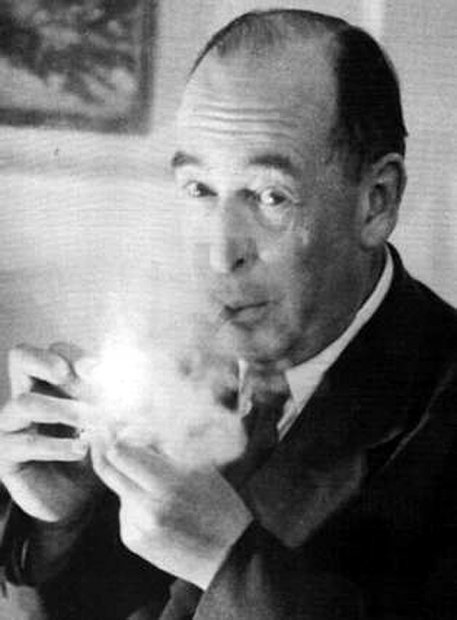 Click here for the third C.S. Lewis lecture, on Lewis as an apologist.
 Hardwired