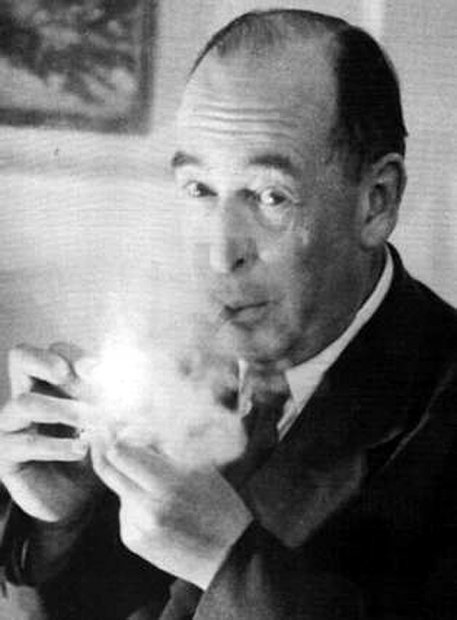
 Here’s the second of four lectures on C.S. Lewis, looking at some of his great ideas and how they play out in the character, Eustace, in Voyage of the Dawn Treader.
Click here to listen.

Here’s the second of four lectures on C.S. Lewis, looking at some of his great ideas and how they play out in the character, Eustace, in Voyage of the Dawn Treader.
Click here to listen.
I get the great privilege of teaching a round of classes on C.S. Lewis in preparation for the release of the movie “The Voyage of the Dawn Treader” alongside my friend Dr. Diana Glyer, Professor at Azusa Pacific University. As I told the class tonight, the special privilege of teaching it this time is that I’m finally teaching alongside someone who knows what she’s talking about.
Tonight we covered an introductory biography of C.S. Lewis’ life and an introduction to the Narnia series. If you’re going to follow along at home, you might want to read “The Voyage of the Dawn Treader,” a few chapters per week.
Classes are Tuesday nights at Glenkirk Church, 6:30-8:00pm. Tune in next week!
Click here to download the audio.
 So this is what I’ve been wondering about lately.
In the pre-Enlightenment Middle Ages, there was really a sense that you had a devil on one shoulder giving you bad advice and an angel on the other giving you good advice. Their location may not be literal, but the world back then was thought to be enchanted. There were ghosts and tree spirits everywhere. You see a living example of this kind of thinking in modern Islam. You’ll notice when Muslims bow in prayer a moment when they look over one shoulder and then over the other. That is literally an acknowledgement of the angel on one side keeping track of their good deeds and the angel on the other side keeping track of their bad deeds.
But for most post-Enlightenment thinkers, there’s no one on either side. Mostly. But we do still think in the same dualistic way. There are good forces and bad both working on us, we feel, but the good force we dub a “conscience” or “superego,” and we attribute it to socialization and genetic impulses. Nonetheless, we personify it and call it a “nagging” conscience. On the bad side we have a subconscious, or things like “anger issues,” which again we say is nothing more than a mix of biological impulses and a family hangover.
What’s interesting to me is that the results of both worldviews are the same. The modern mind feels itself tugged upon by two riders steering it in different directions as much as the Medieval mind did. We still have something “outside” of ourselves to blame, in the sense that it’s “my conscience” or “my issues” to blame, somehow not just “me.”
So what I’ve been wondering is what’s the gain from the demythologized forces at work on us? Are we better off without anthropomorphic spirits and instead just chemicals bubbling around in our brains? Or were the Medievals wiser, with clear spiritual forces at work, and consequently better prayer lives and a more humble faith?
Don’t worry, if you decide to walk around talking to them, people will just think you’re using bluetooth.
So I hate the word “blessed” in general. It strikes me as a meaningless word, because it’s full of implications that it never has to commit to. Someone who is rich is blessed, someone who has a good day is blessed, the dinner got blessed, it kind of means holy, it sometimes means talented. In general, it’s just the hyper religious cousin of “lucky.” Blessed goes to the knitting circle at church while lucky goes to the dance club.
The Greek word behind it is makarios.
Makarios, as the Greeks used it around the time of Jesus, didn’t mean it in a strictly religious sense, the way blessed is so clearly pious. Sometimes it gets translated “happy,” which isn’t bad. The problem is that when you read the beatitudes with “happy,” it seems like Jesus is being sarcastic.
So I looked specifically at how a number of ancient Greeks used makarios. It tends to fall into about three categories. It’s used to refer to the pantheon of gods, when they are makarios because they don’t have to worry about mortality and mortgage payments. It’s used for the dead, because the dead can finally rest from the worries of this world. And it’s used for the elite rich, who don’t even have to leave the house to do their own grocery shopping, because they can pay someone to do it.
So makarios has the sense of being free from the cares of the world. Read the beatitudes this way:
Now when he saw the crowds, he went up on a mountainside and sat down. His disciples came to him, and he began to teach them saying:
“Carefree are the poor in spirit, for theirs is the kingdom of heaven.
Carefree are those who mourn, for they will be comforted.
Carefree are the meek, for they will inherit the earth.
Carefree are those who hunger and thirst for righteousness, for they will be filled.
Carefree are the merciful, for they will be shown mercy.
Carefree are the pure in heart, for they will see God.
Carefree are the peacemakers, for they will be called sons of God.
Carefree are those who are persecuted because of righteousness, for theirs is the kingdom of heaven.
Carefree are you when people insult you, persecute you and falsely say all kinds of evil against you because of me. Rejoice and be glad, because great is your reward in heaven, for in the same way they persecuted the prophets who were before you.”
Read that way, you get close to perfect sense. Of course the meek are carefree when it comes to being meek, they’re going to get everything in the end anyway as if they hadn’t been meek. You’re carefree if you mourn because in the end you know it will go away. You can be carefree in showing mercy, instead of anxiously seeking revenge, because you know in the end you’ll be shown mercy too.
 Reading in Heath’s “Switch” that studies have shown that people presented with good and bad photos always fixate longer on the bad ones. People who learn bad stuff about someone else remember it more than the good stuff. People are more likely to bring up negative events in their lives than positive ones. Studies showed that there is no exception to the fact that attention to the bad is consistently stronger than attention to the good.
Having read this, I can’t stop thinking about it, which I guess is another data point for the study.
Rather than assuming it’s just pessimism, though, I think it’s a case of our souls showing themselves. We’re hardwired for heaven, for perfection. Anything less than that, albeit ordinary and common, nonetheless attracts our attention, because it stands out as odd. A lamppost in the woods would only look odd if you’re from a world where lampposts appear on streets. Cracks and fractures are only interesting if you’re from a world where things don’t get broken. Tears are only provocative if you think there might be a world where they might all be wiped away.
Anselm’s ontological argument claimed to prove the existence of God, because no greater thing can be thought, and a great thing existing is greater than it not existing, therefore by definition it exists. Not a lot of followers of that line of thought today. But what if our reactions to the world couldn’t possibly be conditioned into existence in this world? But what if we assert that we know heaven exists because we can’t take the world seriously otherwise?

The focusing illusion is psychological phenomenon that comes from the world of surveys and statistics. Put simply, the order of the questions that you ask shapes the answers. For instance, a group of college students were asked two questions, in this order: How happy are you? How often did you go on dates. There was no observable correlation between the frequency of dating and the degree of happiness reported. However, when they asked the questions in the reverse order, making the students first focus on how often they were going on dates, there was a higher correlation between the answer to the two questions. The order of the questions changed the answers (Batterson, Primal).
We Christians in America tend to ask two questions. We ask first what we want to accomplish with our lives: our work, our family, our homes, our playtime. Then we ask what Jesus’ death on the cross means to us: salvation, heaven, forgiveness. But I wonder how much our answer to the second question would change if we asked it first, if it weren’t already so anchored in our life plans that it were free to make its own, independent demands on our lives.
 Mt. 23:15 “Woe to you, teachers of the law and Pharisees, you hypocrites! You travel over land and sea to win a single convert, and when he becomes one, you make him twice as much a son of hell as you are.”
Wow, Jesus. “Son of hell.” Poetically bad mood we’re in, isn’t it?
Of course Jesus didn’t have Screwtape in mind when he said that. “Hell” here is Gehenna, quite a literal place, a valley south of Jerusalem. It had been a place where sacrifices had been offered to the bull god, Molech. Iron statues of him were formed with a fireplace at the bottom and a series of shelves on which sacrifices were placed: crops, herds, and children. Worship of Molech is called an abomination in the Hebrew Scriptures. When the fires were lit, the metal of the statue would contract, and it would look as though the bull were flexing its arms. Milton called him the “horrid king besmeared with the blood of human sacrifice and parents’ tears.” (2 Chron. 28:3, Jer. 7:31)
When Nehemiah rebuilt the city walls, to the south they placed the Dung Gate, the gate through which the waste of Jerusalem was exported, down to the cursed valley, where it was burned. Literally, Gehenna was a place of fire remembered for its child sacrifices.
So when Jesus tells the Pharisees that they are making their converts children of hell, he has in mind children whose lives were robbed of them in dedication to mindless religion. And this is a particularly good interpretation of what legalism does to the human soul. Those who are locked into blind, fearful, law abidance are only sacrifices to mindless religion. And that’s not what Jesus was about. In fact, it sort of ticked him off.
The legalists are “sons of hell.” The children of Gehenna. Poetically bad mood, Jesus.
Your mom is a Pharisee. Rather, a Pharisee might look a bit like your mom. I mean, the gospel writers paint the Pharisees in draconian strokes, as though they were just prowling around looking for a prophet to stone. But that’s not the whole story.
The Pharisees were great guys. During the Babylonian captivity, they were the ones who kept the people together and separate from the culture around them (hence Pharisee, perushim in Hebrew, “set apart ones”). In that sense, kind of like your mom. They kept the family together, took the pictures, made the scrapbooks, told the family stories, remembered everything you did, kept the keepsakes, and made sure you didn’t end up dating someone from a family whose values were different than your family’s. And you love your mom for it. On those days where you feel empty, you call your mom, because the sound of her voice is a reminder of who you are. The Pharisees did just that. And everyone loved them for it.
The problem, of course, is that your mom doesn’t want you hanging out with prostitutes or touching lepers or being associated with con men. Bad influences. Guilt by association. And love is a magical thing…you never know which of these hooligans you might end up attaching yourself to. So better to keep you plugged into groups of the good kids. If Mom is the undisputed matriarch of the family, those bad kids just never get past her. Who knows how the gospel story might have gone if the Pharisees had just had some supervised after school programs to require everyone to attend?
I’ve wondered if I could spot Jesus today in a crowd or if he would just blend in. I find myself now wondering if I could spot a Pharisee, or if they would just look like me and my social circle.
The Pharisees just had a motherly instinct, a twinge of pride, and the kind of authority that is granted through the fear of the herd, and that’s all it took for them to spy Jesus for the bad influence that he was.
Daniel Wegner is a Harvard sociologist who has developed the concept of transactive memory. He observes that people have the habit of storing memory outside their bodies…in other people’s brains. Wegner did a study in which married couples were given lists of words to remember. In a second group, married couples were split apart from their spouses, paired with a stranger, and those pairs were asked to remember the same list of words. The result: married couples working together had a lot better chance of remembering the list of words than people paired with a stranger. Why? Transactive memory. “Honey, would you remind me to pick up the kids from school?”
The problem is that transactive memory is a poison to the church.
Wegner theorizes that in any given family system, people are assigned the role of expert in a given field. You know how some families have the techno-crazy teenager who can operate every gadget in the home, so that when a new smartphone is purchased, they just hand the phone to the teen and say, “Figure this out for us?” That teen becomes the memory bank for how all things technical work in the home, and consequently, that person’s expertise in the assigned field grows over time. Sometimes a family member is assigned to be the family historian, remembering who said what to whom and when. Someone may be appointed family doctor, remember which medicines work for whom. Someone is assigned to be the spiritual authority, remembering what the family believes and values.
In the church, transactive memory is hard at work as well, but not necessarily to our betterment. Because in the church, we have the habit of assigning the clergy the role of expert in the faith, relieving our own minds of the burden of remembering. What does the Bible say? What do other faiths believe? What is the church for? These are mental tasks assigned for storage in the mind of the Pastor. That’s a pretty big weight to hand off, because:
1. Salvation depends on it, and
2. It empowers the paid religious professional with a power that no one person should have over another.
It’s like handing out the responsibility of remembering how to eat or breathe. Are we sure we want someone else doing that for us? Perhaps the habit of remembering and practicing faith is too important to assign to any one member of the family.
 There’s someone I pray for because they don’t believe in God. I talk to them about God and then pray for them, and then when I can’t sleep at night because I’m thinking about them, I say, “I have to leave this in God’s hands.”
I don’t know if that’s theologically sound or not.
It sounds right. But the person who looks at the poor without doing anything and says “I have to leave this in God’s hands” sounds wrong to me. But then the person who serves the poor and realizes they can’t save everyone and says the same thing again sounds right. I can only say this: often the way I use “It’s in God’s hands” isn’t as much a theological claim as an escape. It’s my way of saying, “I’m not going to work on this anymore, and I’d like to baptize that decision.”
The place where the Church’s mission fails is where Christians start to believe that the Church is magic.
A friend of mine really doesn’t know how to handle money. I mean praying-over-the-lottery-ticket doesn’t know how to handle money. So when it comes time to think about saving, budgeting, and spending wisely, he says that God will just take care of it anyway. For him, the church is magic. When he comes to that place where he just can’t figure it out, he let’s God take credit for the results. The Church is magic…I don’t need to know how to do it.
We could call this, “spiritualizing our weaknesses.” It’s the point at which, rather than admitting I don’t know what I’m doing, I claim that my faith is so strong that I don’t need to know what I’m doing. Faith is the Great Oz; my ability is the little man hiding behind the curtain.
I wonder what the Church would look like if for just one year we Christians, in deepest faith, agreed to admit to the places where we just need help and not fall back on a magic Church.
I have a friend who used to step into the pulpit without a sermon written, because, he said, the Holy Spirit would just speak to him when he got there. One week he got into the pulpit and honestly felt like the Holy Spirit was saying to him, “You’re just being lazy.”
 Hardwired