

Category: Uncategorized
Unmet Expectations

This weekend, the Christian Church heads into Palm Sunday, the day that commemorates Jesus’ final entry into Jerusalem before he died. It is a weekend of ironic and unmet expectations.
This week in Jesus’ life was the beginning of Passover, the Jewish Independence Day. It commemorated the fact that God had set his people free from slavery in Egypt, as surely as July 4th commemorates a war for freedom that released the American colonies from the British monarchy. The Jewish people went to Jerusalem to remember, and also to conspire. Rome controlled Jerusalem, and though the ruler wore the laurel wreath instead of the serpentine Nemes headdress, they felt the same about the tyrant. They went for Passover in hopes of rebellion.
In marched Jesus. He was a conspirator who had riled the religious powers that had felt so oppressive. He was murmuring about a new kingdom. At one point they tried to force him to replace King Herod (John 6:15). His disciples expected him to become an earthly ruler (Mark 10:37). The people cheered for the king who came riding in, perhaps taunting Herod who was hiding behind the walls.
And a few days later he was dead. They killed him. Those very same crowds turned on him. Why such a pivot? Unmet expectations. Jesus wouldn’t be what they wanted him to be. They wanted a general to drive out Rome and give them earthly peace and blessings. He was talking about a kingdom that had no national borders.
A fair word to we who claim to follow him, we who are religious, we who frequent houses of worship. If the story bears out, we are the ones who are most likely to miss it – we are the ones who hold the nails. Jesus isn’t here to meet our expectations. His goal isn’t to make us comfortable. He’s not catering to religious sensibilities. We like to mutiny against Presidents who don’t usher in a world of peace. We chase away pastors who change what we’re used to. We rebel against parents who don’t let us have our way. And we won’t stop at rejecting God who doesn’t support an insular suburban bubble in which we continue to pursue money and satisfaction, baptizing them in the name of the American dream.
It’s a fair word as we enter this weekend, singing the praise of Jesus, who may have no intentions of doing what we want.
But on the other side of our expectations are his. And if we take his expectations upon our shoulders, we may find that his are actually lighter than our own. We may find that what needs to go to the cross are our demands of Jesus, because, freed from them, we stand before an empty tomb in which our potential for a meaningful life was once laid to rest. I had a friend who became a Christian because on Saturday night she went to a nightclub, and on Sunday she went to church. She said that there was such a stark difference between the darkness of the night before and the light of the morning, that the light was irresistible. Leaving our expectations for him in exchange for his expectations for us is the move from darkness to light.
Disciples and customers
The critical decision that the modern church must make is whether or not to raise up disciples or customers. The results will be very different.
You can have a very big church filled with customers. Appeal to the expectations, calm every complaint, give the old guard what they want, and appease the donors. This can generate a gathering of satisfied church-attenders who bring their friends, promising them a similar customer-satisfaction experience.
On the other hand, a church can create disciples. This necessarily requires telling people that they can’t have what they want, that Jesus’ call is to take up your cross and to die to yourself. A church in a frenzy of attracting customers can never deliver a message like this. A church that delivers a message like this will never attract customers. But it is fundamentally the road to discipleship. Churches that create disciples define their purpose by their mission, not by the whims of their shareholders.
The result of a disciple-making church is a most likely initially smaller but impassioned group of people who are truly committed to the mission of Jesus in the world. But when a gathering of people takes Jesus’ mission to heart, they become an unstoppable force for the kingdom.
The leadership of the church just has to decide at the beginning, when the groundwork for the church is being laid: customers or disciples?
Getting our Teeth

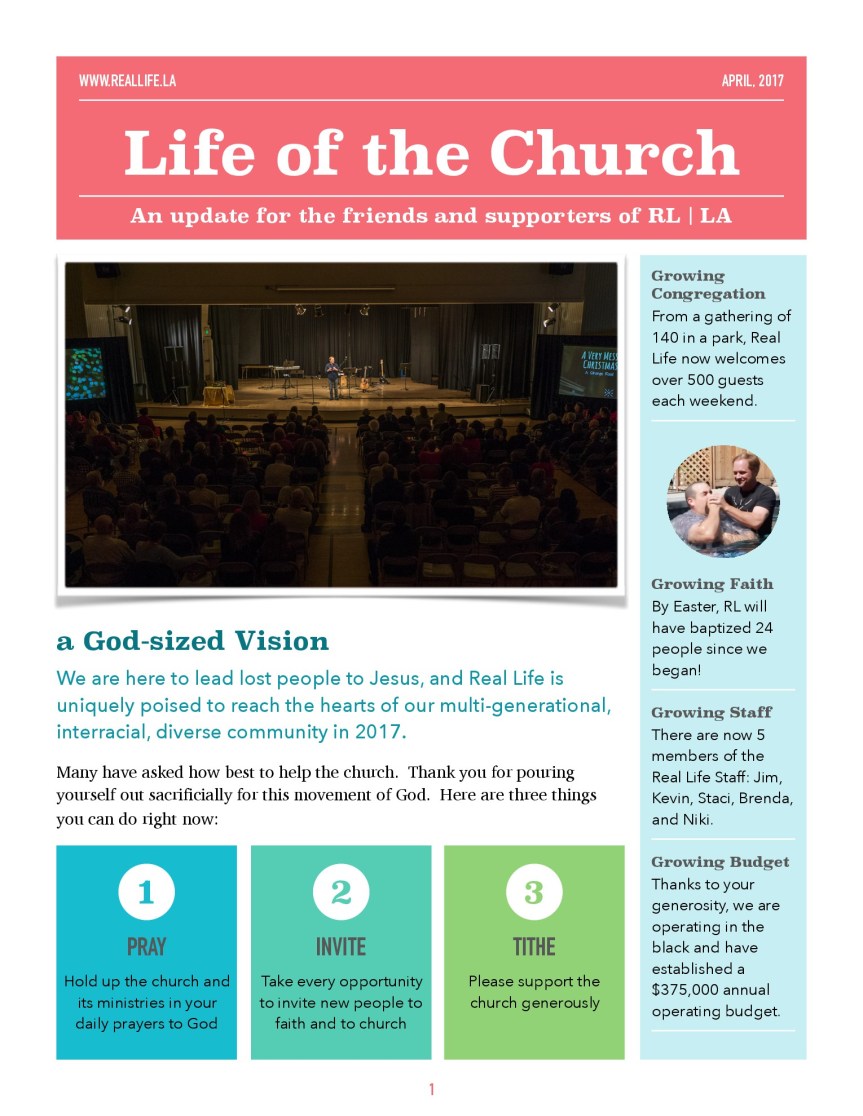
The little church that I pastor just passed it’s 6 month anniversary. We are a church b0rn out of a painful labor that has relaxed into the joy of new life. There are abundant signs that God is blessing our experiment – new guests, growing resources, fifteen small group Bible studies, and a general ethos that fluctuates between an appropriately modest joy and just outright, childish fun.
Now something happening – the thing that usually happens to 6 month olds. We’re getting our teeth. We’re starting to grow into a thing that’s going to be able to influence the world, shape things, have a voice. The evidence – there are 18 baptisms coming to Real Life between now and Easter. This means that people are making life-changing decisions to follow Jesus, from young kids to grown ups. We’re seeing people change direction in a life-changing way. This is what growing churches are supposed to do.
Most churches in America go months, or even years, without baptisms. The passion to reach lost people for Jesus passed long ago, and they’ve settled into routines that keep the already converted happy. You would think a clear reading of the life of Jesus would cure this, but they keep reading it and nothing changes.
A church should look like a ship that’s just weathered a storm at sea – the entire crew is tired, everyone’s telling the story of how it happened, and the floor is soaking wet. Join us in setting sail at Real Life…we’re gaining steam.
Biblical Rejects
Check out the litany of people who got majorly rejected while fulfilling the call of God; I mean rejected to a biblical degree.
Abraham was isolated and persecuted in a number of the places he went.
Moses was chased out of Egypt, then chased out of Egypt again, then berated by friends and family as he led people through the desert.
David was chased out of town by Saul, and in fact spent a number of years in hiding.
The prophets were, by and large, persecuted, alienated, and killed.
Jesus, after a short ministry, was crucified, mostly at the hands of religious people who scorned him.
The disciples and their circles faced waves of martyrdom.
Throughout history, some of the most devout and profound followers of Jesus have faced the same, often at the hands of other would-be followers of Jesus who loved the law more than they listened to the Spirit. Luther, Calvin, Edwards, and Wesley were all at one time chased out of town.
Imagine a community of faith in which the emphasis was not on making sure the insiders were safe on the inside, but rather that outsiders felt welcomed if they should risk showing up. Imagine a community of Jesus people who were more interested in loving the blatantly sinful than in drafting statements saying what the sin was. Imagine a community of faith that was, well, a bit embarrassing to religious people, because so many of the participants didn’t act the way religious people were supposed to act, because they are still broken and still working on it.
Instead of a community that complains about the pastor wearing blue jeans and a t-shirt, imagine a community where the tattoos are a little bit surprising. Think of a community  where you’re as likely to be invited to a pub as to a prayer meeting (not more likely, just as likely – and hey, you can pray at the pub). What if there were a Christian community where you could say, “Here’s the stupid thing I did last week,” and have people respond, “I’ve done that too,” as opposed to being afraid that everyone was going to talk about you behind your back?
Some friends of mine and I want a community like that, a community where you can live real life and not be ashamed of it. Rejects welcome. Pharisees – probably not your thing.
Et tu, Church?
 “We assume that our followers will have our backs. But that is all a comforting fantasy if you are truly trying to bring change to an organizational system. Whether it is a family, a church, a business, a not-for-profit or a government, all the best literature makes it clear: to lead you must be able to disappoint your own people. But, even doing so well (‘at a rate they can absorb’) does not preclude them turning on you. In fact, when you disappoint your own people, they will turn on you.”
“Sabotage is natural. It’s normal. It’s part and parcel of the systemic process of leadership…Saboteurs are usually doing nothing but unconsciously supporting the status quo. They are protecting the system and keeping it in place. They are preserving something dear to them.”
“Many who sabotage you will even claim that they are doing you a favor by doing so. [Edwin] Friedman describes the ‘peace-mongers’ as ‘highly anxious risk-avoiders’ who are ‘more concerned with good feelings than progress’ and consistently prefer the peaceful status quo over the turbulence of change – even if change is necessary.”
-Tod Bolsinger, Canoeing the Mountains
Soaring, by C.S. Cowles
A guest blog from a retired friend of mine, written in honor of retirees.
“They will soar on wings like eagles”
(Isa. 40:39)
While sitting on the Point overlooking scenic Payette Lake in the heart of Idaho’s mountains, I noticed movement at the bottom of the cliff. It was an osprey launching itself over the water. It worked its elegant wings until it found an updraft. Then it relaxed. Fascinated, I watched it glide in lazy circles effortlessly riding an invisible thermal up and up until it was eye-level with me. It continued to rise. High above me it headed out across the lake.
In that osprey I found a wonderful metaphor for those of us well into the third trimester of our lives. With family raised and career established, we are free to break away and soar: soar up to where new vistas of opportunity unfold, where uncharted waters can be explored, where long-cherished dreams can be pursued.
Biblical examples come quickly to mind: Abraham responding to the momentous call of God at 75, Moses launching the most revolutionary freedom movement in history at 80, and Anna the first to preach Jesus as redeemer at 84.
My life has been deeply impacted by retirees who “soared on wings like eagles.” There was Dr. H. Orton Wiley, esteemed early Nazarene leader, who at 83 filled blackboards with theological truth that still excites me today. There was Dr. Clovis Chappell, who at 85 was so feeble he could hardly totter over to the podium at a pastor’s conclave. Yet his “inner man” burned with such intensity that it set my soul on fire. On that day I was raised from the dead of disillusionment and despair at the lowest time of my ministry. I am quite sure that I would not be who I am or have done what by God’s grace I’ve been able to do apart from those two stalwart men of God who “soared on wings like eagles.”
Then there were the `big three’ in my first church: retired couples who formed the inner core of my tiny congregation. They wrapped their accepting, loving, and enabling arms around our young family, and bore us up “on wings like eagles.” And then there was the elderly District School Superintendent who not-so-gently confided that “sermons do not have to be eternal in order to be immortal.” Though a bitter pill to swallow, especially for one who thought he had to deliver “the whole counsel of God” in every sermon, he taught me one of the most valuable lessons of my preaching life: namely, that “the mind cannot absorb what the seat cannot endure.”
One of today’s most exciting frontiers are people who in the “prime time” years of their lives launch second and third careers. I have a cousin who since retirement has made 23 mission-trips to South China, continuing the pioneering work begun by our grandfather in the early 1900’s. She raises money, gathers Bibles, and collects study materials for Chinese believers. She is “soaring on wings of an eagle,” and loving every minute of it.
I have another cousin on the other side of my family who in semi-retirement felt called to resurrect the Stone Corral Community Church established by our ancestors in the 1870’s. It had fallen upon hard times and died. He secured the deed to the property, chased out the birds and animals in the abandoned building, and rounded up scattered remnants of the congregation most of whom were also retirees. Together they refurbished the building, enlisted a retired pastor to lead them, and today average well over 100 in worship. My cousin who plays the piano for their services is “soaring on wings like an eagle.”
And so it goes all across the land. Retirees are teaching classes, feeding the homeless, enrolling in seminary, refurbishing churches, going on mission trips, tutoring disadvantaged children, visiting nursing homes, writing letters of encouragement, all the while having the time of their lives.
Dr. William McCumber, pastor, educator, author, and long time editor of Holiness Today, died recently. I had the privilege of following him as pastor of Atlanta First Church many years ago. After retiring for about the third time, he accepted the call to pastor his home church in Gainsville, Georgia, at 80 years of age. He was still going strong at the  time of his passing at 87.
I was thinking about him as I stepped out to begin my early morning devotional walk. I looked up. Stretched across the sky was the glowing contrail of an airplane set on fire by the rays of the rising sun. Barely able to see the glint of the airliner I thought: There goes Bill, soaring “on wings like an eagle.”
Soaring. That’s what I want to do until I too “soar up on eagle’s wings” to be with my Lord.
Resolving to Read the Bible

It’s January 2nd, and I really don’t want to go to the gym this morning, because there will be lines of well-intended people who I’ve never seen before. New Year’s resolutions do that. I figure I’ve got until Valentine’s Day before I can use the place undisturbed again.
Many people set out every January with the resolution that they are going to read the whole Bible this year, which is a great goal. I have a few thoughts that may get you past February.
- Don’t read it left to right. That’s not how it was written – the books don’t appear in chronological order – and that’s not the best way to understand it. We’re used to reading books from left to right, because that’s the way English texts are written. Hebrew goes right to left. Chinese sometimes reads top down. But the Bible is a book that reads from the middle outwards. The best place to start reading the Bible is with the story of Jesus’ life, the gospel, in Matthew, Mark, Luke, or John. Everything before that is pointing towards Jesus’ life; everything afterwards is reflecting back on Jesus’ life. Read the gospel first.
- Save the file cabinet material for the end. I meet so many well intentioned people who tell me, “I’m going to read the whole Bible this year!” And I say, “Good job!”, because I’m a pastor, and I guess I’m supposed to encourage this sort of thing. They read Genesis, and then they come back to me saying, “It’s great! There’s so much adventure! I love it!” I say hesitantly, “Uh-huh. They come back a couple of weeks later and they say, “I’ve read Exodus! It’s amazing! I love this book.” I say, “Yup.” And then I never hear from them again. Because then they come to Leviticus, and they aren’t all that enthralled with the specificities of how to sacrifice your goat. They come to something which, even for the original authors, was file cabinet material, and they get bored. You know, it’s a really important document, so you need to keep it, so you put it in your file cabinet. It’s not pleasure reading. And all those resolutions die in Leviticus like so many sacrificial lambs. We’re going to read that stuff too – just not yet.
- Ask someone who has read the Bible what you should read next. After reading a gospel, ask someone who knows it, and even better, who also knows you, what you should read next. Generally I recommend a shorter book that gives you a taste of a bigger genre of literature. Read the book of James next. It’s quick, easy, and practical. It contains a lot of moral advice that’s sometime pithy and the kind of thing a lot of people go to the Bible for. Then read Ephesians. It will give you a little taste of Paul’s 13 letters in the New Testament, a sense for his theology, and a sense for those letters trying to teach the church to get along. Read Micah so you know who the prophets are.
- Read each book by itself. Some guides to reading the Bible recommend a section of
 this book and a section of that book at the same time. That can be an ok way to go at it. To have a true grasp of the context, you want to read any one of the 66 books by itself. In other words, when you sit down to read Romans, read the whole book from beginning to end, even if it takes a few days. Don’t read a little of Romans and then come back to it six months later.
 - Use study aids. There are commentaries that are a great help to understanding parts of the Bible. You can read a single-volume commentary, which has notes on every single book of the Bible. I like the ones with pictures. When you get further along, you might want to read an entire commentary on one book of the Bible, like Romans. N.T. Wright has a readable series of commentaries called “The Bible for Everyone.” And of course, you can always listen to sermon series by preachers who like to go through books of the Bible. Some people find that it helps to take notes, keep a journal, or illustrate the pages of their Bibles as they go.
Hope this helps! May God bless the reading of His Word!
The Grammar of the Gospel
 I have been doing some teaching at a local university, primarily to international students, and in that process, have found myself spending a lot of time explaining English prepositions. A friend of mine says, “If you’ve mastered prepositions, you’ve mastered English.” That’s because the rules governing which preposition we use and when are virtually nonsensical.
If you’re inside you stand in the corner; if you’re outside you stand on the corner. The bus is around the corner.
“I’m sitting on the bus.” Are you? Get down. That’s dangerous.
Martin Luther, in trying to describe the presence of God in the eucharist in a way that was sufficiently un-Catholic called it “in, with, and under” the bread and wine. I’ve parsed the German of that sentence, and I still have no idea what he means.
But it occurs to be that a life lived well is all about the prepositions. If you get the prepositions wrong, you’re going to get life wrong. Most church-goers say they believe “in” Jesus. By this, they mean a consent to the doctrine of his existence. That creed is, according to the Bible, meaningless and irrelevant (James 2:19).
“In” is not the critical preposition. A life lived well is a life lived from Jesus and for Jesus. Belief in, as it is usually used, is just an acknowledgement of present realities. What matters is that we understand the origin of our present reality and then our destination. If we come from Jesus, we do not just know he is real; we make him the foundation, the cause, and the source of who we are. If we live for Jesus, it means our life’s ultimate goal, its telos and destination, are to honor him. We have an initial design and an ultimate purpose – from and for.
The existence of a bus does not tell you who you are greeting at the station or where you might headed yourself. You can believe in the bus, ineffectually. But to know where the bus came from and where it is going are the only matters of consequence.
JerkBook
An Observation
There is a place to which the kingdom of God has not extended in the American church,  and that is Facebook. Christians seem to think that though God can probe our deepest thoughts, he can’t read our online accounts. Facebook is to Christians what a long stretch of empty highway is to a compulsive speed-demon, that is, the one place where the authorities can’t see you get away with it.
Except on Facebook, everyone sees it. I once talked to a man who wouldn’t even consider church because, he said, he looked at what Christians had written on Facebook.
When Jesus says things like “love your enemy,” “turn the other cheek,” and “bless and do not curse,” those commands actually extend not only finally but firstly to our casual daily interactions that seem virtually insignificant. Those teachings extend primarily into the mundane. I look at Christians’ Facebook pages that are a long string of insults of political figures, divergent ideologies, and other religions, and I wonder what they’re trying to accomplish. No one is converted by hatred.
Facebook is a center for childish gossip among those who claim to believe that action without love is just noise (1 Cor. 13). I once confronted someone about gossip and he told me I just had a different definition of gossip than him. Going around and talking about what you don’t like about an individual is gossip, no matter why you feel justified in doing it. We may think a political figure is a viable target, but an intelligent and kind-hearted follower of Jesus should know how to critique a political position without spewing venom. When we talk about our enemies, we are still required to speak in love. If you don’t love, you don’t know God (1 John 4:8).
 A Challenge
Scroll back through your Facebook page and ask yourself a question about each recent post. “Does this show that Jesus loves a lost world?” (Do this on your own social media accounts, not on someone else’s.) And maybe as an act of holy worship today, you need to delete some of the junk you shouldn’t have posted in the first place.
A Disclaimer
You get a pass for pictures of food, cats, Star Wars memes, and so forth. ; )
 Hardwired