
Domino 2

Domino.jpg

I was at a swanky dinner party a couple of weeks ago talking to a stranger about the ripple effects of the internet.  By swanky, I mean someone else was paying for the tacos I was eating, which in my world is pretty swanky.  I turned to my wife and said, “This is a free dinner.” She replied, “We must be on a date.” Since before we were married, we’ve always tried to get something for free when we go out, which we both think is romantic, so it signifies that we’re on a date.  TMI?

So, anyway…

My new friend made a fascinating observation.  He noted that the codex, the modern book, was first printed in 1450.  It was the Gutenberg Bible.  We’re still feeling the ripple effects of that invention.  In a sense, Amazon is a ripple effect of it, because Amazon initially started out as a bookstore.  It became the one that put Borders Books out of business.  It looks to be becoming the one that will put Macy’s, Sears, JCPenny, and Kohl’s out of business.  Eventually, maybe it will put printed books out of business.  But in any case, it’s a manifestation of the effects of an invention that is over 560 years old.

He then pointed to the internet.  He said if we think of the chain of dominoes that will be knocked down as a result of the internet, we are only now at the point of the first domino hitting the second one.  There will be hundreds of dominoes down the line, effects we haven’t even imagined yet.  We should resist the temptation to take for granted that the use of the internet is settled.  It’s not just for word processing and for Facebook.  So now is the time to think about what it’s really for and what dominoes might fall next.

Malls are going to go out of business.  I mean entirely.  The anchor stores are being shut down by online shopping.  Most other shopping will go too.  One day what’s left of shopping malls will be giant food courts.  People still like to go out, eat, drink, and stare at other people.  That’s where malls are going.  The Westfield Santa Anita mall in Arcadia, CA is remarkably successful, and increasing, what it is is a series of restaurants, many of which have bars.  In an online world, people need places to be social face-to-face.

Universities are going out of business.  I was in Seattle talking to the President of a small university, and I asked him when his school was going online.  He said that that was something they just weren’t going to do.  I looked quizzical and told him I thought that that was where university education was going.  He was notably defensive and told me he didn’t think it would work.  I told him about a university down here in Southern California where I thought it was working.  Two weeks later I happened to be talking to a Vice President of that Southern California University, and he happened to mention that the President of a little University in Seattle had called him to ask him how to do what they were doing with online education.  There will still be university education of course, but 90% of it will be online.  Yale uploading classes to Youtube for free is just the tip of the iceberg.  All professors of note will be recorded.  For a fraction of the cost of their salaries, they will be given royalties on recorded lectures.  PhD candidates will be paid to learn to manage tech services and proctor online exams.  Education will no longer be concentrated in wealthy nations, because everyone will have access.

Screen Shot 2017-12-01 at 11.24.54 PM.png
Know what this is?  You probably should.

Now here’s the big one.  Central banking is up for grabs.  Bitcoin was invented in 2009.  8 years later, it is trading at over $10,000 per coin.  This is an unregulated system of currency in which people trade $USD for online tokens.  They can be used to purchase everything from computers to a cold beer at over 100,000 retailers.  More importantly, they are an investment that can be bought or sold.  And given the vast expansion, it serves as a potential threat to traditional banking.  Picture an utter and entire revisioning of economics.  Banking as we know it might just be done completely differently in the future.  We might have the option to choose between a nationally regulated currency and an international, unregulated currency that connects nations together the way the euro has connected Europe.  Think about the implications.  The first bank, which, in the midst of economic crisis, chooses to invest in bitcoin instead of depending on the rate set by the Fed will usher in an economic Copernican revolution.  I’m not fantasizing.  This is probably going to happen.

Now imagine sitting in your living room, each wall a floor-to-ceiling video monitor, with the capacity to talk to anyone in the world about any subject, both of you capable of accessing resources to answer any question either of you might have.  The inventors, entrepreneurs, and creatives will no longer face a lack of resources.  Any idea can quickly become reality.

It’s going to get bigger than that.

Imagine you can talk for 5 minutes to someone whose family is starving in a small, faraway nation.  Wouldn’t you give them money?  Online charity will revolutionize world geography.  You are no longer constrained to poverty by geographic necessity.  Poverty will be roaming, as will wealth.

And that will then create the final impact of the internet.  International boundaries will become irrelevant, and countries, governed by power structures and legal systems, will no longer unite people.  Think about how people used to be tied together by a geographic neighborhood, and now they have online networks of people who don’t necessarily live nearby.  That will turn into international alliances of people governed by social contract committed to a shared belief system irregardless of geography.  Right now I can move to France and be a citizen of France if I want to.  What if I could change citizenship without leaving my living room?

Call it crazy if you want to.  Or be creative and imagine your own future.  But what’s most important is to realize that the effects of the internet have only just begun, and it is, if nothing else, a tool for boundary breaking.

Bibliophilology (or, What Kind of Book is the Bible?)

Tianjin_Library.jpg
The Tianjin Bahai Library in Tianjin, China

I’ve listened to arguments about the Bible all of my life.  I’ve heard it mocked by literature professors and defended by fundamentalists like King Kong cradling Ann Darrow at the top of the Empire State Building (I suspect, if it had a personality, that’s about how much the Bible would want to be protected).  Usually attackers and defenders talk past each other.  Often, I’m not sure that either have read it.

In part, the confusion arises from the lack of clarity about what kind of book the Bible is.  There are different approaches.

A Math Book

Some people think of the Bible like a math textbook.  It is a book of brute facts reducible to logical certainty, and if any one of them is wrong, the whole thing is suspect.  If there is an error in the math book, we’re going to have to scrutinize every problem to make sure the authors didn’t do it more than once.  Aggressors like to point out discrepancies in the biblical texts (Mark 16:5, Luke 24:4), and say that they’ve found a fatal flaw.  Defenders foolishly agree to the argument and concoct desperate explanations about how Once Upon A Time there was a perfect Bible, but then there was a copying error.  This would be like claiming this blog was written by Tinkerbell, and then when someone presents a video of me typing it myself, I reply, “She’s very tricky, isn’t she?”

The mistake is giving in on the idea that the Bible is like a math book to begin with.  The authors had no intention of communicating ideas that work like mathematics.  The statement “The Bible is true” makes as much sense as saying “The tree is true.” That’s not a valid way to evaluate it.

A Novel

Some then say the Bible is like a novel.  It’s a fascinating collection of stories that might have moral points, but they are not grounded in history.  Here, there is immediately a problem – all the history.  The authors of the Bible at a number of points clearly think they are reporting historical events, unabashedly with their own opinions about the events – who was the greatest warrior, who was a liar, and why God did what he did.  The historical character of the Bible is inescapable.  Bart Ehrman, who is not a religious believer and who is deeply skeptical about religion, said of Jesus, “He certainly existed, as virtually every competent scholar of antiquity, Christian or non-Christian, agrees.”

A defender of the novel thesis might argue then that it is historical fiction – a novel created out of historical events, but truly fiction.  However, from the earliest recorded events to the present, a growing and countless population have believed that some cross-section of the historical events recorded in the Bible actually happened as the Bible said they did.  The authors meant for much of it to be historical, even if inescapably biased, and most readers take that fact at face value.  That reduces the sorting out of the historical from the non largely to an act of bias.  It’s unsurprising that holders of this thesis usually say the supernatural elements are the fiction, regardless of what else might be historical, and that viewpoint comes from a predisposition to a certain ideology, not to a study of history.

A Compilation

Both of these approaches spring from a kind of fundamentalism that the Bible doesn’t encourage.  A better way to think about the Bible is as a compilation of various forms of literature.  There are within it long lists of names that were created specifically to be kept in a file cabinet.  They were not meant to be devotional material – they were meant to keep a paper trail of land owners.  There are poems which have no more truth value than a flower, which is still an infinite kind of value.  There are historical narratives that are brute facts – events that happened and which are recorded by eye-witnesses.  There are fabricated parables, stories created to make a point that don’t even attempt to pose as history, prophetic and apocalyptic predictions of the future, collections of practical advice, records of military conquests, virtue and vice lists, and more.

No two types of literature are the same.  They serve different functions, communicate in their own styles, and must be evaluated according to the norms of that style.  That, for any serious reader and serious believer is not a threat to faith.  It’s a challenging and thought-provoking invitation to a deep study of God.

Vitality and Vision

There is one key characteristic that distinguishes thriving organizations from dying organizations, and that is vision.  Tony Mayo, of Harvard, says “when initially describing someone as a ‘great business leader,’ the knee-jerk reaction is often to cite something about his or her strategic ability or vision.”1  Vision gives purpose to any business, team, or church, and without vision, an organization is rudderless.

The vision of any church should be to reach a lost world for Jesus, simply because it was His vision.  He himself said he had come for the sick, not the healthy and that a good shepherd leaves 99 safe sheep to seek the one who is lost.  Churches whose mission is to care for their own, or to preserve conservative ideals, or “to keep everyone happy,” have committed themselves wholeheartedly to rejecting Jesus’ call on their lives, even while they still talk about Jesus.

When a church has rejected Jesus’ vision, it picks a surrogate.  Leadership guru John Maxwell writes, “If your organization has a wonderful culture, but no vision, then you might really enjoy your time together, but you’ll never go anywhere.”2  Instead of reaching for a high-impact future, a church without vision turns to memories of the glory days and talks about how great it is because of how great it was.  It returns to the same leaders it has always had, the ones who provided it a vision in the past, because it does not realize that yesterday’s vision cannot be today’s.  I always read news articles about churches that have failed, because the quotes from the last remaining members are so revealing.  They say things like, “We used to have such great potlucks.  I don’t know what happened.” They hide behind claims like, “I guess people just don’t go to church like they used to.” What has actually happened is that at some point the church settled for life as usual instead of pursuing a mission to reach a lost world.  They traded vision for safety.

A vital church is one in which vision defines the church.  It decides what programs and activities happen and which ones don’t.  Vision defines the vocabulary, visual imagery, and public presentation of the church.  A vital church is ok saying “Good-bye” to those who reject the vision.  It’s not ok with saying “Good-bye” to vision in order to please the discontent.

Vital churches are churches that declare, “There goes Jesus!” and go chasing after him.  It’s a vision you don’t have to second-guess, rewrite, or pass occasional amendments to.  It’s his vision, and it works.

1 https://hbr.org/2007/10/the-importance-of-vision

2 http://www.johnmaxwell.com/blog/culture-vs-vision-is-it-really-either-or

Transformative Leadership and Church Planting

There are a range of types of leadership.  I don’t mean styles, like authoritarian or laissez-faire; I mean contexts which call for different kinds leadership, like entrepreneurship, which is appropriate at the initiation of an organization, management, which is leadership for steady organizations with a charted trajectory, and rehabilitation, for organizations that are facing an impending closure.  You really need different kinds of leaders for different contexts, and most leaders are going to serve better in one context than another.

Something that’s fascinating about starting a new church is the kind of leadership it requires.  You are certainly an entrepreneur, but the first thing you have to do is to lead change.  That’s because the first people who usually come visit a new church are not people who don’t believe in God; they’re Christians who are looking for a new church.  They’ve decided whatever experience of church they had before wasn’t what they want or are called to, but they’re not giving up on church.  For that population, those who lay the groundwork for the for the future of what the church will be, leadership must be transformative.  The leader inherits the whole package of experiences and expectations that Christians already have, and then he or she must lead change from the start.  But unlike an established organization, there are no formal institutional traditions for anyone to lean on.  The leader has to lead transformational change specifically in the expectations of a people who have come looking for something new.

I’m new to this.  We’re a year in to our new church.  Here’s a few things I’ve learned so far about transforming expectations

1. You have to be clear about what you’re not.

Being clear about what you are is fun and exciting.  You can proclaim big visions for life-change and kingdom work.  But refining your mission into a specific task requires defining boundaries against what you are not.  For instance, megachurches from at least the 1980s have thrived on offering a buffet of activities for every demographic.  When you list them all, it looks like the menu at the Cheesecake Factory.  Effective new churches start with the idea that we’re going to do a few things well.  Specifically, a good church seeks to experience dynamic worship as a community, effective discipleship in small groups, engaging children’s programs, and absolutely nothing else.  That means all the favorite menu options have to go.  When they ask for a sports ministry, you have to respond the way Chick-fil-A would if you ask them for a cheeseburger.

2. You can teach what you know, but you can only recreate what you are.

RLC Service 082116-7.jpg

Telling people that they should talk to lost people about Jesus is great.  Giving them examples of people who have done it is inspiring.  Having seminars to teach them how to do it is thoughtful.  But if the leader isn’t doing it, neither is anyone else.  Want to hear your church talking about their conversations with people who don’t believe in God.  Tell them your stories about talking to people who don’t believe in God.  Some great stories that I’ve heard have come to me as I was standing at the door after a Sunday worship service, and someone ran up to me and said, “That story that you shared reminds me of something that happened to me this week….”  And if I’m paying attention, and if it’s relevant, I ask that person to share that story in church or on video the following week.

3. You have to repeat the thing you just repeated.

If you haven’t said it in 6 days, there’s a solid chance they’ve forgotten it or marginalized it.  If you sent your congregation out on a mission last Sunday, start this Sunday by asking them how it went.  If it slips away for you, it’s definitely gone for them.  Placing vision statements on your site, in your print materials, on signs, and in speeches is an essential form of repetition.  At about the time you’re sick of hearing yourself, someone is only just catching on.  When you’re transforming people’s expectations, this is an essential step to breaking old patterns.


If the pastor is the only person who sees the vision of the church, it’s not a vision – it’s a hallucination.

4. You have to switch from fulfilling goals to pursuing vision.

RLLA 20170416_100633.jpg
Send off after Easter baptisms this year

Good leaders know how to set goals and love doing it.  Youcan’t very well lead without a sense for what you want to achieve.  But pursuing vision means breaking out of the standard measurable goals inherent in your field and chasing after vision-driven goals that many people might not respect.  This week I talked with Ger Jones, the pastor of Vintage Church LA.  I went to his Alpha program where I ended up in a conversation with an atheist who had been invited to the church by another atheist.  Neither believed; both loved coming.  Ger noted that at ordinary churches you might count how many people attend.  At great churches you might count how many people are baptized.  But he wondered how many people count how many conversations your congregation had with atheists that week.  I myself would ask – how many churches have atheists who are not only attending, but are evangelizing others and bringing them to church?

Transforming the expectations of already churched people means changing the standards of measurement that most churches are using.

These are just a few of the early lessons that I have learned and am learning again.  Starting a new church was nothing I ever dreamed of doing, but in the end, it’s been more educational than college, but exhilarating than mountain-climbing, and more clearly Spirit-led than any ministry I’ve ever experienced.

I Don’t Want to Be A Christian

I sat with a friend today who is not a Christian.  She knows I’m a Christian and generally avoids the subject.  Today, out of the blue, she said, “Have you always been a Christian?”

I told her my story of growing up going to boring, dead churches.  I told her about rejecting the faith on rational grounds because of the wide variety of religions in the world and the painful exclusivity of Christianity.  I told her about my return to the faith.

She grinned and looked away.

“What?” I asked.

“I don’t want to be a Christian,” she declared.

She told me about experiencing pushy Christians who tried to manipulate her to believe and who wouldn’t respect her disinterest when she said “no.” She talked about churches that made her fall asleep.

Listening to her description of what she had experienced from Christians, I couldn’t help but think it:

“I don’t want to be a Christian either.”

And by that I mean, I don’t want to be a Christian like the Christians she’s met.

I don’t want to be a Christian who disregards people’s feelings when they tell me they don’t want to hear or have heard enough.  I want to be a Christian who talks about Jesus with people who are open to listening, usually because I’ve taken the time to listen to them first, and then respects them if they say “No thanks.”

And I don’t want to be a Christian who goes to or leads a boring church.  Boring churches should almost unilaterally be closed.  They should be shut down until the people who are called to lead them can come up with a meaningful vision for what it looks like to reach lost people with the gospel.  And I don’t care if your approach is miraculous healings or one-to-one evangelism or an attractive megachurch or artsy alternative community, but if a church doesn’t have a vision, the church needs to close.  If a church is boring, it’s already closed in every way except the literal way, and that’s only a matter of time.

I told her that the way Christians behave isn’t a measure of whether or not Jesus is God.  And the real question is whether or not Jesus is God, which is irrelevant to how Christians behave.  She seemed unconvinced and changed the subject.  I let her change the subject.

In that exchange, I have to trust that God did what he wanted to do.  God never forces himself on us.  Christians need to unilaterally stop forcing themselves on anyone else.

But I do have one thing better than force, manipulation, or nagging.  I can ask you to pray for my friend.  Please do.


megaphone.jpg

Augustine on Science and Religion

Augustine.jpg

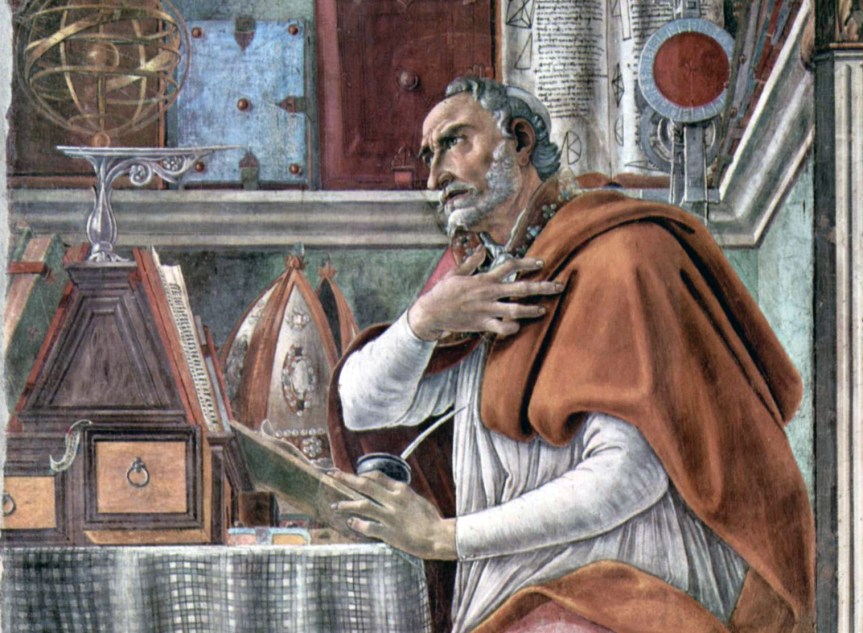
There is knowledge to be had, after all, about the earth, about the sky, about the other elements of this world, about the movements and revolutions or even the magnitude and distances of the constellations, about the predictable eclipses of moon and sun, about the cycles of years and seasons, about the nature of animals, fruits, stones, and everything else of this kind.  And it frequently happens that even non-Christians will have knowledge of this sort in a way that they can substantiate with scientific arguments of experiments.  Now it is quite disgraceful and disastrous, something to be on one’s guard against at all costs, that they should ever hear Christians spouting what they claim our Christian literature has to say on these topics, and talking such nonsense that they can scarcely contain their laughter when they see the to be toto caelo, as the saying goes, wide of the mark.  And what is so vexing is not that misguided people should be laughed at, as that our authors should be assumed by outsiders to have held such views and, to the great detriment of those about whose salvation we are so concerned, should be written off and consigned to the waste paper basket as so many ignoramuses.

Whenever, you see, they catch out some members of the Christian community making mistakes on a subject which they know inside and out, and defending their hollow opinions on the authority of our books, on what grounds are they going to trust those books on the resurrection of the dead and the hope of eternal life and the kingdom of heaven, when they suppose they include any number of mistakes and fallacies on matters which they themselves have been able to master either by experiment or by the surest of calculations?  It is impossible to say what trouble and grief such rash, self-assured know-alls cause the more cautious and experienced brothers and sisters.  Whenever they find themselves challenged and taken to task for some shaky and false theory of theirs by people who do not recognize the authority of our books, they try to defend what they have aired with the most frivolous temerity and patent falsehood by bringing forward these same sacred books to justify it.  Or they even quote from memory many things said in them which they imagine will provide them with valid evidence, not understanding either what they are saying, or the matters on which they are asserting themselves (1 Tim 1:7).  –Augustine, The Literal Meaning of Genesis, 1:19:39.

Black and White

Us.jpg

It was in 2000 that Bob Jones University, bulwark of conservative, right-wing Christianity, lifted its ban on interracial dating.  I wrote them a tongue-in-cheek thank-you note, telling them that my non-white wife and I appreciated their validation of our marriage.  I received sort of a harumph of a response.  To me it was an irrelevancy and a joke – a meaningless, far-away institution, condemned by its own hypocrisy, was announcing the end of the Paleolithic Era.

When the white supremacist marches in Virginia began this last few days, my first response was incredulity.  Americans do stupid things to capture the news for a week, and then they move on.  I couldn’t believe it was something real or lasting.  I was born in Atlanta, and I can remember the two times growing up that I heard someone say something racist.  I remember being baffled as a kid, too.  At a Boy Scout meeting, one boy told me that he didn’t like black people, and I shot back, “Why!?” He had no answer, and I was confused.  I think I join a number of people who greet racist sentiments as the kind of prehistoric tribalism that comes from the same people who look for UFOs, stock their bomb shelters, wave around Bibles they haven’t read, and whisper conspiracy theories.

I see this all at a distance because I am white and entitled.  A black friend once asked me what the experience of growing up white in America is like.  I must have looked stumped, because he said, “You’ve never had to answer that question, have you?” He had. All his life, he had an answer.  Now I do too.  Growing up white in America is the experience of comfortable apathy.  No one makes you be afraid for yourself and your family and your friends.  No one makes your compassion extend to people who are victims to a hatred that seems ridiculous to you.  So as a white person, you have to shed complacency, yours and your society’s.  You have to raise the general alert that there is an idiocy that is not acceptable among those who actually believe one race should receive favoritism over others, even if you take for granted that it is idiocy.  America can’t afford quiet entitlement.

Racists in Virginia need to read the Bibles that I know they own.  Jesus told a parable about a good Samaritan (Luke 10).  It’s his anti-racist parable.  Samaritans were the outside race.  They grew up in the wrong place, believed the wrong doctrines, married the wrong people, and weren’t considered pure by the majority.  In Jesus’ parable, the outsider is the good guy, the hero, the one who does what is right in the eyes of God. Jesus also stops and has a conversation with a Samaritan woman (a double-whammy of taboo) in plain site of the public (John 4).  The Bible crescendoes with the fact that in Christ, racial boundaries are no more (Galatians 3:28).  The gospel is an anti-racist manifesto.

Noma.jpg

My daughter’s skin is not the same color is mine, nor her eyes.  She has facial features that aren’t shaped exactly like mine.  She is a good metaphor for heaven in that way. Those who hold to racial prejudice condemn themselves to hell.  In this life, they will suffer the hell of separation and hatred, and in the next world, they will have to chose between their perceived hell of standing hand-in-hand with every race forever united under Jesus or removal from that – hell itself. Love is the better way.

What Church should learn from Macy’s

macys-logoIt’s now widely recognized that we are in a retail apocalypse, with major retailers plummeting in sales, stock value, and vision.  Macy’s, JC Penny, Sears, and Kohl’s seem destined to follow in the footsteps of Borders Books and Sport Chalet (R.I.P).  I got a $5 Starbucks card for taking a survey in a large mall recently, and the main question was, “What stores do you want to go in the anchor locations when we lose the ones we have?” (Contenders included Target and Costco.)

Churches are like Macy’s.  A lot like Macy’s.

The European churches that were shuttered ahead of American churches were our Borders.  At that point, everyone should have paid very close attention to what was coming.  What happened instead?  Churches fought over homosexuality and opposed stylistic change.  Especially those of the Protestant denominational variety have lost their status as cultural centers in communities.

Department stores need to shed buildings and develop fluid online connectivity. Churches need to shed the trappings of Christian yesteryear and ask a lot more questions about what people who aren’t Christians are concerned about and listening to.

I talk to a number of pastors who are worried about this.  Some are leading entrepreneurial ventures to reach a lost world.  I talk to a few parishioners who are content to float from church to church on an experiential Easter egg hunt.  Fortunately, I’m blessed to be a part of a church with a God-sized vision that isn’t wed to anachronisms.

It’s painful to listen to people that they don’t want things to change, because they like it the way it is, or was.  So it’s time for an assessment of our vision and values.  Are we about the mission of God, or are we about the institution that we joined 20 years ago, which we hope stays as is because of all the good memories?

Birthday

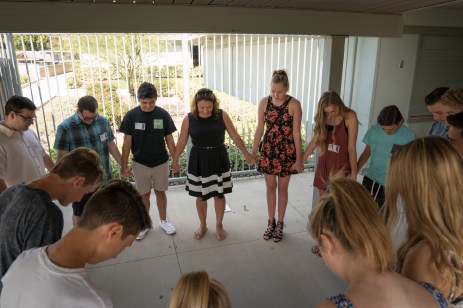
download.jpgThis is a note to the four dozen kids who decided to follow Jesus at Real Life Church this week.  I’m so proud of you!  I’m so thankful for you.  This week you made a decision to follow Jesus in this life.  You heard a clear message about how much Jesus loves you, and you said “yes” to him.  Great decision!!! You don’t yet realize how great a choice that was, so I want to give you an idea.

I made a choice like that when I was in high school.  I realized that the story of Jesus is undoubtedly true, and I knew there was nothing more important than following him and telling people about him.  A few things started to change in my life:

1.  I got serious about reading the Bible.  Since it really is God’s Word, there’s no book that is more important.  Read it every day!

2.  I started loving people more.  I realized Jesus loved everyone, no matter how broken they were, so I realized I was supposed to love everyone too.

3. I realized life has a purpose, and not everyone lives for that purpose.  It’s possible to do life wrong, and I didn’t want to get it wrong!  Life exists so that we can love God and other people.  That means that we should spend every day telling people about Jesus.

4. I knew there was a big difference between people who followed Jesus and people who were just religious.  In fact, Jesus had more arguments with religious people than anyone else!  Jesus was so frustrated with people who went to church but who were judgmental and unloving towards other people.  There’s a big difference between loving Jesus and just going to church!

So if you decided to follow Jesus this week, it’s kind of like a new birthday for you.  You should throw a party!  This is the week that you started living a new life – a life of love and purpose.  There are many challenges that you will face as you follow Jesus, but Jesus is stronger than anything in the world.

I’m so proud of you!  Don’t ever give up!

Pastor Jim