
This is a public service announcement.
You may stop posting links on your Facebook page and writing “this” above them. That is now over.
Sincerely,
2017

This is a public service announcement.
You may stop posting links on your Facebook page and writing “this” above them. That is now over.
Sincerely,
2017
CHANGES IN WORSHIP
Worship has been changing in America. It’s been changing radically in the 20th century, and even more so in the second half of the second century. The so-called “worship wars” of the 1980s led to the rise of contemporary worship styles and services. “Blended” services were formed in order to allow contemporary worship and a variety of instruments into shrinking churches with the hope that the church would slowly evolve and grow. By the late 1990s, most churches that had hope of having a future had already changed mostly or entirely to contemporary worship. In the first decade of the 21st century, the American Church witnessed rapid church closures, the impending death of mainline Protestant churches that had refused to change what needed to be changed, and the rise of a massive church planting movement. Church plants began from the ground up with contemporary worship styles, following on the successes of churches that first pioneered contemporary worship in the 1980s.
Today, churches that cling to traditional worship styles are among the few. Most of them have designated a single service to traditional worship for those who still long for it, usually meeting in a separate room on campus while the main worship space is used for contemporary worship.
This is where we are.
For most people, this is not a surprise. Most people have looked around the church culture and seen that this change is not only underway but is now pervasive. The media has widely reported on the signs that traditional worship is passing from our culture. Commentators have observed that traditional churches do not have a strong future. In my own area, one church has recently cancelled its only traditional worship service, another church has removed its traditional elements from its largest, formerly blended service, and a nearby church plant that started with contemporary worship 3 years ago now has 2000 people attending each weekend. But behind these facts are a lot of anxiety and uncertainty, and that’s where a pastor’s heart goes.
CHALLENGES
The most challenging part of this is that there is still a population, largely septuagenarians, who feel alienated by the change. For them, the experience of modern worship is a lot like the couple of hours I spend playing with my kids in the afternoon: it’s noisy, it wears me out, it gives me a headache, and it’s not really fun for me, but I do it because I love my kids. After my kids go to bed, I have “me time,” which is far more peaceful and relaxing, and is really what I want. For that generation, a worship service that is “for the kids” wears them out, and they are left wondering where to find a space for themselves. They feel disoriented and ignored.
The issues are obvious:
A LITTLE HISTORY
The disagreements are not new. In the 3rd century, churches fought to keep instruments out entirely, because they were associated with pagan cults. In the 15th century, John Wycliffe complained that the music was being written in a way that was too complex so that only the choir could sing, and everyone else just had to stare. In the 17th century, Reformed churches fought to keep the organ out. In the 18th century, a pastor wrote an article opposing the new music being written by Isaac Watts. He said, “There are several reasons for opposing it. One, it’s too new. Two, it’s often worldly, even blasphemous. The new Christian music is not as pleasant as the more established style. Because there are so many songs, you can’t learn them all. It puts too much emphasis on instrumental music rather than Godly lyrics. This new music creates disturbances making people act indecently and disorderly. The preceding generation got along without it. It’s a money making scene and some of these new music upstarts are lewd and loose.” That was in response to “When I Survey The Wondrous Cross” and “Joy to the World.” In 1903, Pope Pius X banned the piano in worship by papal decree. Later in the 19th century, the founder of the Salvation Army quipped, “Why should the devil have the best music?” and then began writing far more enthusiastic church music. In the 20th century, many Christians expressed skepticism at the early gospel radio broadcasts of the evangelist Charles Fuller. Then in the 1970s, pioneers fused modern rock with Christian themes and started a furor of their own. Sigh.
PASTORS AND THEIR PEOPLE 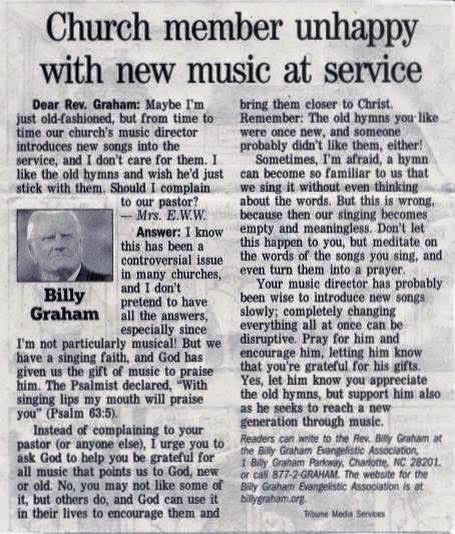
This puts pastors in a bind. We have to align our people with our mission, our strategy, and our cultural context. Usually these four things don’t line up well or easily. We are left to disregard either the culture, making us irrelevant, or to disregard our mission, making us directionless, to disregard our people, making us insensitive, or to disregard strategy, making us look confused. The pastor, who is more subject to public opinion (and consequent crucifixion!) than anyone else, has the burden of guiding this alignment and being resented for it, no matter the results.
At a former church, I approached a choir to have them sing less frequently. I did so with the unanimous consent of our Elder board. In the midst of the conversation with the choir, I was interrupted, then booed, then told that what I was saying “was a bunch of crap.” The next weekend, a lone choir member came to me and said, “No one has the right to treat their pastor that way.”
Now personally, I don’t feel any resentment towards those who fondly remember and still prefer traditional worship. For them, it was a feeling of home and a feeling of family. Talk of “blended services” today is an anachronism. Some think the compromise that they made in the 1980s to allow the band to meet in another room for a service for young adults was as much compromise as they needed to make. And for those who have attended the same church for years, they don’t think that the massive changes that have already happened in our culture need to affect them further. It’s painful and disorienting for them.
But this is the last chance for churches to live or die.
TODAY
Today churches that can provide a separate space for a traditional service may allow it to go on in that space for a while. For churches that have a single worship venue, effective ones will no longer maintain traditional or even blended services if they want the church to have a future. Those that are trying to do so have by and large already seen their young adults leave for other churches.
That’s the state in which churches and pastors find themselves today. There is not a quick solution for the population who does not welcome the change in styles. They feel marginalized. Nor is there a possibility that vital churches will go backwards. That is a leadership failure of the highest order, and it will cost them their future. We love each other and we keep moving.
The only viable way forward will come when people who love Jesus put the gospel and the kingdom in front of their own preferences to make way for those who don’t yet know Jesus. It’s only when our hearts beat for lost people and for Jesus that the mission of the church will overwhelm our preferences. This is not something that we can bring about by our own effort, because only the Holy Spirit has the power to change hearts. At the end of the day, the best we can do is to cast vision, to pray, and to keep preaching the gospel for the salvation of humankind.
This weekend, the Christian Church heads into Palm Sunday, the day that commemorates Jesus’ final entry into Jerusalem before he died. It is a weekend of ironic and unmet expectations.
This week in Jesus’ life was the beginning of Passover, the Jewish Independence Day. It commemorated the fact that God had set his people free from slavery in Egypt, as surely as July 4th commemorates a war for freedom that released the American colonies from the British monarchy. The Jewish people went to Jerusalem to remember, and also to conspire. Rome controlled Jerusalem, and though the ruler wore the laurel wreath instead of the serpentine Nemes headdress, they felt the same about the tyrant. They went for Passover in hopes of rebellion.
In marched Jesus. He was a conspirator who had riled the religious powers that had felt so oppressive. He was murmuring about a new kingdom. At one point they tried to force him to replace King Herod (John 6:15). His disciples expected him to become an earthly ruler (Mark 10:37). The people cheered for the king who came riding in, perhaps taunting Herod who was hiding behind the walls.
And a few days later he was dead. They killed him. Those very same crowds turned on him. Why such a pivot? Unmet expectations. Jesus wouldn’t be what they wanted him to be. They wanted a general to drive out Rome and give them earthly peace and blessings. He was talking about a kingdom that had no national borders.
A fair word to we who claim to follow him, we who are religious, we who frequent houses of worship. If the story bears out, we are the ones who are most likely to miss it – we are the ones who hold the nails. Jesus isn’t here to meet our expectations. His goal isn’t to make us comfortable. He’s not catering to religious sensibilities. We like to mutiny against Presidents who don’t usher in a world of peace. We chase away pastors who change what we’re used to. We rebel against parents who don’t let us have our way. And we won’t stop at rejecting God who doesn’t support an insular suburban bubble in which we continue to pursue money and satisfaction, baptizing them in the name of the American dream.
It’s a fair word as we enter this weekend, singing the praise of Jesus, who may have no intentions of doing what we want.
But on the other side of our expectations are his. And if we take his expectations upon our shoulders, we may find that his are actually lighter than our own. We may find that what needs to go to the cross are our demands of Jesus, because, freed from them, we stand before an empty tomb in which our potential for a meaningful life was once laid to rest. I had a friend who became a Christian because on Saturday night she went to a nightclub, and on Sunday she went to church. She said that there was such a stark difference between the darkness of the night before and the light of the morning, that the light was irresistible. Leaving our expectations for him in exchange for his expectations for us is the move from darkness to light.
The critical decision that the modern church must make is whether or not to raise up disciples or customers. The results will be very different.
You can have a very big church filled with customers. Appeal to the expectations, calm every complaint, give the old guard what they want, and appease the donors. This can generate a gathering of satisfied church-attenders who bring their friends, promising them a similar customer-satisfaction experience.
On the other hand, a church can create disciples. This necessarily requires telling people that they can’t have what they want, that Jesus’ call is to take up your cross and to die to yourself. A church in a frenzy of attracting customers can never deliver a message like this. A church that delivers a message like this will never attract customers. But it is fundamentally the road to discipleship. Churches that create disciples define their purpose by their mission, not by the whims of their shareholders.
The result of a disciple-making church is a most likely initially smaller but impassioned group of people who are truly committed to the mission of Jesus in the world. But when a gathering of people takes Jesus’ mission to heart, they become an unstoppable force for the kingdom.
The leadership of the church just has to decide at the beginning, when the groundwork for the church is being laid: customers or disciples?

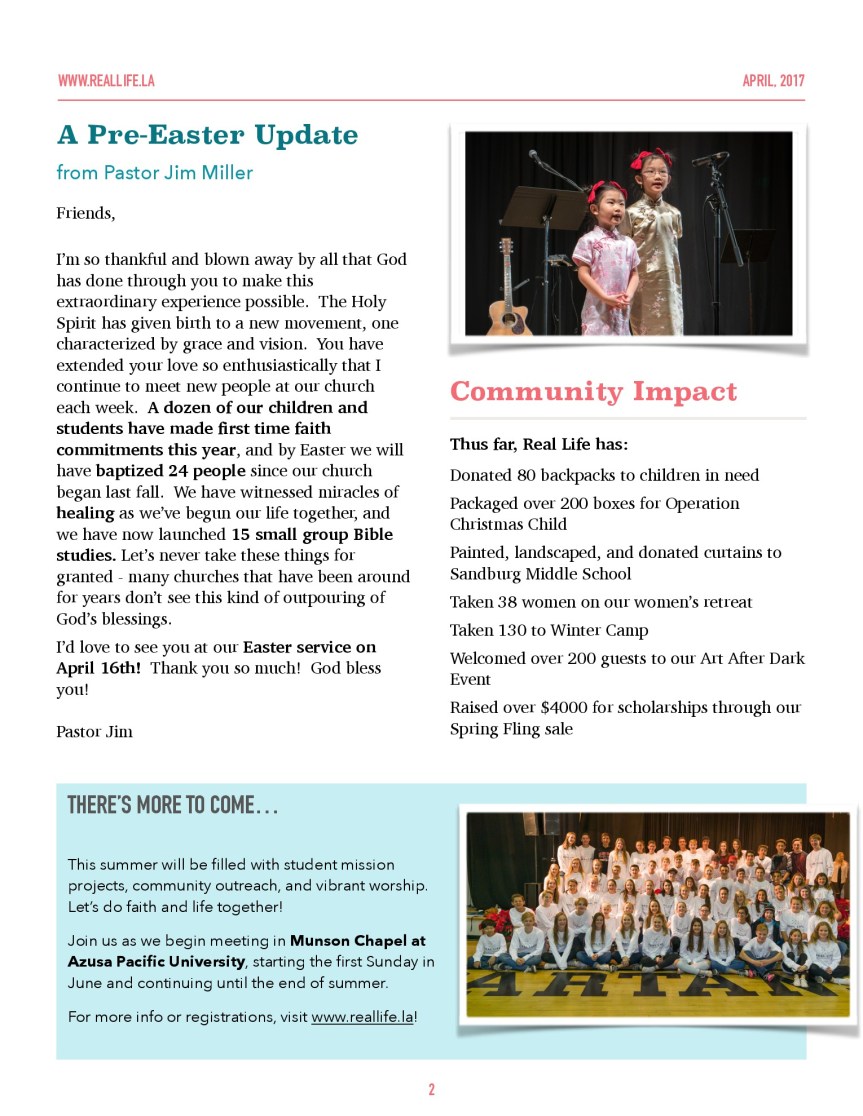
The little church that I pastor just passed it’s 6 month anniversary. We are a church b0rn out of a painful labor that has relaxed into the joy of new life. There are abundant signs that God is blessing our experiment – new guests, growing resources, fifteen small group Bible studies, and a general ethos that fluctuates between an appropriately modest joy and just outright, childish fun.
Now something happening – the thing that usually happens to 6 month olds. We’re getting our teeth. We’re starting to grow into a thing that’s going to be able to influence the world, shape things, have a voice. The evidence – there are 18 baptisms coming to Real Life between now and Easter. This means that people are making life-changing decisions to follow Jesus, from young kids to grown ups. We’re seeing people change direction in a life-changing way. This is what growing churches are supposed to do.
Most churches in America go months, or even years, without baptisms. The passion to reach lost people for Jesus passed long ago, and they’ve settled into routines that keep the already converted happy. You would think a clear reading of the life of Jesus would cure this, but they keep reading it and nothing changes.
A church should look like a ship that’s just weathered a storm at sea – the entire crew is tired, everyone’s telling the story of how it happened, and the floor is soaking wet. Join us in setting sail at Real Life…we’re gaining steam.
Check out the litany of people who got majorly rejected while fulfilling the call of God; I mean rejected to a biblical degree.
Abraham was isolated and persecuted in a number of the places he went.
Moses was chased out of Egypt, then chased out of Egypt again, then berated by friends and family as he led people through the desert.
David was chased out of town by Saul, and in fact spent a number of years in hiding.
The prophets were, by and large, persecuted, alienated, and killed.
Jesus, after a short ministry, was crucified, mostly at the hands of religious people who scorned him.
The disciples and their circles faced waves of martyrdom.
Throughout history, some of the most devout and profound followers of Jesus have faced the same, often at the hands of other would-be followers of Jesus who loved the law more than they listened to the Spirit. Luther, Calvin, Edwards, and Wesley were all at one time chased out of town.
Imagine a community of faith in which the emphasis was not on making sure the insiders were safe on the inside, but rather that outsiders felt welcomed if they should risk showing up. Imagine a community of Jesus people who were more interested in loving the blatantly sinful than in drafting statements saying what the sin was. Imagine a community of faith that was, well, a bit embarrassing to religious people, because so many of the participants didn’t act the way religious people were supposed to act, because they are still broken and still working on it.
Instead of a community that complains about the pastor wearing blue jeans and a t-shirt, imagine a community where the tattoos are a little bit surprising. Think of a community  where you’re as likely to be invited to a pub as to a prayer meeting (not more likely, just as likely – and hey, you can pray at the pub). What if there were a Christian community where you could say, “Here’s the stupid thing I did last week,” and have people respond, “I’ve done that too,” as opposed to being afraid that everyone was going to talk about you behind your back?
Some friends of mine and I want a community like that, a community where you can live real life and not be ashamed of it. Rejects welcome. Pharisees – probably not your thing.
 “We assume that our followers will have our backs. But that is all a comforting fantasy if you are truly trying to bring change to an organizational system. Whether it is a family, a church, a business, a not-for-profit or a government, all the best literature makes it clear: to lead you must be able to disappoint your own people. But, even doing so well (‘at a rate they can absorb’) does not preclude them turning on you. In fact, when you disappoint your own people, they will turn on you.”
“Sabotage is natural. It’s normal. It’s part and parcel of the systemic process of leadership…Saboteurs are usually doing nothing but unconsciously supporting the status quo. They are protecting the system and keeping it in place. They are preserving something dear to them.”
“Many who sabotage you will even claim that they are doing you a favor by doing so. [Edwin] Friedman describes the ‘peace-mongers’ as ‘highly anxious risk-avoiders’ who are ‘more concerned with good feelings than progress’ and consistently prefer the peaceful status quo over the turbulence of change – even if change is necessary.”
-Tod Bolsinger, Canoeing the Mountains
A guest blog from a retired friend of mine, written in honor of retirees.
“They will soar on wings like eagles”
(Isa. 40:39)
While sitting on the Point overlooking scenic Payette Lake in the heart of Idaho’s mountains, I noticed movement at the bottom of the cliff. It was an osprey launching itself over the water. It worked its elegant wings until it found an updraft. Then it relaxed. Fascinated, I watched it glide in lazy circles effortlessly riding an invisible thermal up and up until it was eye-level with me. It continued to rise. High above me it headed out across the lake.
In that osprey I found a wonderful metaphor for those of us well into the third trimester of our lives. With family raised and career established, we are free to break away and soar: soar up to where new vistas of opportunity unfold, where uncharted waters can be explored, where long-cherished dreams can be pursued.
Biblical examples come quickly to mind: Abraham responding to the momentous call of God at 75, Moses launching the most revolutionary freedom movement in history at 80, and Anna the first to preach Jesus as redeemer at 84.
My life has been deeply impacted by retirees who “soared on wings like eagles.” There was Dr. H. Orton Wiley, esteemed early Nazarene leader, who at 83 filled blackboards with theological truth that still excites me today. There was Dr. Clovis Chappell, who at 85 was so feeble he could hardly totter over to the podium at a pastor’s conclave. Yet his “inner man” burned with such intensity that it set my soul on fire. On that day I was raised from the dead of disillusionment and despair at the lowest time of my ministry. I am quite sure that I would not be who I am or have done what by God’s grace I’ve been able to do apart from those two stalwart men of God who “soared on wings like eagles.”
Then there were the `big three’ in my first church: retired couples who formed the inner core of my tiny congregation. They wrapped their accepting, loving, and enabling arms around our young family, and bore us up “on wings like eagles.” And then there was the elderly District School Superintendent who not-so-gently confided that “sermons do not have to be eternal in order to be immortal.” Though a bitter pill to swallow, especially for one who thought he had to deliver “the whole counsel of God” in every sermon, he taught me one of the most valuable lessons of my preaching life: namely, that “the mind cannot absorb what the seat cannot endure.”
One of today’s most exciting frontiers are people who in the “prime time” years of their lives launch second and third careers. I have a cousin who since retirement has made 23 mission-trips to South China, continuing the pioneering work begun by our grandfather in the early 1900’s. She raises money, gathers Bibles, and collects study materials for Chinese believers. She is “soaring on wings of an eagle,” and loving every minute of it.
I have another cousin on the other side of my family who in semi-retirement felt called to resurrect the Stone Corral Community Church established by our ancestors in the 1870’s. It had fallen upon hard times and died. He secured the deed to the property, chased out the birds and animals in the abandoned building, and rounded up scattered remnants of the congregation most of whom were also retirees. Together they refurbished the building, enlisted a retired pastor to lead them, and today average well over 100 in worship. My cousin who plays the piano for their services is “soaring on wings like an eagle.”
And so it goes all across the land. Retirees are teaching classes, feeding the homeless, enrolling in seminary, refurbishing churches, going on mission trips, tutoring disadvantaged children, visiting nursing homes, writing letters of encouragement, all the while having the time of their lives.
Dr. William McCumber, pastor, educator, author, and long time editor of Holiness Today, died recently. I had the privilege of following him as pastor of Atlanta First Church many years ago. After retiring for about the third time, he accepted the call to pastor his home church in Gainsville, Georgia, at 80 years of age. He was still going strong at the  time of his passing at 87.
I was thinking about him as I stepped out to begin my early morning devotional walk. I looked up. Stretched across the sky was the glowing contrail of an airplane set on fire by the rays of the rising sun. Barely able to see the glint of the airliner I thought: There goes Bill, soaring “on wings like an eagle.”
Soaring. That’s what I want to do until I too “soar up on eagle’s wings” to be with my Lord.

It’s January 2nd, and I really don’t want to go to the gym this morning, because there will be lines of well-intended people who I’ve never seen before. New Year’s resolutions do that. I figure I’ve got until Valentine’s Day before I can use the place undisturbed again.
Many people set out every January with the resolution that they are going to read the whole Bible this year, which is a great goal. I have a few thoughts that may get you past February.
 this book and a section of that book at the same time. That can be an ok way to go at it. To have a true grasp of the context, you want to read any one of the 66 books by itself. In other words, when you sit down to read Romans, read the whole book from beginning to end, even if it takes a few days. Don’t read a little of Romans and then come back to it six months later.
Hope this helps! May God bless the reading of His Word!
 Hardwired