The Theology of The Creation of Adam

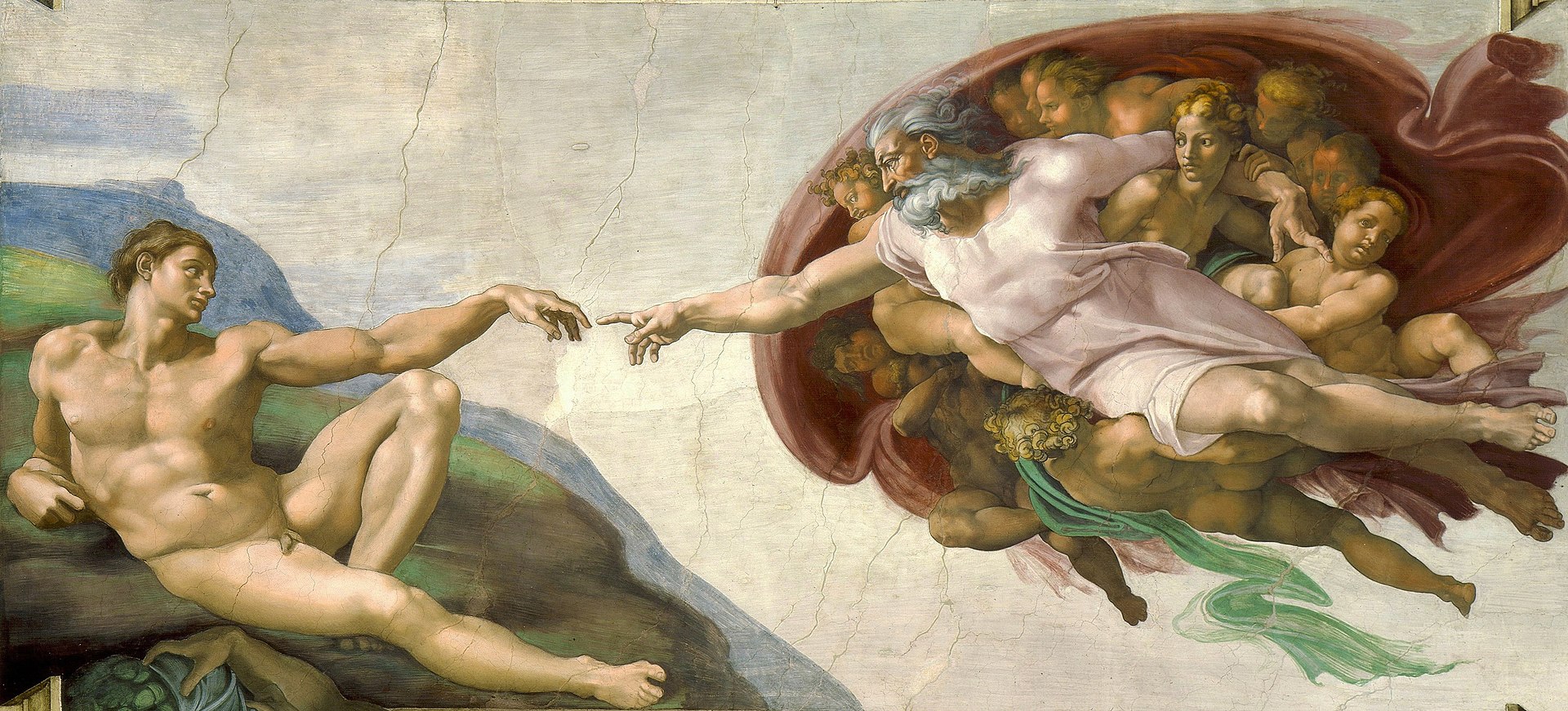
This very familiar painting, The Creation of Adam, by Michelangelo, has a fascinating history behind it and a deep theological revelation within it.

The Sistine Chapel, in Vatican City, was completed in 1483, and since has been used as the chapel for the Pope to hold special worship services. We are most familiar with one of the scenes from the ceiling, depicting the Creation of Adam. What’s first and most significant about the painting was that it was without precedent.  No one had done anything on this scale before.  This is to painting what the first TV was to video. The ceiling was commissioned by Pope Julius 2 in 1508, and the Pope made certain specifications about what he wanted – originally the 12 apostles. But Michelangelo demanded freedom to do what he wanted, and instead painted a story of salvation, from Creation to the fall to Noah and the flood. Around those are the story of the Old Testament and the prophets, because they forecast the coming of the Messiah, leading to the Last Judgment. Around the lower tier are a series of tapestries of New Testament figures created by the legendary painter Raphael. Botticelli did one of the scenes as well.

Now what’s most engaging about this particular panel of the ceiling (I mean, after Adam says, “Hey, eyes up here”), is the musculature of the hands and the expressions on the faces. God’s hand is stretched, extended. He is leaning forward.  God is desperate for this connection. God wants to reach to Adam. Adam is leaning backwards as casually as if he were watching YouTube. And yes, he may have stopped on the 700 Club channel for a minute, but he doesn’t seem that interested. His hand is extended a little, but it’s dropping.  He’s unconcerned. This is not critical for him. Do you see what Michelangelo is telling us theologically?  Our relationship with God is his doing, not ours. It is by grace because he loved us, and not because we deserved it, and not because I was a generally good person in this life, and not because I made the right decision. Dead is dead.

Ephesians 2 tells us that we are “dead in our transgressions and sins.” But verses 4 and 5 give us the great promise: “But because of his great love for us, God, who is rich in mercy, made us alive with Christ even when we were dead in transgressions—it is by grace you have been saved.”

Michelangelo teaches us that without God’s activity, we are lost, not in malice and rage, but in apathy and lifelessness. All the energy of Creation and salvation are God’s work.

We are then set free to life, to real life, to life on Jesus’ terms. We rise from apathy to adventure.

I once knew a guy who said that he wasn’t going to donate to charity until he was older and got rich. He told me, “I can give so much more if I wait until I have a lot.”  You know what’s going to happen? That guy’s never going to give anything.  He won’t develop the musculature for it. He’s just going to atrophy. That’s like saying, “I’m going to go to the gym when I retire.  Right now I’m too busy with work and kids and stuff.  But when I finally retire, then I’m going to get in shape.” You’ll be lucky if you make it to retirement like that.

When we set out to follow Jesus, it is to join the passion of a life lived in love, in self-sacrifice, in generosity, in care for the desperate. We move from spectator to player. When we follow Jesus, we leave behind stale religious attendance, and we become the priests and missionaries. With Jesus, the call is not to complacent intellectual assent. When we follow Jesus, we rise to life.

      The Theology of The Starry Night

      Almost everyone has seen Van Gogh’s The Starry Night on t-shirts, coffee mugs, and college dorm room posters. Not everyone knows that it was painted by a man in an explicit, desperate search for God. Not everyone realizes that there is a hidden message in the painting.

      In his younger years, Van Gogh, son of a minister, attended a Christian school and became quite religious. He once said that it was his goal to preach the gospel everywhere. So at the age of 24, his parents sent him to study theology in Amsterdam. Unfortunately, he failed the entrance exam. Undeterred, he became a pastor’s assistant. He went to work in a coal mining village where he dressed like and lived among the poor. For this, in less than a year, the religious organization for which he worked dismissed him for “undermining the dignity of the priesthood.”

      At 27, he entered art school, again with a theological purpose. He wrote to his brother, Theo, that he wanted “to try to understand the real significance of what the great artists, the serious masters, tell us in their masterpieces, that leads to God.”

      However, conflicts with his family, especially his father, led him to denounce his family’s religion as hypocritical. At its peak, he refused to go to church with them on Christmas, leading to a break in their relationship. From there, things would deteriorate, and he would go on to marry a prostitute, have a child with her, abandon them both, battle disease, and eventually be put in a mental asylum. The Starry Night was the view from his window in 1889.

      It is an intentionally theological painting. He wrote to Theo that he had a “tremendous need for, shall I say the word—for religion—so I go outside at night to paint the stars.”

      Van Gogh was an Impressionist. The Impressionists tried to capture light in the abstract, and this painting is certainly all about the lights. The first lights that catch our eyes are of course the stars – playful and extravagant, impossibly large and strangely in motion, blown about by the wind. Two spires point our attention towards the sky – the cypress tree in front that burns like a black fire and the church steeple sitting quietly in the background.

      Now hone in on that steeple. Notice that all the houses have their lights on, warm, cozy little abodes. The only building that is dark is the church. Here is Van Gogh’s secret message, hiding in plain sight like a magician’s sleight-of-hand. Mystery, wonder, and spirituality are to be found in nature. The institutional church is dead and lifeless. This was the conclusion that this once fervently religious man came to, son of a stern pastor, rejected by seminary and ministry. The church had not shown him grace, and so he went looking elsewhere.

      He considered the work a failure. He wrote to Theo, “once again I allowed myself to be led astray into reaching for stars that are too big—another failure—and I have had my fill of that.” He left behind some 2000 paintings and 600 letters to his brother. At 37, Van Gogh took his own life. The God of the stars made him wonder but could not heal the wounds of his heart and the troubles of his mind.

      Read Psalm 19. David walks us through the spiritual journey that everyone must take. David discovers the God of nature who provides wonder and warmth, but it is in the written word of God that he discovers God’s identity. Without that, the God of nature is a fierce and unfamiliar thing, bringer of forest fires, earthquakes, and floods. The God of the Scriptures reveals himself as one who does not want the world broken, but rather seeks to heal it and to restore life. That God ultimately revealed himself by walking among us in the flesh and in humility – Jesus of Nazareth. From there, David falls to his knees in confession.

      C.S. Lewis would point to the importance of God’s self-revelation over and above our intuitions from God we get from nature. In Mere Christianity, he writes, “In fact, that is just why a vague religion – all about feeling God in nature, and so on – is so attractive. It is all thrills and no work; like watching the waves from the beach. But you will not get to Newfoundland by studying the Atlantic that way, and you will not get eternal life by simply feeling the presence of God in flowers or music.”

      The Starry Night tells the sad story of a young man on a passionate search for God, yet the church, instead of offering grace, became a darkened building to him. Nature whispered of God’s majesty, but it did not speak of His love. Without the church to carry the name of Jesus, Van Gogh was left with a silent, untamed presence—a God who seemed distant and indifferent.

      Yet, the God who scattered stars across the heavens did not remain distant. Through Jesus, He entered our broken world, bringing light to dark places and healing to wounded hearts. Like a masterpiece explained by its painter, God’s self-revelation in Scripture shows us the purpose and love behind the creation. Only by letting the Great Artist interpret His work can we find our place in the beauty He designed.

      An Artful Connection

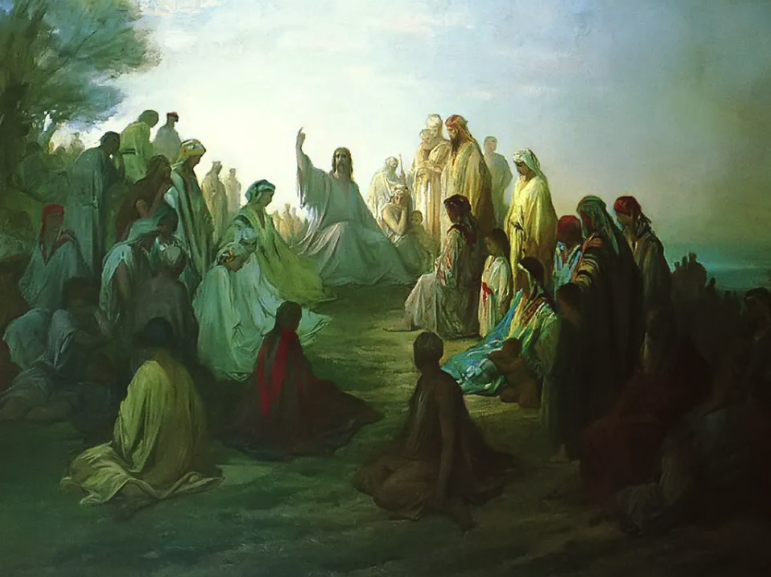
      Looking at Gustave Dore’s “Jesus Preaching on the Mountain” (1865), an oil painting of Jesus giving the Sermon on the Mount, and it suddenly occurs to me I know what Dore was thinking about. The image is of Jesus in front of a crowd, index finger on his right hand extended heavenward.

      Take a close look at the posture of Jesus:

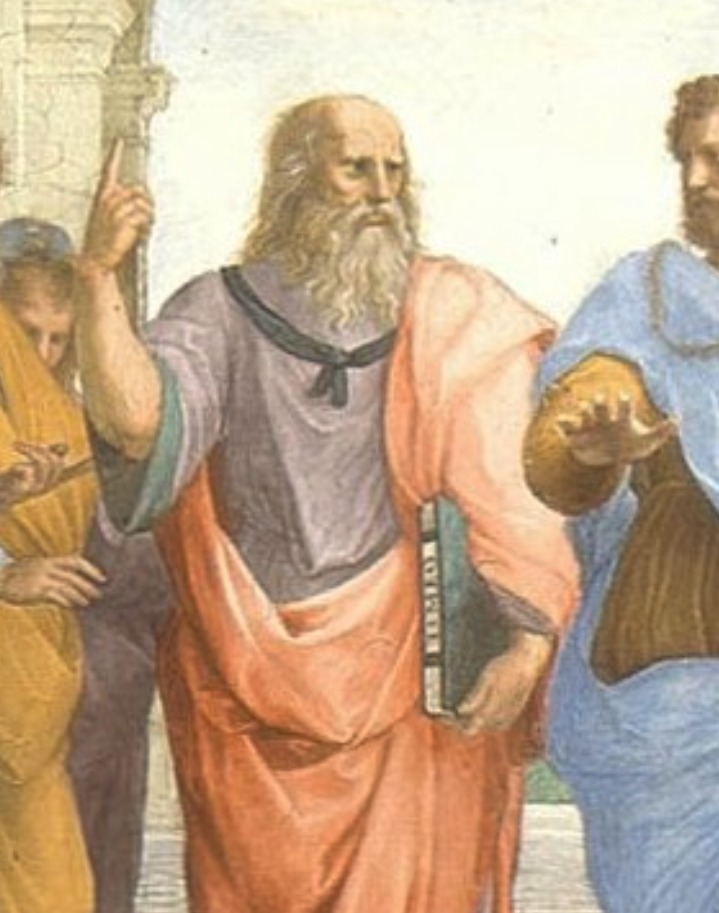
      Now tell me if that doesn’t bear a striking resemblance to this guy:

      That’s the Greek philosopher Plato as he appears in Raphael’s “School of Athens” (1511). Plato is holding a copy of his own dialogue, the Timaeus, a distinctly theological work in which Plato writes that the order and the structure of the universe are the product of a creative and intentional mind of a craftsman. It is a work that early Christians globbed onto as a philosophical precursor to revealed faith and proof that they had the answers the world needed.

      Now pan back and look at the whole of the “School of Athens,” and compare the structure of the painting to that of Dore’s work.

      The paintings are both horizontally bisected by the heads of the main character(s) and the crowd around them. The crowds line both sides of the central figures attentively, while others sprawl on the ground up ahead of them.

      I think Dore borrowed the composition of his painting. However, it wasn’t for simple pragmatism nor merely allusion or homage. He’s telling us something philosophically.

      Plato, who lived 400 years before Jesus, speculated about the nature of the universe and its Creator. He deduced that there were universal truths or principles grounded in a unifying source of the universe. Dore, a lifelong Christian who created a celebrated illustrated Bible finds the conclusion to Plato’s ponderings in the person of Jesus. Jesus speaks of a heavenly Father who was incarnate in Jesus himself, the ultimate revelation of the mysteries at which the philosophers could only wonder.

      Good message for us! Should we have the sense that there is an order-making, intelligent mind that brought the beauty of the universe to be, we might consider that Jesus knew exactly who it is that we are looking for. And in the Sermon on the Mount, Jesus tells us what the world, guided by this Creator, should look like.

      Apple

      Magritte.pngHere’s a painting that’s changed the world.

      It’s by Belgian surrealist Renee Magritte of a man in a hat with a green apple where his face should be.  You can tell it was painted in the 1960s, because when you look at it, you wonder, “What was that guy on?”

      Magritte said that the painting was intended to capture that feeling that we all have that there’s something more than what we can see, something behind the visible.  We feel it every time we try to communicate and feel that we’re not getting our message across.  Know what that feels like?  If not, date someone.  You’ll experience it.

      I was content to give the painting a quick glance and then walk away, but I saw the title of the painting: The Son of Man.  That’s a title that is distinctively Judeo-Christian.  Daniel uses it in a prophecy about a coming savior, and Jesus takes up the term for himself to refer to his humanity, which often veiled his divinity.  So then I wondered at the religious possibilities.  An apple has a well-publicized connection to the Christian faith.  Adam and Eve ate one and were kicked out of Eden.  The Bible doesn’t actually say that the

      forbidden fruit was an apple, but the Latin word for apple tree, malus, is also the Latin word for evil, so the play on words contributed to medieval artistic portrayals of the garden.

      The apple represents the Fall, the brokenness of the world.  And that is the thing that stops us from seeing the Son of Man.  His disciples missed it, his family missed it, certainly his enemies missed it.  God walked the earth and we couldn’t see him, because we were blinded by our own brokenness, by the Fall.

      Apple-computer-logo.jpg

      Coincidentally, Beatles’ member Paul McCartney bought one of Magritte’s paintings of an apple and named his record company Apple Corps (a play on “apple core”).  Another young hipster who loved the Beatles started up a computer company and named it after McCartney’s record company – Apple Computers.

      So that little icon on your iPhone is courtesy of a Belgian agnostic who couldn’t quite find God, but had a sense that the brokenness of the world stood in the way of us seeing him.  Think about that when you see the Apple logo.  It sits over devices that are supposed to allow you to see most of the knowledge in the world.  And yet, because of human brokenness, we’ll never quite see it right.  It’s only because God breaks through our brokenness and saves us that we can ever see.