On Character (or: What’s Missing In A Polarized, Hateful, Back-biting, Canceling, Self-Righteous, Judgmental Culture)

By now everyone has had the opportunity to see the irony of the American Left, champions of compassion, responding to the assassination of Christian martyr Charlie Kirk with ridicule and condemnation. We’re also seeing the bizarre claims of the American Right – in whose CV are abortion clinic bombings and anti-LGBT violence – that only the Left is like this. Let’s not miss the meta-conversation about human nature here. This says something profound about the species.

Two recent developments are shaping the human psyche. First, the advent of social media (Instagram in 2010 being the watershed), and second, the pandemic of 2020. Ten years apart, but in the span of world history, adjacent. Social media allowed us to zoom in on each other’s minutae – what we had for breakfast, how we look in the bathroom mirror, what we brag about, and what inflames us. “Comments” sections are a Pandora’s Box of pettiness.

A comedian recently observed: social media has allowed us to see how dumb everyone is. We all had our suspicions, but now we have proof.

A moment later, the pandemic allowed us to see everyone at their worst and most destructive. We all saw, writ large, the power of deception and lies, slander and hate, cancel culture and power mongering. And blame, blame, blame.

I’m not hearing much talk about it, but at the heart of all of this is a longing for character. No political party can claim better standing here. We are, all of us, a greedy, dishonest, murderous, self-righteous lot. We destroy over a disagreement and feign offense over slight infractions. We don’t mourn with those who mourn; we shame them for it.

Character and its target, virtue, are notoriously hard to define, but by it, I mean that self-reflective, self-disciplined attempt to align one’s values with the divine order and hold to them consistently. The divine order is the nature of creation and God’s intention for human nature. We see it most clearly in the life of Jesus of Nazareth. That’s the target; a virtuous life is a life that seeks to imitate Jesus. Character is the self-disciplined attempt to constantly refine one’s self in humility to achieve that target. For a secular person, character is an attempt to align one’s self consistently and repeatedly with an ephemeral goodness (though I don’t see how that can be concretely grounded in anything).

What the ideological extremes in American culture lack is character. Neither one has it because neither one deems it necessary. This is where the mighty middle is so vital. People with character tend to be humble enough to allow others space to be. Character is only forged over long time and through repeated effort. It is the thousand strokes of a chisel before a statue starts to take shape. It is the long work of a soldier, when no enemy is in sight, to throw up a fortress that will stand when the enemy bears down upon them, according to Seneca (Letter 18).

For those who desire to seek character, I can share a few maxims I’ve found as a starting point. You can do your own research to find out where they come from.

“Love your neighbor.

Love your enemy.

If someone strikes you on one cheek, turn the other cheek to them as well.

Don’t repay evil with evil; answer it with good.

Judge other people the way you want to be judged.

Do not let unwholesome talk come out of your mouths.

Be kind, compassionate, and forgiving of one another.

Put the needs of others above your own.

Only three things are going to last – faith, hope, and love. The greatest one is love.”

Without a renewed pursuit of character, I’m afraid we stay where we are. Stuck.

Right-Wing Activism, Christianity, and American Martyrdom

What Charlie Kirk Actually Was

There’s something a bit off about the way the media headlines are reporting on the assassination of Charlie Kirk. They are calling him a “conservative activist” (CNN), a “right-wing activist” (BBC), an “influential figure on the right” (WSJ), a “conservative influencer” (NYT), and a “fearless patriot” (Fox).

It feels to me like they are all dancing around the thing that preceded and grounded all of Kirk’s beliefs.

He was a Christian.

He was a Jesus-follower, a believer, a man of faith. This is not determined or affected by the positions he took on various social and political issues. It was determined by the position he took on the nature of Jesus of Nazareth. Charlie unambiguously called Jesus Lord and Savior.

He was a Christian.

Pretending his faith was irrelevant to his moral viewpoints is like pretending the sun is irrelevant to daylight. Given that it appears that the murderer’s motive was objection to Kirk’s moral views, this was not merely a political act; it was the religious persecution of a Christian who outspokenly preached the message of the gospel. As such, when he was killed for his beliefs, he became a martyr. He is a martyr who died on American soil in a public and grisly way.

So I don’t want us also dancing around two consequences, the way we’re dancing around who he was.

A Consequence For Christians

First, the martyrdom of a Christian on American soil is de facto an attack on all Christians. We are one body. If one part suffers, every part suffers with it (1st Cor. 12:26). We can no longer charge Christians with paranoia when they talk about being persecuted for their faith in America. 

Christians around the world suffer persecution to an extent that most Americans do not imagine. Estimates from the UK Parliament suggest that 1 in every 7 Christians in the world endures some kind of persecution, defining persecution as hostility directed at the target because of their identification with Jesus Christ. The Pew Research Center reports that Christians experience harassment in nearly 75% of countries worldwide. In some countries, they are murdered for their faith or face discrimination that is legally protected.

In America, Christians have enjoyed the status of a majority – influencing laws, education, and culture. Anxiety about persecution among well-to-do, comfortable Christians has largely seemed laughable. Harassment has typically been little more than social bristling.

But now that is not the case. A scale tipped. This is not mockery from the stage or condescension from the university lectern, which Christians have endured for decades. This is murder for faith.

Christians should be aware that we stand on new ground. We are not relieved of Jesus’ command to love our enemies and pray for those who persecute us, to repay evil with good and bless rather than curse. We are to double down on these things. We also can’t be naive about where we are. More clearly than ever, this is not the Promised Land. This is Babylon. Practice the faith so as to keep it alive in a foreign land.

A Consequence for America

Secondly, there are spiritual consequences for the making of martyrs. It is the cry of the saints that brought down God’s wrath on Pharaoh in the book of Exodus, on Haman in the book of Esther, on Saul when he went after David, on David when he murdered Uriah, on the ruling class when they oppressed the poor, and on Rome when they began martyring Christians.

“The martyrs’ blood is the seed of the church,” said the 2nd century church leader, Tertullian. He knew; he had witnessed the martyrdoms in Carthage. He’s not being poetic when he says this. He’s talking about a spiritual reality that when blood is shed, it calls out from the ground to God, and God gets angry. And God responds.

Secularism in America has taken an evil turn. It is no longer merely the intellectual skepticism of well-mannered agnostics. It has a wing that is seething with hatred and callous towards goodness and towards life.

So let’s be clear. Faith matters when you choose how to conduct your daily life. Faith matters to what you do behind closed doors. Faith matters when you choose who to vote for and when you choose who to date. Faith matters when you decide what to do with your money. It matters to how you form your moral commitments and to what you tell your friends. People of faith can live with deep peace, but we cannot relax. Faith needs to matter in everything we do in Babylon.

Faith must shape our identity, our families, our calling, and our citizenship. Let the people of faith stand up and be counted, unashamed and unafraid, doing everything in the name of Jesus Christ, our Lord.

Blame, Charlie Kirk, and Jesus

We live in a culture addicted to blame. It happened this summer when floods in central Texas killed over two dozen children. Questions began before the waters receded about whether the owners of the camp were negligent. Once upon a time, such natural disasters were written off as “acts of God,” presuming no human liability (though still strangely blaming the Big Guy). We now seem bent on finding fault.

Recently, I’ve watched blame be cast like a net over whatever group an individual might represent – a political party, the mentally ill, a gender, a race, an ideology, or a religion. We used to call this prejudice and bigotry. An intelligent person could distinguish an individual from a group. Pointing to the worst case was understood to be a straw man that was avoiding dealing with the best case, or even the average case. For some reason, a cross-section of Americans now defend broad-brush demonizing.

The History of Blame

It didn’t used to be like this. About a lifetime ago, there was a dramatic shift in the way legal cases placed culpability. Through the 1800s, if you were hurt by a product or service, it was generally your problem. The policy of caveat emptor reigned – buyer beware. In the wake of the Industrial Revolution, a suspicious eye turned towards companies and their wealthy magnates. A decisive case was the 1916 MacPherson vs. Buick Motor Company, where the New York Court of Appeals allowed a man who had been injured by a defective wheel to hold the company liable. Thereafter, contracts were no longer required to prove culpability.

A court ruling in the 1960s then declared that companies could be held liable for defective products even if they hadn’t been negligent.

By the late 20th century, lawsuits abounded – asbestos, medical malpractice, tobacco, and even spilt hot coffee. Blame snowballed. Blame was a multi-billion dollar industry.

Modern neo-liberal, post-civil-rights-era activists and thinkers, particularly in elite universities, have advanced blame to the ideological realm. The recognition of ancestral land ownership, the tracing of longstanding structural inequities to a modern beneficiary, the attribution of explanation for crime to structures rather than individuals, the attribution of health issues to a food industry rather than choice – all of these are modern manifestations of a blame culture stretched to ambiguous ideological grounds. They bring out the wounded and the disingenuous capitalizers alike.

The Spirituality of Blame

Jesus said, “What you loose on earth, you loose in heaven.” When we loose a culture of blame on the earth, we invite a spirit of blame to take spiritual power over our society. I believe we are there.

In the wake of the assassination of Charlie Kirk, blame is an odd thing. The person who shot him was clearly responsible. Given a cogent, functioning mind, that person’s ideology must have been the motive. The culture that created his ideology seems to be the garden that grew it. There must have been gardeners.

But the eagerness to blame Democrats, liberals, or what have you for a violent culture will only go so far. Who murdered Democratic Representative Melissa Hortman? What motivated the shooter in the Buffalo shopping mart? Who has been responsible for abortion clinic bombings and LGBTQ-directed violence in America? The extreme right blames the extreme left and vice versa. The common thread is extremism.

A Way Out

Today, I’m inclined to turn the spirit of this age back on itself. The blame goes to a seething culture of blame. Polarization is a product of the extremes pulling us away from the middle, pulling us away from dialogue and communication. In this landscape, the enemy is clearly “over there” with the guilty and can be attacked from a distance. We need not find common ground – we retreat and leave scorched earth behind us.

One of the things I like best about Jesus of Nazareth is that he was always on the bad guys’ side. When the religious right formed a rock-throwing hoard, Jesus went and stood by the woman caught in adultery. When the nationalists gathered to evaluate Jesus’ loyalty, he went and had lunch with the traitorous tax collector, Zacchaeus. When zealots sought to kill Roman sympathizers and Romans sought to kill rebels, Jesus put Matthew the Roman-employed tax collector and Simon the Zealot in his inner circle of twelve. When he could have been a member of the Sanhedrin, Jesus was counted among sinners. When Creation staged a rebellion against its Creator, Jesus incarnated among the Creation.

Jesus of Nazareth didn’t seek to destroy us when we became his enemies. He sought to win us back. When we crucified him, he did not flood the earth and wash us away. He began, one by one, to win us over to his side. He also didn’t tell us to destroy our enemies. He showed us how to convert them. When I realize what he did for me when I hated him, I can do little more than bow and submit to his Way. It is the way of acknowledging my own guilt rather than finding a group to scapegoat. And rather than throwing rocks, I seek to stand alongside the sinful and broken the way he stood alongside me, with the hope we will forsake sin.

America has submitted itself to a spirit of blame, and we are spiraling in it. Peace will not be found by finally driving out one end of the political spectrum. It will be found by exorcising the spirit of the age and choosing grace instead.

Winning 2025

Paul, imprisoned and facing martyrdom, looks back over his life to give us that which is most important. He writes, “In the presence of God and of Christ Jesus, who will judge the living and the dead, and in view of his appearing and his kingdom, I give you this charge:” (2nd Timothy 4)

Paul is employing a courtroom vocabulary. He’s making it clear: in light of God’s ultimate judgment and the revealing of His eternal kingdom, we’re given a charge. It’s serious. It’s life-defining. But here’s the good news—we don’t have to figure it all out alone. God’s word provides the blueprint.

Paul’s charge to Timothy, and to us, is straightforward. Just like a vineyard owner who plants a vineyard according to his design, sends his son to check in on the laborers, and returns in the end to pay what is do, so we are tasked with tending to our lives. Here’s what he tells him to do:

2 Timothy 4:2-5:
“Preach the word; be prepared in season and out of season; correct, rebuke and encourage—with great patience and careful instruction. For the time will come when people will not put up with sound doctrine. Instead, to suit their own desires, they will gather around them a great number of teachers to say what their itching ears want to hear. They will turn their ears away from the truth and turn aside to myths. But you, keep your head in all situations, endure hardship, do the work of an evangelist, discharge all the duties of your ministry.”

Our instructions:

  • Tell people about Jesus.
  • Warn against what’s wrong.
  • Encourage what’s right.
  • Be patient, be clear, be wise.
  • Persevere through life’s challenges.

Paul is a mentor to Timothy, which sets up a model for effective discipleship. This isn’t just for pastors or ministry leaders. It’s for all of us—at work, at home, in our neighborhoods. Everyone needs a mentor, and everyone can be a mentor. Paul mentored Timothy; who’s your Timothy? And who’s your Paul?

Reflections from a Mirror

Mentorship isn’t always about grand wisdom. Sometimes it’s about holding up a mirror. I’ve had mentors reflect back things I needed to hear, like when a fellow pastor once told me I was “a little too blunt.” Tough feedback, but I needed it as a young pastor.

I’ve also had moments of being the mirror. I remember a young pastor feeling discouraged because his church wasn’t growing fast enough. When I asked, he shared that his church had doubled from 70 to 150 people in a year. I told him, “You have one of the fastest-growing churches in America.” Sometimes, we just need someone to show us the blessings we’re too close to see.

Three Prophecies for 2025

Now, drawing from Paul’s mentoring of Timothy, let’s practice the same activity of looking at what is most important and how we should prepare ourselves for the road ahead. Paul warned Timothy about a time when people would reject sound doctrine. That time feels closer than ever. Here’s what I see coming in the year ahead:

  1. A New Ideological Divide
    There’s a growing split in American conservatism between secular conservatives and religious conservatives. They may talk about shared values, but their motivations differ. While one group may focus on familiarity or financial stability, the other roots their values in following Jesus. In 2025, many won’t put up with Jesus’ values—whether they identify as liberal or conservative.
  2. The AI Revolution
    Artificial intelligence is accelerating—jobs, education, and even how we process information are going to transform. Education will shift away from memorization toward critical thinking. We will train children to be filters of information rather than receptacles of information. The skill set for the rising generation will be the ability to sort out the useful from the rubbish.
  3. Truth vs. Lies
    As filters on information tighten, discerning truth will become a critical life skill. Conspiracy theories abound (seriously, Russians hacking hot tubs?). But the solution isn’t censorship; it’s teaching logic and critical thinking. We must raise a generation equipped to separate fact from fiction.

Finishing the Race

Fortunately, Paul sets out to show us how to do this. Invite Jesus into your decision making and let the Holy Spirit be a filter for discerning what is true. Paul is absolutely unintimidated by the future that he sees. Rather, he’s victorious.
“For I am already being poured out like a drink offering, and the time for my departure is near. I have fought the good fight, I have finished the race, I have kept the faith. Now there is in store for me the crown of righteousness, which the Lord, the righteous Judge, will award to me on that day—and not only to me, but also to all who have longed for his appearing.”

Picture Paul, in prison, near death, arms raised in a V, shouting, “Woo! I won!” That’s the joy of a life well-lived for Jesus.

Success in 2025

Here’s how to win the race this year:

  • Find a mentor who knows and loves Jesus.
  • Be a mentor who guides others in faith.
  • Stay the course: Tell people about Jesus, stand for truth, encourage others, and persevere for His name.

Run the race with patience, wisdom, and joy. And when you cross the finish line, you’ll get to make the declaration of faith that all saints have made when their race is run: “Woo! I won! I won! I won!”

The Anti-scientific Dogmatism of Atheism, (or: Why Harvard Professor Steven Pinker is a Big, Fat, Stupidhead)

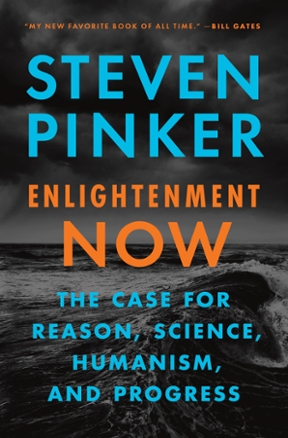
Pinker.jpgSteven Pinker’s Enlightenment Now is a 2018 bestselling book from the hand of a Harvard professor of psychology which triumphs the accomplishments of science, reason, progress, and humanism. The values of the Enlightenment, he says, have worked. We’re a better species for all of these intellectual developments, which have led to tangible improvements in all human society – longer lives, better healthcare, less violence, more education, broader knowledge, and more happiness. Critics have piled praise on this mega-seller. Bill Gates has called it his “favorite book of all time.”

Not everyone likes it. Pinker claims that liberal and conservative critics of his work alike are offended at his ideas and “really hate progress” (52). In fact, his critics don’t generally hone in on his pollyanna pronouncements. They focus on the fact that he attributes progress to an overly simplistic cause-and-effect relationship with the values that Pinker favors. The Atlantic calls attention to the fact that the scientific establishment upends the emotional attachments and longings of the hometown suburbanite (Gopnik, 4/18; also cf. Szalai, NYT, 2/18), but longing for traditional family isn’t one of the values that Pinker perceives to be contributing to human flourishing. Vox points out that the true challenges to Enlightenment Now are “reasonable points made by knowledgeable professionals about what one needs to prove to give a convincing account of the impact of the Enlightenment” (Hanlon, 5/18), professionals like David Bell, Princeton historian, who questions why Pinker doesn’t engage in any real analysis of Enlightenment thinkers. Rousseau, for instance, was one of the most popular Enlightenment thinkers and didn’t believe in the progress Pinker panagyrizes, and Enlightenment thinkers didn’t oppose religion the way Pinker says enlightened people must. The critics aren’t cynical. They’re rightly confused.

Me too.

My concern is a different one, speaking as a pastor and at least casual theologian. Pinker makes sweeping dismissals of anything he disagrees with, and does so with disregard for science and reason. He attempts to steal ethics from religion and hand it to science, despite the deplorably unethical uses to which science has been given historically, and his treatment of religion is exactly the kind of polemical, polarized nonsense that he is so critical of in the world of politics.

Pinker likes reason when it works for him and otherwise sets it aside – exactly the behavior that he so articulately chastises.

When it comes to ethics, there is a rigorous body of moral commitments which Pinker depends upon. However, it’s not entirely clear where they come from. “The moral worldview of any scientifically literate person – one who is not blinkered by fundamentalism – requires a clean break from religious conceptions of meaning and value” (477). So not from there. He tips his hat to the reality that science cannot make definitive ethical prescriptions either, but he seems to hold on to the hope. Elsewhere, Pinker has claimed that maybe ethics can be found in the nature of morality, because evolution produces progress (it doesn’t actually), which is of moral value because Pinker says it is (“Evolution and Ethics,” Intelligent Thought, 2006, 150). Omitted is any consideration of the fact that modern racism was propped up by scientific theories spanning from Charles Darwin himself through the well-educated scientists of the Third Reich. The problem here is not that the science was bad, but that the scientists were bad, and bad scientists will always use the tools of science to forward evil achievements. Science is ethically neutral.

Likewise, on the subject of religion, the optimistic professor says unequivocally, “There is no such thing as fate, providence, karma, spells, curses, augury, divine retribution, or answered prayers…” (477). Notice the deceptive grouping of the mainstream – answered prayer – with the not so much – spells. It’s like saying, “You know…science, with its gravity, evolution, aether, dark energy, leeching, feminine hysteria, Chernobyl, and Piltdown man.” More importantly, notice that he gives no reason, evidence, or science behind his claim. In a 2004 lecture to the Freedom From Religion Foundation, Pinker calls the Bible “a manual for rape and genocide and destruction.” He then goes on to say that he is not aware of any scientific enquiry into the claims of religion, and tries to account for the ubiquity of religion through a quirky, piecemeal explanation that leans on psychological vocabulary without doing any science.

So here’s the kind of scientific evidence I want Pinker to account for. Scientists study first-hand evidence right under their own noses and then account for it. Some time ago, I was leading a Bible study in a room of about 40 people. We were reading miracle stories from the Bible and asking if we should have similar experiences today. A friend of mine, a medical doctor, raised his hand and told me, “Jim, I think God is telling me to pray for someone.”
“Good for you,” I said. Pastors are supposed to encourage these things, but I didn’t know what to do with that.

“I mean right now,” he said.

“Oh,” I said. This is getting weird.

“Someone in this room has trouble clenching his left hand all the way,” he said. I had no experience in such things, and only knew them through televised fundraising charlatans. Fortunately, my thoughts were interrupted.

“That’s me,” said another guy at the back of the room. “I haven’t been able to close my left hand all the way for about 20 years.” He said it didn’t bother him much, and only hurt occasionally. I sent the doctor to pray for the man in the back of the room and made plans to sympathize when nothing happened.

The next day, the man with the injured hand called me on the phone. “I don’t know what to tell you,” he said. “My hand has been healed. Not only that, but when that guy started talking, I felt a warm sensation flow upwards from my feet through my whole body.”

Here’s the deal, Steven Pinker. Both of these guys are still friends of mine. Both can tell you the story. I’ll give you their phone numbers. A medical doctor is not a tribalistic anti-intellectual. Nor am I, actually. Nor are most Christians in America, though you seem to think they are. Furthermore, you can’t write this account off as lacking witnesses, because there was a crowd, nor coincidence, because the doctor described the situation before it happened. You can’t complain that the experiment is irreplicable, because it was, itself, a repeated test of former cases, the ones in the Bible.

The problem with Pinker’s book, and Pinker himself, generally, is that reason goes out the window on the subject of religion. Pinker claims that “we know” religion isn’t true. The problem is that there are Christians at his Harvard, and throughout the Ivy League, and not just among the student body – among the faculties. Neither John Lennox at Oxford, nor Alister McGrath at King’s College, nor Robert George at Princeton, nor Nicholas Wolterstorff at Yale, nor Michael McConnell at Stanford, nor Alvin Plantinga at Notre Dame, nor Martin Nowak at Harvard know that religion isn’t true.

They, like the values that you don’t subscribe to, simply don’t count.

Christian Persecution in 2019

The bombings in Sri Lankan churches that killed over 300 people, claimed by ISIS and said to intentionally target Christians in response to mosque attacks in Christchurch, New Zealand, bring a moment’s attention to a horrifying underlying trend.  The persecution of Christians around the world is at an all-time high.  According to Open Doors USA, a watchdog group:

  • 1 in 9 Christians worldwide experience high levels of persecution today
  • 345 Christians are killed each month for faith-related reasons
  • Christian women generally face the worst of it
  • China and India, the two most populous nations in the world, have bad records for human rights violations against Christians
  • Reported incidents of the persecution of Christians in the first half of 2019 are already higher than they were in 2018

The Wall Street Journal reports an exodus of Christians out of Egypt, as Muslim persecution of this minority grows, and the Christian population of Egypt in the last hundred years has shrunk from 15% to 9%.

Why the increase is a fair question.  Surely it doesn’t have to rise.  One would hope that as the world becomes increasingly interconnected, all forms of persecution would wane.  An increases worldwide speaks of a trend, and trends have causes.

I have a suggestion.

The world of philosophy and its ideas are hotly contested in the University.  Some people think of it as nothing more than intellectual banter, but history says otherwise.  Ideas propagate themselves from the University and through a culture, and ideas lead to actions, belief spawns behavior.  Marx’s ideas about the oppression of workers in the wake of the Industrial Revolution led to the birth of new political regimes and the deaths of hundreds of thousands in the hands of tyrants.  What started as philosophy made its way to warfare.  Likewise, Darwin’s concept of the survival of the fittest profoundly influenced Frederick Nietzsche, who chided Christianity for protecting the weak.  The weak should be put aside, he said.  Only power and genius should be allowed to thrive.  Nietzsche’s sister, Elizabeth, took over his estate as he fell to mental illness, and she promoted his works.  As Nietzsche’s praise of power was taught in the German universities, the Nazis would take it on wholesale as an ideology.  Nietzsche’s work was so influential on the Nazi regime that Hitler attended Elizabeth’s funeral.  They agreed, the weak should be put aside.  There are dozens of other examples of how ivory tower ideas later carry worldwide influence.

Now, what have philosophers and academicians been saying about Christianity recently?

After the Sept. 11, 2001 terrorist attacks, a group of boisterous and condescending intellectuals began propagating atheist literature in the public sphere.  They had absolutely no new ideas to promote – most of their work was panned by their peers.  What was new was the absolute ire with which they approached their subject.  There has rarely been such a concerted mockery of religious people as this circle put together.

Richard Dawkins, an Oxford professor, has been perhaps the most sardonic.  He refers to dawkinsthe God of the Bible as “the most malevolent bully in all of fiction” and he calls religion “a kind of mental illness.” He says God is “about as likely as the tooth fairy.” Anyone who has been to a secular American university knows that these types of taunt are taken up wholesale by the average sophomore, and Christian students are often mocked into a defensive silence.


It’s been over 12 years since Dawkins began his public attack on religion.  It’s been reported that his book has sold over 3 million copies, relatively small for the planet’s population.  However, the unofficial Arabic pdf of the book has been downloaded 13 million times.  (Arabic is the language of the Quran.)

Now, one could suggest that the book’s popularity in Arabic comes from a number of different impulses – curious, defensive, etc. – none of which have to do with the persecution of Christians.  But I want to suggest that there is a growing side effect of the treatment of Christianity in the American University.  As the American culture becomes visibly less supportive of its religious bodies, those who see Christianity as a rival become all the more empowered to act out against it.  If Christianity is ridiculed in America, it’s unlikely that the financial strength of America’s institutions is likely to be leveraged to make a difference in its defense overseas.  Furthermore, according to the Associated Press, church membership in America had dropped over the last two decades from 70% to around 50%.  There are simply fewer Christians pleading and speaking out for their brothers and sisters who are minority groups elsewhere in the world.  Here, Christianity remains an open target of public ridicule in a way that other religions are exempt from.

If the public voices of the University consider Christianity a fair and easy target for mockery (and no, they don’t give equal time to insulting Islam and Judaism), it’s easy to see that those will be propagated through the culture and ultimately be expressed in the form of action, specifically, action against Christians.  A dozen years of vicious attacks on Christianity may be paying off in the form of growing persecution.

Given its general uselessness as a contribution to intellectual exploration and inquiry, it might be fair to ask whether the open mockery of Christianity coming from public intellectuals ought not to be considered hate speech.  That seems the most apt description.

Kyo

E69599.png
Kyo

It’s not news that the Christian church is not proliferating in Japan.  It’s less than half a percent of the population.  There’s an interesting phenomenon in the Japanese language that help accounts for this.

In Japanese, a religion is named with the title of that religion, followed by the suffix pictured here, pronounced “kyo” (rhymes with crow).  So Christianity is “Curisoto-kyo.”  Islam is “Isulamu-kyo.”  Literally translated, it simply means “teaching,” but as with many words, there is a nuance not captured by the strict definition.

The nation of Japan is not religious in the Western sense.  They may offer worship to idols or ancestors, loosely grouped under the title, “Shinto,” but Shinto has no clearly defined doctrines.  When the Japanese talk about religions, they are generally referring to ideas from outside.  And when they think of such things, they still discuss the 1995 subway gas attack that killed 13 people and poisoned thousands.  The leader of that attack was executed this summer.  The name of that cult was Shinri-kyo.  “Kyo” has subsequently come to imply “cult.”  Because Christianity falls under the same broad umbrella of religious teachings, it too now bears a suffix that implies “cult.” Everyone in Japan has heard of the gas attacks.  Less than 1% of the population is Christian.  But when Christianity comes up, it’s immediately branded as related to the gas attacks.  No surprise that it’s not catching on.

A word to wise Christians in America: guilt by association is a real thing.  If Christians generally associate with unloving power-mongers who are more interested in politics that loving the lost, don’t be surprised when no one wants to talk to Christians any more.  At that point, the faith might as well be branded “The Christian Party,” because the suffix captures exactly how it’s thought of.  In America, there is a real risk that people may come to think Christianity is just a political slate that claims to have fallen from heaven.

That’s simply not what Jesus came to build.  He wasn’t out to create political power structures to shelter the fearful.  The teachings of Jesus (Jesuskyo?) are all about surrendering in the name of love.  The more his followers do so, the more likely Japan and the rest of the world are to see Christianity stand apart from cultish shadows.

Disciples and customers

The critical decision that the modern church must make is whether or not to raise up disciples or customers.  The results will be very different.

You can have a very big church filled with customers.  Appeal to the expectations, calm every complaint, give the old guard what they want, and appease the donors.  This can generate a gathering of satisfied church-attenders who bring their friends, promising them a similar customer-satisfaction experience.

On the other hand, a church can create disciples.  This necessarily requires telling peoplehqdefault.jpg that they can’t have what they want, that Jesus’ call is to take up your cross and to die to yourself.  A church in a frenzy of attracting customers can never deliver a message like this.  A church that delivers a message like this will never attract customers.  But it is fundamentally the road to discipleship.  Churches that create disciples define their purpose by their mission, not by the whims of their shareholders.

The result of a disciple-making church is a most likely initially smaller but impassioned group of people who are truly committed to the mission of Jesus in the world.  But when a gathering of people takes Jesus’ mission to heart, they become an unstoppable force for the kingdom.

The leadership of the church just has to decide at the beginning, when the groundwork for the church is being laid: customers or disciples?

JerkBook

An Observation
There is a place to which the kingdom of God has not extended in the American church, unnamedand that is Facebook.  Christians seem to think that though God can probe our deepest thoughts, he can’t read our online accounts.  Facebook is to Christians what a long stretch of empty highway is to a compulsive speed-demon, that is, the one place where the authorities can’t see you get away with it.

Except on Facebook, everyone sees it.  I once talked to a man who wouldn’t even consider church because, he said, he looked at what Christians had written on Facebook.

When Jesus says things like “love your enemy,” “turn the other cheek,” and “bless and do not curse,” those commands actually extend not only finally but firstly to our casual daily interactions that seem virtually insignificant.  Those teachings extend primarily into the mundane.  I look at Christians’ Facebook pages that are a long string of insults of political figures, divergent ideologies, and other religions, and I wonder what they’re trying to accomplish.  No one is converted by hatred.

Facebook is a center for childish gossip among those who claim to believe that action without love is just noise (1 Cor. 13).  I once confronted someone about gossip and he told me I just had a different definition of gossip than him.  Going around and talking about what you don’t like about an individual is gossip, no matter why you feel justified in doing it.  We may think a political figure is a viable target, but an intelligent and kind-hearted follower of Jesus should know how to critique a political position without spewing venom. When we talk about our enemies, we are still required to speak in love.  If you don’t love, you don’t know God (1 John 4:8).

fbA Challenge

Scroll back through your Facebook page and ask yourself a question about each recent post.  “Does this show that Jesus loves a lost world?” (Do this on your own social media accounts, not on someone else’s.)  And maybe as an act of holy worship today, you need to delete some of the junk you shouldn’t have posted in the first place.

A Disclaimer

You get a pass for pictures of food, cats, Star Wars memes, and so forth. ; )

Life Without God

AdamBefore we commit to something, if we’re wise, we weigh the consequences.  Before we take a job, we consider the pay, the hours, the benefits, the commute, the effects on our families, and the relative enjoyment and fulfillment we will find in it.  Sometimes we take one because we’re desperate, and anyone who has done so knows about how well that works.  When we date and marry, if our friends are wise, they ask us if our romantic interest is good for us, if they’re fun, if they fulfill us, if we can see ourselves with them over the long haul.  We’re often too enamored to ask these questions ourselves, but this is what the voice of wisdom would say.

It concerns me that there is another decision which the bulk of the population makes wholesale without wise consideration of the consequences, and that’s the decision to live life without God.  Whether by tacit negligence of explicit rejection, we choose to do life on our own terms without God.  I wonder how that decision might go if we weighed the consequences as we do with a profession or a partner.

No Origin

Without God, we come from nowhere.  We are not designed.  We have no purpose.  When we talk about living a meaningful life, we really can’t mean “meaningful” in any traditional sense, because without an origin, we aren’t made for a purpose.  We are, in stark terms, an accident, blindly wrought by inanimate forces of nature, a marionette of physics.  If we were sensible about this, we would never have reason to get out of the bed in the morning, because there is nothing for which we are made.

No Destination

Similarly, we’re not going anywhere.  From the dust we come and to the dust we return.  As a result, there’s obviously no goal.  Again, meaning must be crucified as a twisted prank of evolutionary forces.  The most basic of purposes – making the world better – is a stupid waste of time.  The world is going to perish in the eventual heat death of the universe, long after human life is gone, with no one left to remember it or appreciate it.  Self-awareness will have been a cruel mistake.  Raising our children is an arbitrary pastime.  Accomplishments are trophies thrown in the fire.  With nowhere to go, we have absolutely no reason to live.

No rules

Realize the tectonic implications for politics and ethics.  Any rules we have to govern human life are arbitrary constructs.  Might does make right, by sheer virtue of the fact that no one else can.  Values like civility or fairness or justice are tools of power for the manipulative to use to force a gullible (and religious) lower class into behaving and working to produce luxuries for the rulers.  Voltaire was right – if there is no God, he must be invented to keep the peasants in line.  Nietzsche was right – if there is no God, values are the whims of the strong.  If there is no God, the only real morality is anarchy, and complex political systems to reign that anarchy in are just stalling techniques to help the rich die in peace.

Without God, the obvious consequence is that we have no past, no future, and a horrible present.  This in no way proves that there is a God, it simply, and wisely, lays out the consequences of casually ignoring the possibility that He exists.