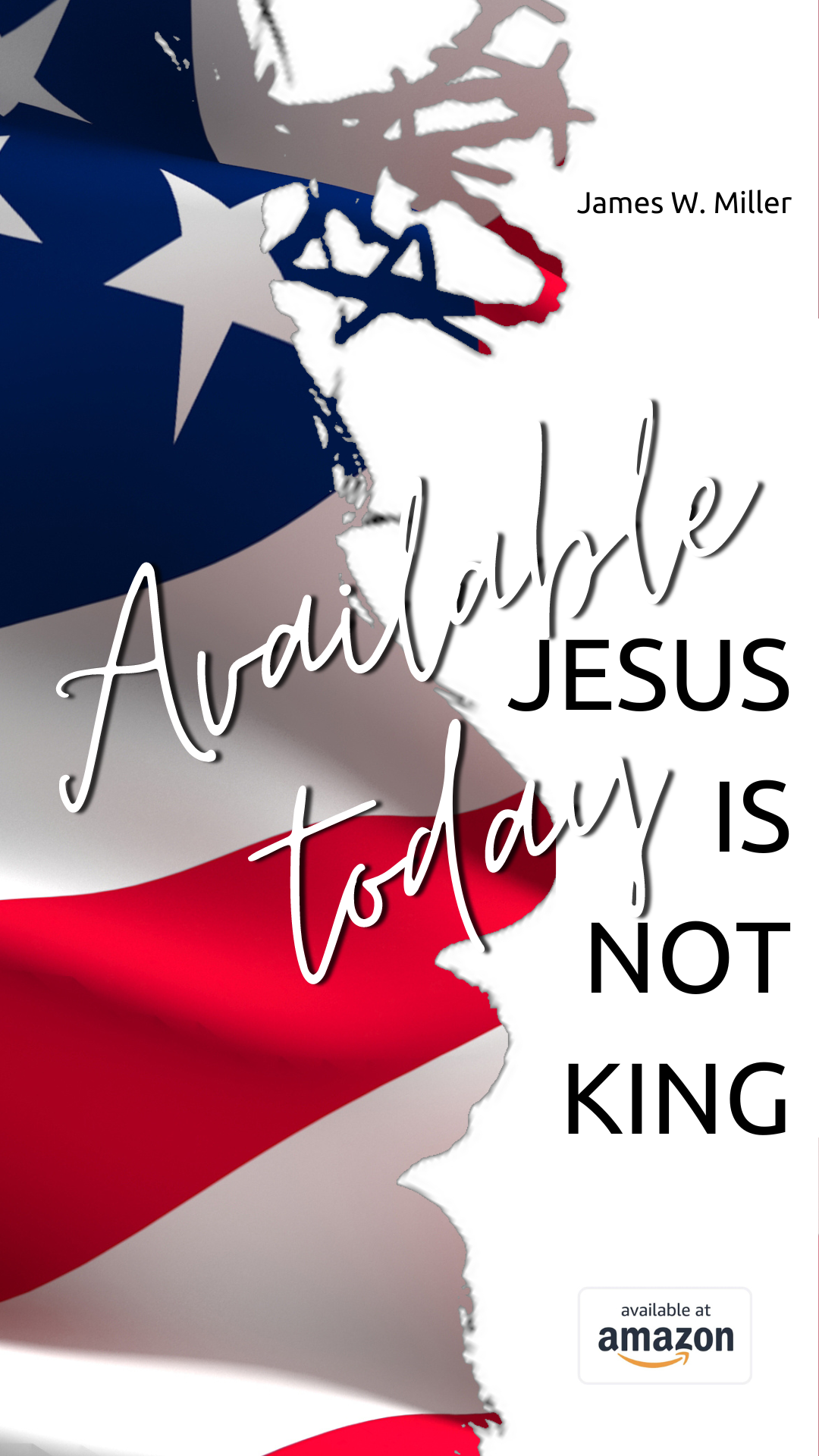
The premise of the book is that Christians for 2000 years have been trying to put Jesus in a position that he rejected. They tried to make him king by force (John 6) to depose Herod and expel Rome. But Jesus was not trying to be a king governing with earthly power and military might. His goal was to win hearts.
In an election year, many Christian voters have been lulled into the belief that if only they can vote someone into power who will represent their moral views, they will be freed from the hard work of ministry and discipleship. The mess of the 2024 political scene is proof that we’ve gotten it wrong.
In this book, I propose an alternative role for the church in modern politics – to reclaim the prophetic voice that is more loyal to truth than to party, more committed to righteousness than power. Jesus is the King of Kings, but it might not be the king we
Not too many years ago, one of the primary condenders for the presidential election was a Mormon, today one is a Hindu, and there are elected officials who, presumably, could run for highest office and who are Muslims. The Hindu candidate has said repeatedly that it matters that there is a God, and he recently tweeted, “We share a common creed.” The problem I have with the ecclesiastical melting pot is that whether you look at this in terms of philosophy of religion, history, ethics, or sociology, we’re not talking about the same God, and that really matters.
This comes as a counter-intuitive shock to the average Joe who assumes all religions go roughly in the same category, the way apples, bananas, and apricots are all in the same row of the grocery store. Pick your favorite flavor; they all serve a related nutritional purpose. But no one who actively practices a faith and knows a good deal about alternate faiths thinks this way. Similar does not mean the same.
It’s like this. Two people might compare notes about their childhood experiences. One says, “When I was a kid, there was this guy in the house who was always there, and we called him ‘Dad.'”
“My house too!” her friend responds. “We had a guy like that and we called him ‘Dad.’ Maybe it was the same guy?”
“Well,” says the first, “my dad provided for me and wore out-of-date clothing and thought his jokes were all funny.”
“Mine too! We must be talking about the same guy! Isn’t that amazing? We have the same dad!”
“Well,” the first one continues, “my dad taught me that when someone does something wrong to you, you should love them anyway.”
“Oh,” says the second, a little bit mystified. “My dad told me that when someone does something wrong to you, you should punch them in the nose.”
Similar doesn’t mean the same. This also applies in matters of faith. Multiple faiths may talk about a God who created the world, who dictates principles for living, and who will be our judge in the end. But that doesn’t mean a shared identity; that only proves similarity. If one God tells you to love your enemies and another one tells you to get revenge, you are talking about different personalities, different “parents,” different gods.
Average Joe in the produce aisle may still not care about this. He’s going to pick his favorite fruit and leave you alone when you pick yours. Likewise, he’s going to care very little about the fruit preference of the person we elect president of the United States. The rub here is that gods dictate ethical norms the way parents set rules in the home. Not all gods have the same personality, and consequently, they do not share the same set of ethical principles.
Christianity is a faith that teaches the ultimate dignity and worth of every individual, regardless of their level of accomplishment, their intelligence, their moral uprightness, their able-bodiedness, and any other category into which we want to parse them. Jesus loves us all. America still enjoys the residue of a culture largely influenced by the teachings of Jesus. If you have a heart-to-heart conversation with someone who has been simmering in Confucian ideology, you find that there are sticking points at which you simply don’t share a common worldview, particularly as it concerns ethics. I invited a friend who was new to America to serve at a homeless ministry some years ago. They had never seen one before. They asked with incredulity, “You give all these groceries away for free?” They had been taught that if you gave your things away, there might come a time where you would not have enough for yourself, and you would starve. Those who have truly imbibed the values of Jesus believe that we should give to all who ask, that God can rain bread down from the sky, that we who sacrifice will receive much more in this life, and in the life to come, eternity.
In fact, it was on the basis of theology that the founders in America crafted some of the ethical mores which they prescribed. When Thomas Jefferson argued that there were unalienable rights bestowed by a Creator, he was borrowing from the British philosopher John Locke. Locke had argued with extensive citation from the Bible for the freedom of religious practice and liberty for the people. There is a direct line from the teachings of Jesus to Locke to Jefferson, and thus to the governing principles of America. In fact, one of the harshest critics of American independence from the monarchy was another British philosopher named Jeremy Bentham. Bentham was an atheist. He refered to the rights of dignity and freedom of each individual as “nonsense on stilts.” The nonsense was the idea that indivuals deserved freedom, and the stilts was the theology upon which such values were based. As an atheist, he believed only in doing what is best for the greatest number of people; sometimes the minority had to be overruled or ignored.
So put in place a leader who believes in a territorial god who advocates violent self-defense and ultimate conquest and you have the makings of a dictatorship. Put in place a leader who believes that the ultimate goal of humanity is to lose one’s identity to be subsumed into something universal, and you have the makings of something more negligent. Put in place a leader who really believes in Jesus, and you should have the makings of a nation which upholds the belief that every human being is of ultimate worth, that our country should do what’s best for everyone in the world so much as is possible. Gods create ethical systems. The objects of worship our elected leaders revere are not inconsequential.
Of course, if history is any indicator, we can rest assured that a generally blasé approach to faith and a hypocritical approach to ethics is all we will ever get from our politicians, so we needn’t worry too much nor get our hopes up. God is going to be a distant Creator who bestows only loosely prescribed unalienable rights, and nothing more. When it comes to the religious beliefs of our leaders, you say tomato, I say tomato.



 Hardwired