
Looking at Gustave Dore’s “Jesus Preaching on the Mountain” (1865), an oil painting of Jesus giving the Sermon on the Mount, and it suddenly occurs to me I know what Dore was thinking about. The image is of Jesus in front of a crowd, index finger on his right hand extended heavenward.
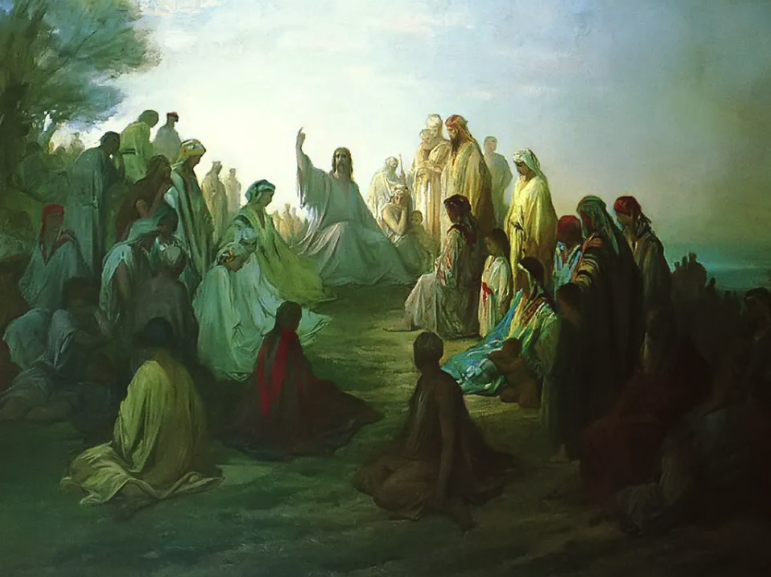
Take a close look at the posture of Jesus:

Now tell me if that doesn’t bear a striking resemblance to this guy:
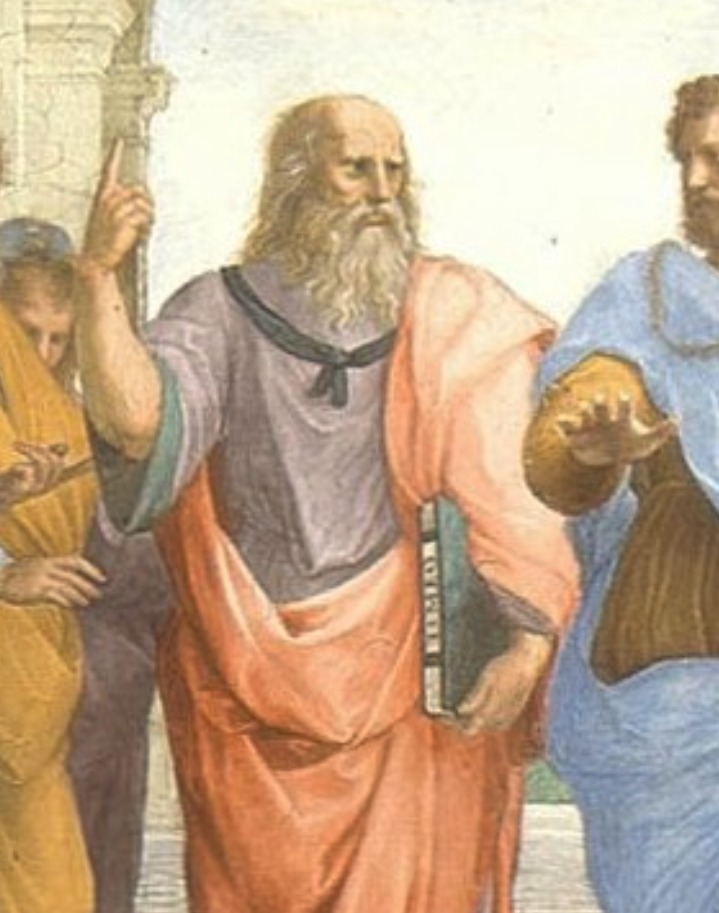
That’s the Greek philosopher Plato as he appears in Raphael’s “School of Athens” (1511). Plato is holding a copy of his own dialogue, the Timaeus, a distinctly theological work in which Plato writes that the order and the structure of the universe are the product of a creative and intentional mind of a craftsman. It is a work that early Christians globbed onto as a philosophical precursor to revealed faith and proof that they had the answers the world needed.
Now pan back and look at the whole of the “School of Athens,” and compare the structure of the painting to that of Dore’s work.

The paintings are both horizontally bisected by the heads of the main character(s) and the crowd around them. The crowds line both sides of the central figures attentively, while others sprawl on the ground up ahead of them.
I think Dore borrowed the composition of his painting. However, it wasn’t for simple pragmatism nor merely allusion or homage. He’s telling us something philosophically.
Plato, who lived 400 years before Jesus, speculated about the nature of the universe and its Creator. He deduced that there were universal truths or principles grounded in a unifying source of the universe. Dore, a lifelong Christian who created a celebrated illustrated Bible finds the conclusion to Plato’s ponderings in the person of Jesus. Jesus speaks of a heavenly Father who was incarnate in Jesus himself, the ultimate revelation of the mysteries at which the philosophers could only wonder.
Good message for us! Should we have the sense that there is an order-making, intelligent mind that brought the beauty of the universe to be, we might consider that Jesus knew exactly who it is that we are looking for. And in the Sermon on the Mount, Jesus tells us what the world, guided by this Creator, should look like.
 Hardwired