
Where are you right now? Sitting quietly in a church? Residing peacefully in the San Gabriel Valley or thereabouts. Where you are is a matter of perspective. The earth rotates on its axis, spinning a circumference of 25,000 miles every 24 hours. Meaning that you’re travelling over 1000 miles per hour. We’re going that way (east). You guys are headed right for me. Additionally, the earth is orbiting the sun, so even if you sit right there until tomorrow, you’ll be somewhere else. And if you follow these thoughts out, you’ll come to discover that time isn’t going at the same speed for every place in the universe. I learned all this from Einstein, who, as far as I can tell, makes more sense to artists than engineers. All that to say, you’re not where you think you are.
Now figure this in. Psychology is a science that is still in its infancy. We’re still exploring all of what psychology has to reveal. But one of the big milestones in our self-understanding as the human animal came when Freud and his ilk showed us that our deepest motivations can be shaped by things our parents did, repressed memories, biochemistry, drives and desires that we don’t have complete control over. Where you are right now, in the more subjective sense, is in part determined by things you’re not even aware of.
Plus, things happen in your life before you know they’re going on. You don’t find out someone has lied to you the minute it happens, only later. Someone may have lied to you already, and that lie may be damaging you right now, and you don’t know it. We don’t find out we’re sick the minute the cells mutate, only later. You could be sick right now.
Spiritually, Jesus would say that we are in motion as well. He says that many, many people are headed through a wide door that leads to destruction, and only a few are headed through a door that leads to life. We right now are most likely growing closer to or further away from God, even as we sit quietly and still.
Where are you? Do you even know?
Here I am, we say confidently. I am educated or employed or married or befriended. But the truth is that we don’t always know where we are.
I remember visiting a man in the hospital when I was a chaplain, many years ago. He was weeping. He told me he had lost his Corvette, and then his house, and then his wife, and of course his insurance, and now his health. Everything was spiraling. And there was a time in his life when we was saying, “Here I am. I’ve done it exactly the way I wanted. Made the money, got the girl, built my empire.” But where he was going was not in his control.
Here I am, we say, but we don’t know where we are. Confidence is always a game.
Some people say faith begins when you decide you believe in Jesus. Some people say it begins when before you even know God is there, because he chooses you before you choose him. I think true faith begins when we admit to God that we don’t know where we are.
Genesis 22: 1 Some time later God tested Abraham. He said to him, “Abraham!”
“Here I am,” he replied.
2 Then God said, “Take your son, your only son, whom you love—Isaac—and go to the region of Moriah. Sacrifice him there as a burnt offering on a mountain I will show you.”
3 Early the next morning Abraham got up and loaded his donkey. He took with him two of his servants and his son Isaac. When he had cut enough wood for the burnt offering, he set out for the place God had told him about. 4 On the third day Abraham looked up and saw the place in the distance. 5 He said to his servants, “Stay here with the donkey while I and the boy go over there. We will worship and then we will come back to you.”
6 Abraham took the wood for the burnt offering and placed it on his son Isaac, and he himself carried the fire and the knife. As the two of them went on together, 7 Isaac spoke up and said to his father Abraham, “Father?”
“Yes, my son?” Abraham replied.
“The fire and wood are here,” Isaac said, “but where is the lamb for the burnt offering?”
8 Abraham answered, “God himself will provide the lamb for the burnt offering, my son.” And the two of them went on together.
9 When they reached the place God had told him about, Abraham built an altar there and arranged the wood on it. He bound his son Isaac and laid him on the altar, on top of the wood. 10 Then he reached out his hand and took the knife to slay his son. 11 But the angel of the Lord called out to him from heaven, “Abraham! Abraham!”
“Here I am,” he replied.
12 “Do not lay a hand on the boy,” he said. “Do not do anything to him. Now I know that you fear God, because you have not withheld from me your son, your only son.”
13 Abraham looked up and there in a thicket he saw a ram caught by its horns. He went over and took the ram and sacrificed it as a burnt offering instead of his son. 14 So Abraham called that place The Lord Will Provide. And to this day it is said, “On the mountain of the Lord it will be provided.”
15 The angel of the Lord called to Abraham from heaven a second time 16 and said, “I swear by myself, declares the Lord, that because you have done this and have not withheld your son, your only son, 17 I will surely bless you and make your descendants as numerous as the stars in the sky and as the sand on the seashore. Your descendants will take possession of the cities of their enemies, 18 and through your offspring all nations on earth will be blessed, because you have obeyed me.”
Abraham was a man surrounded by pagan religions and false gods. Widely worshipped in the ancient Mediterranean world was a god known as Molech, the god of fire, often pictured as a bull. Molech was an angry god, and it was believed that he had to be appeased with sacrifices to stop him from sending droughts on the crops or storms on the seas. Huge shrines were built to Molech, statues, with a fire at their base. In the chest were built seven doors, ovens into which were placed offerings: a goat, a bull, a bag of grain, a dove, a sheep, a ram, and a human child. Molech demanded everything. They believed that in giving up their own they would be forgiven for whatever they had done. They would stand around the burning statue and chant, “We are not men, we are oxen!” In 1921, a cemetery was uncovered in Carthage Greece, which had an inscription that read MLK, Molech, and in the cemetery were found the remains of animals and children by the thousands. Abraham would have seen these worship services.
But Abraham had a different God. His God called him to a new home and promised him that he would one day have as many children as there are stars in the sky. The Hebrew Bible is clear, “Do not give any of your children to be sacrificed to Molech, for you must not profane the name of your God. I am the LORD.” (Lev. 18:21) For the rest of the Bible Molech is referred to as the detestable god.
Abraham followed God’s call. And everywhere he went, he profited. He stopped one place and someone gave him flocks. He stopped somewhere else and someone gave him land. Abraham was getting rich. And he must have thought, “Here I am. I’ve got it all together. God is on my side, I’ve got it made, maybe it’s time for a Corvette.”
And Abraham had a son, a son that he loved, Isaac. Isaac was the miracle child. He would have been so proud. In the community you can imagine that they stopped calling him Abraham and started calling him “Isaac’s dad,” which he would have loved.
Then one day Abraham was living in the hill country, in the lands that would one day be called Israel and belong to one of his descendants. And God called and said, “Give me your son.” And you can imagine the agony of a father betrayed by a god who had seemed so good. And everything in him must have reeled. This God who had given him everything would now take it away. “Go to Mt. Moriah and sacrifice your son to me.”
And Abraham gave up everything. He gave up his will to decide for God. He surrendered everything to the god who had seemed to be so good, believing that God must somehow know what he was doing, despite the horrible call.
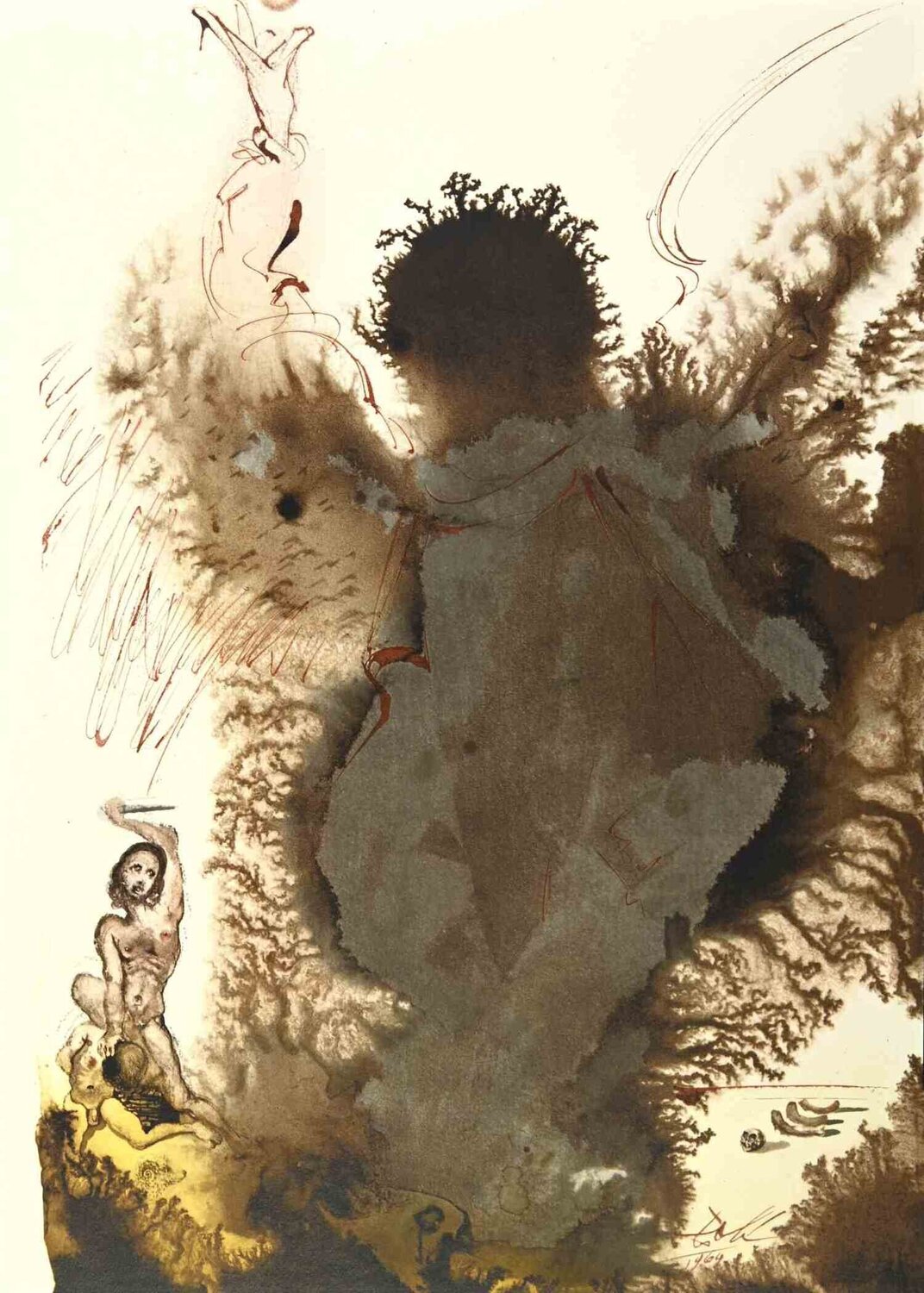
My favorite artistic rendering of this story comes from Salvador Dali, in a painting entitled “Abraham, Abraham!” Because Abraham is not the center of the picture. Abraham is small, distant, and decentered. The back of the angels overwhelms the center of the page. The story is not about Abraham. The story is about God. God who steps into the middle of Abraham’s life, knocks him out of the center, disorients him. Dali understood the story.
This God, we find, is a good God. A God who passionately loves Abraham. He will even show Abraham that he will never take from him what he has promised.
Abraham says in verse 1, “Here I am.”
And God says, “No you’re not! Get out of the center of your life! Never rely only on yourself. You cannot make it in this world without me. You would have nothing without me! But see who I am! I am the god who loves you! I am not Molech and I will not take your children!”
But only when Abraham has experienced the sacrifice of his own will, has experienced this God for who he is, can he say rightfully, in verse 11 “Here I am.”
After that, Abraham was not known as the father of Isaac. He was known as the father of faith.
God has to disorient us to set us straight.
Only when we give up our wills for his do we know where we really stand in the universe.
As my kids would lie in their crib, they learned that they could cry out, and mom and dad would come running, and faces would appear above and around the crib, looking down at them. And from where they lay, they must have felt like the center of the universe.
As they got older, they found friends. But if you read Piaget’s descriptions of children’s conversations, you will learn that when children talk, they don’t primarily talk to share communication, they primarily talk just to be heard. Because they believe themselves to be the center of the universe.
There are adults who have never stepped out of that worldview. “Here I am,” we can say confidently, “I’ve made myself who I am.”
Faith begins at that moment when we surrender the center of the universe to God. We can’t go there, our families can’t go there, our work can’t go there. If you want to live life right, you have to put God in the center.
You know, there’s a funny thing about that hill country in which Abraham lived. No one knows exactly where it was, but it is believed to have been somewhere outside of modern day Jerusalem. There’s another hill there, called “The place of the skull,” because there appears to be a skull in the side of the hill. It would not at all surprise me if, in the poetry of God, it was the same hill.
Because there another son was called to be sacrificed, bound and surrendered. But this time, God himself would take the place of humanity’s sacrifices. God himself would put himself in the place of people who could not be forgiven without sacrifice for all that they had done wrong. In that moment, humanity would decenter God. Humanity would refuse to let God walk among them or lead them. Humanity would reject God and instead have him tortured and killed. And God, hidden quietly in human form, would go willingingly. It is at this moment that God would say, “I am the God of love! I will not require sacrifice from you! I will spare your children and take their place in the fire. If only you will believe in me.”
We have to be disoriented in order to be set straight.
Our sins decentered God. Your decision to surrender to Jesus puts him back.
Christians sometimes act like all we have to do is sign on the dotted line that we believe and then back to life as usual. “Here I am,” we say. “I’ve got life all figured out now, and I’m going to heaven, so off I go to spend my life making money and being comfortable.”
Don’t go on with life. Make him the center.
I talk to college students who go off to school and tell me they don’t go to church anymore because they can’t find one they like. And I tell them, “Then you chose the wrong school! Because the most important thing that happens to you in college is not that you get a degree so that you can get a job, the most important thing that happens to you is that your faith matures into adulthood!” We don’t know where we are until we surrender to God.
I talk to people with busy and important jobs who get a lot done and who don’t have time for church. And I ask them, What will it profit you if you gain the whole world and lose your soul? Because we don’t even know where we are until we surrender to God.
I knew a man who sat in church and week after week with tears quietly rolling down his face. And when the Pastor finally asked what was wrong, he said, “All the wasted years.”
Step out of the center of your life! Because the God of love has walked among us. He has died for us. He will never take away our children the way the office god does in late night hours and weeks away. How could we not have the humility to surrender the center of our lives to the one who really belongs there.
This is Jesus. Believe. And don’t just believe. Surrender. Because only when you do can you know yourself well enough to say, “Here I am.”
 Hardwired