
Blame, Charlie Kirk, and Jesus

We live in a culture addicted to blame. It happened this summer when floods in central Texas killed over two dozen children. Questions began before the waters receded about whether the owners of the camp were negligent. Once upon a time, such natural disasters were written off as “acts of God,” presuming no human liability (though still strangely blaming the Big Guy). We now seem bent on finding fault.

Recently, I’ve watched blame be cast like a net over whatever group an individual might represent – a political party, the mentally ill, a gender, a race, an ideology, or a religion. We used to call this prejudice and bigotry. An intelligent person could distinguish an individual from a group. Pointing to the worst case was understood to be a straw man that was avoiding dealing with the best case, or even the average case. For some reason, a cross-section of Americans now defend broad-brush demonizing.

The History of Blame

It didn’t used to be like this. About a lifetime ago, there was a dramatic shift in the way legal cases placed culpability. Through the 1800s, if you were hurt by a product or service, it was generally your problem. The policy of caveat emptor reigned – buyer beware. In the wake of the Industrial Revolution, a suspicious eye turned towards companies and their wealthy magnates. A decisive case was the 1916 MacPherson vs. Buick Motor Company, where the New York Court of Appeals allowed a man who had been injured by a defective wheel to hold the company liable. Thereafter, contracts were no longer required to prove culpability.

A court ruling in the 1960s then declared that companies could be held liable for defective products even if they hadn’t been negligent.

By the late 20th century, lawsuits abounded – asbestos, medical malpractice, tobacco, and even spilt hot coffee. Blame snowballed. Blame was a multi-billion dollar industry.

Modern neo-liberal, post-civil-rights-era activists and thinkers, particularly in elite universities, have advanced blame to the ideological realm. The recognition of ancestral land ownership, the tracing of longstanding structural inequities to a modern beneficiary, the attribution of explanation for crime to structures rather than individuals, the attribution of health issues to a food industry rather than choice – all of these are modern manifestations of a blame culture stretched to ambiguous ideological grounds. They bring out the wounded and the disingenuous capitalizers alike.

The Spirituality of Blame

Jesus said, “What you loose on earth, you loose in heaven.” When we loose a culture of blame on the earth, we invite a spirit of blame to take spiritual power over our society. I believe we are there.

In the wake of the assassination of Charlie Kirk, blame is an odd thing. The person who shot him was clearly responsible. Given a cogent, functioning mind, that person’s ideology must have been the motive. The culture that created his ideology seems to be the garden that grew it. There must have been gardeners.

But the eagerness to blame Democrats, liberals, or what have you for a violent culture will only go so far. Who murdered Democratic Representative Melissa Hortman? What motivated the shooter in the Buffalo shopping mart? Who has been responsible for abortion clinic bombings and LGBTQ-directed violence in America? The extreme right blames the extreme left and vice versa. The common thread is extremism.

A Way Out

Today, I’m inclined to turn the spirit of this age back on itself. The blame goes to a seething culture of blame. Polarization is a product of the extremes pulling us away from the middle, pulling us away from dialogue and communication. In this landscape, the enemy is clearly “over there” with the guilty and can be attacked from a distance. We need not find common ground – we retreat and leave scorched earth behind us.

One of the things I like best about Jesus of Nazareth is that he was always on the bad guys’ side. When the religious right formed a rock-throwing hoard, Jesus went and stood by the woman caught in adultery. When the nationalists gathered to evaluate Jesus’ loyalty, he went and had lunch with the traitorous tax collector, Zacchaeus. When zealots sought to kill Roman sympathizers and Romans sought to kill rebels, Jesus put Matthew the Roman-employed tax collector and Simon the Zealot in his inner circle of twelve. When he could have been a member of the Sanhedrin, Jesus was counted among sinners. When Creation staged a rebellion against its Creator, Jesus incarnated among the Creation.

Jesus of Nazareth didn’t seek to destroy us when we became his enemies. He sought to win us back. When we crucified him, he did not flood the earth and wash us away. He began, one by one, to win us over to his side. He also didn’t tell us to destroy our enemies. He showed us how to convert them. When I realize what he did for me when I hated him, I can do little more than bow and submit to his Way. It is the way of acknowledging my own guilt rather than finding a group to scapegoat. And rather than throwing rocks, I seek to stand alongside the sinful and broken the way he stood alongside me, with the hope we will forsake sin.

America has submitted itself to a spirit of blame, and we are spiraling in it. Peace will not be found by finally driving out one end of the political spectrum. It will be found by exorcising the spirit of the age and choosing grace instead.
On Political Violence

This is what I told my church this morning:

You all know that yesterday there was an assassination attempt on a former President of the United States. This is a tragedy for our country, both for the loss of life of an innocent spectator in the crowd, but also for the turmoil it both stems from and creates in our culture.

There is no place for violence like this in American society. It serves no purpose and does no good. It’s evil. Violence of any kind is evil, and this prominent display of it simply spreads fear and anger in a culture desperately in need of peace.

I began this year with a preaching series about living a life of dedication to Jesus and talked about how important it was for us to live a life of faith. I said several times that I anticipated that this would be a hard year, particularly given the political climate. I then began a teaching series about the Sermon on the Mount, the ethical teachings of Jesus. This wasn’t just an idle curiosity; I anticipated that this year we would need to be reminded of the kind of lives that followers of Jesus are called to.

In the Sermon on the Mount, Jesus tells us that not only is it the Law of God that we should not murder, but we should not even hold onto anger towards someone, not even call them a fool. He told us that the old law was an eye for an eye and a tooth for a tooth, but his teaching was that we should love our enemies and pray for those who persecute us. If someone slaps you on one cheek, turn to them the other as well. If someone sues you for your coat, give them your shirt. If someone forces you to walk one mile, walk two with them (Mt. 5). He concludes his ethical teachings by saying, “Do to others what you would have them do to you, this sums up the Law and the Prophets” (Mt. 7).

Followers of Jesus are bound by duty to do what Jesus says.

When others respond with hatred, we respond with love.

When others try to stir up anger and anxiety, we preach peace.

When others respond with blame, we respond with grace.

We debate because truth matters, but we don’t demonize. It would be wrong for followers of Jesus at this moment in our society to stoke the flames of anger and revenge. This is a time to agree that we would all be better if we sorted through our disagreements and differences in worldviews with a fundamental commitment to the fact that God made us all, God loves us all, and God seeks to redeem us all.

We are united in our humanity; let’s unite in a commitment to peace. Amen.

Jim Miller, Real Life Church of LA

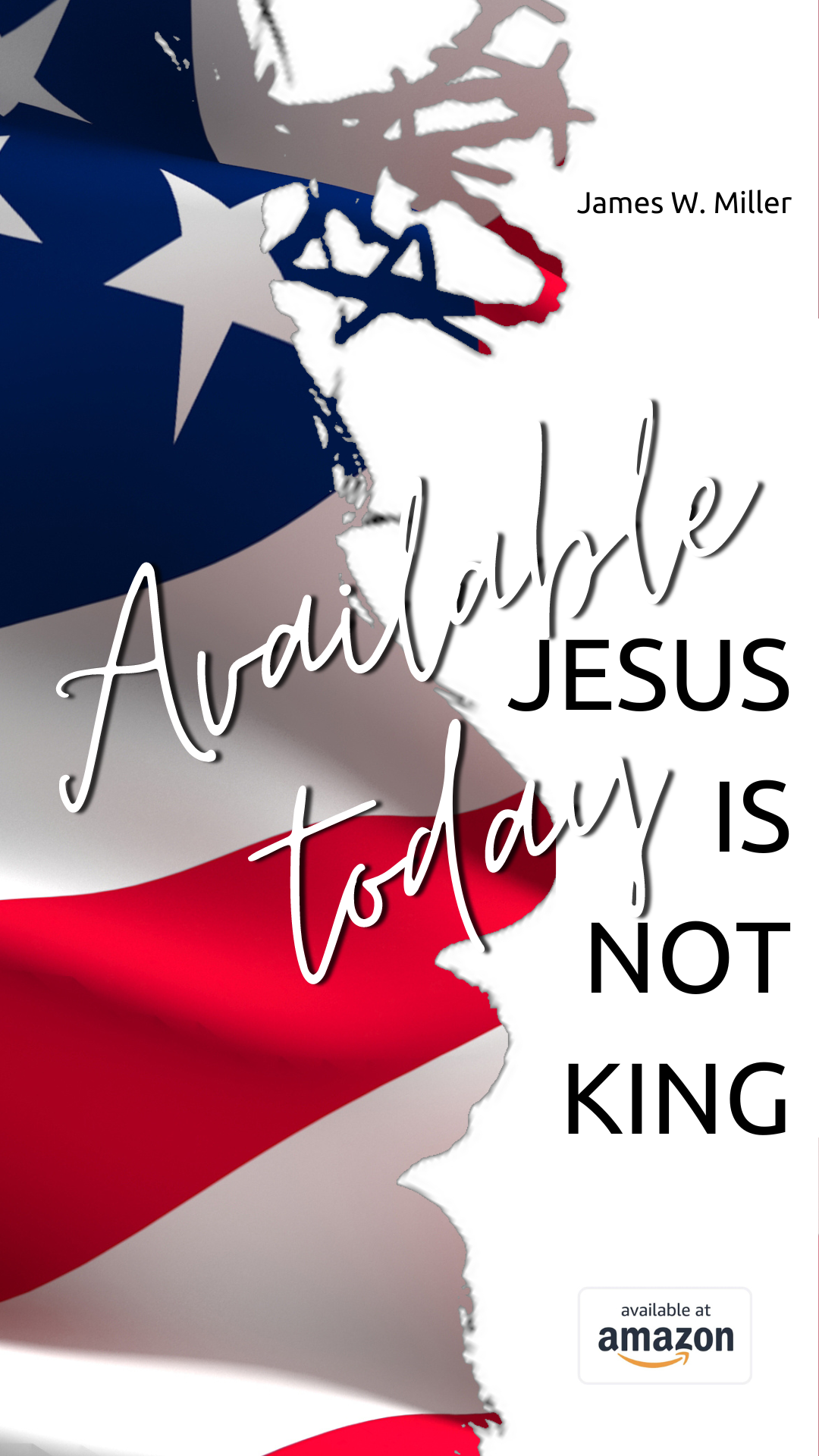
Available today: Jesus Is Not King

My new book, Jesus Is Not King, has been released.

The premise of the book is that Christians for 2000 years have been trying to put Jesus in a position that he rejected. They tried to make him king by force (John 6) to depose Herod and expel Rome. But Jesus was not trying to be a king governing with earthly power and military might. His goal was to win hearts.

In an election year, many Christian voters have been lulled into the belief that if only they can vote someone into power who will represent their moral views, they will be freed from the hard work of ministry and discipleship. The mess of the 2024 political scene is proof that we’ve gotten it wrong.

In this book, I propose an alternative role for the church in modern politics – to reclaim the prophetic voice that is more loyal to truth than to party, more committed to righteousness than power. Jesus is the King of Kings, but it might not be the king we

We can do it this time!

I remember teaching my daughter how to ride a bike. She wobbled up and down the cul-de-sac as I ran close behind, holding onto the back of the seat. When she was ready, I let go. The first time we did it, the ride ended in a crash and tears. But she got back up and tried again.

I ran beside her calling, “We can do it this time!”

As I prepare my little church for 2024, an election year, a year fraught with the potential for conflict, I find myself running alongside the church calling, “We can do it this time!”

We didn’t do great in 2020, when most everyone caved in to anger and anxiety, conspiracy and mutiny. Some people responded with grace and charity, but not most of us. The church honestly has not done great for several decades, in which people who call themselves followers of Jesus have joined in secular mud-slinging and turning a blind eye to the sins of their own parties and candidates.

But I think we can do it this time!

I’m spending time reading the words of Jesus captured in Matthew 5-7, the Sermon on the Mount. His teachings are powerfully counter-intuitive and counter-cultural. I am envisioning a people who are “Sermon on the Mount Christians,” Christians who behave as though these teachings were the only thing they ever heard Jesus say. Can you imagine a Church in which people refuse to call other people fools, refuse to cheat on their spouses, refuse to break promises, and refuse to get revenge? I can imagine it, but I realize there is a group of people out there who can’t – the secular public who has watched the Church fail at these things through all of recent memory.

What if, this year, we pledge to be a people of grace in seasons where win-lose decisions threaten to divide our country and our culture? What if, in 2024, we tried to be Sermon on the Mount Christians?

***

Stay tuned for my new book, “Jesus Is Not King,” a Christian look at political engagement.

Kyo

E69599.png
Kyo

It’s not news that the Christian church is not proliferating in Japan.  It’s less than half a percent of the population.  There’s an interesting phenomenon in the Japanese language that help accounts for this.

In Japanese, a religion is named with the title of that religion, followed by the suffix pictured here, pronounced “kyo” (rhymes with crow).  So Christianity is “Curisoto-kyo.”  Islam is “Isulamu-kyo.”  Literally translated, it simply means “teaching,” but as with many words, there is a nuance not captured by the strict definition.

The nation of Japan is not religious in the Western sense.  They may offer worship to idols or ancestors, loosely grouped under the title, “Shinto,” but Shinto has no clearly defined doctrines.  When the Japanese talk about religions, they are generally referring to ideas from outside.  And when they think of such things, they still discuss the 1995 subway gas attack that killed 13 people and poisoned thousands.  The leader of that attack was executed this summer.  The name of that cult was Shinri-kyo.  “Kyo” has subsequently come to imply “cult.”  Because Christianity falls under the same broad umbrella of religious teachings, it too now bears a suffix that implies “cult.” Everyone in Japan has heard of the gas attacks.  Less than 1% of the population is Christian.  But when Christianity comes up, it’s immediately branded as related to the gas attacks.  No surprise that it’s not catching on.

A word to wise Christians in America: guilt by association is a real thing.  If Christians generally associate with unloving power-mongers who are more interested in politics that loving the lost, don’t be surprised when no one wants to talk to Christians any more.  At that point, the faith might as well be branded “The Christian Party,” because the suffix captures exactly how it’s thought of.  In America, there is a real risk that people may come to think Christianity is just a political slate that claims to have fallen from heaven.

That’s simply not what Jesus came to build.  He wasn’t out to create political power structures to shelter the fearful.  The teachings of Jesus (Jesuskyo?) are all about surrendering in the name of love.  The more his followers do so, the more likely Japan and the rest of the world are to see Christianity stand apart from cultish shadows.