The End of the M.Div.?

Christianity Today’s Out of Ur published an article I wrote about the future of the Masters of Divinity degree and the future of seminary education. 

Image

Long the gold standard of seminary education, the Masters of Divinity degree is a requirement for ordination in many denominations. It requires students to make a serious commitment—usually three years, long study hours, and thousands of tuition dollars. They immerse themselves in biblical Hebrew and Koine Greek—some eagerly, some begrudgingly. The result has been a trusted and standardized course of theological study.

But things are changing.

Four significant influences have shifted students, and consequently schools, away from the M.Div. and into alternative learning tracks. The rise of non-denominational churches that no longer require seminary education, significant financial debt incurred by students who are headed into a profession that will not necessarily empower them to pay it off, the rising possibility and acceptability of online education, and the decline of mainline Protestant denominations have all raised questions about the viability of the M.Div.

“We’re in a huge paradigm shift….”

Read the article here.

The Bestselling Jesus

A review of Killing Jesus, by Bill O’ReillyImage

By James W. Miller

The Last Temptation of Christ witnessed lines of moviegoers and waves of bookbuyers when it was released, largely because Christians threatened to boycott it.  The Passion of the Christ made over $611 million dollars from the hands of the passionately faithful and the militantly opposed.  Zealot, a book that depicted the historical Jesus as something less than the Messiah of God, raced to the bestsellers lists this year, though critics say it offered no new twist on the historical retelling of the life of Jesus.  Bill O’Reilly’s new book, Killing Jesus, is not bound for that kind of glory, for one simple reason: it doesn’t say anything controversial.

Released on September 24th, Killing Jesus, by O’Reilly and cohort Martin Dugard, hovered around #4 on the Amazon bestseller list in the days leading up to it.  By the end of the first day, it was still at #3, standing behind the latest Stephen King and the fourth installment in a young adults science fiction series.  Then on his evening Fox TV show he proclaimed that his book is creating controversy, and that some people think he’s “going to hell for writing it.” Who are these critics?  A few unnamed letter writers.  O’Reilly had a priest and a pastor on the show.  He told them he was getting a lot of heat from evangelicals.  The pastor told O’Reilly that evangelicals “ought to love this book.” O’Reilly replied that “the anti-Christian people” don’t want anyone to read this book.  The priest told O’Reilly that people won’t like the book because it defends the Bible’s accuracy.  O’Reilly assured the audience that the book is footnoted with the facts.  The ordained yes-men assured him he was right.   “I learned a lot,” said the priest.

Finally made it to #2.

But honestly, there’s no controversy here.  The book alternates between a fairly straightforward retelling of the biblical story with only minor narrative expansion, and a fairly unsurprising retelling of the details of the Roman Empire.  As to the latter, the authors hone in on that which is most violent and most sexually depraved, without any particular exploration of the psychology of the Caesars.  The story runs from Herod’s slaughter of the innocents, through the assassination of Julius Caesar, through bloodthirsty stories of Roman military conquests to vile sexual exploits of the subsequent Caesars.  None of this contributes meaningfully to the story of the life of Jesus.  And apparently it’s not scary enough to top Stephen King.

What the book does rightly is to show insistently that Jesus’ life and teachings are inextricably interwoven with the claim to his deity.  This isn’t just a demythologized, historical Jesus narrative, despite the fact that the authors tend away from the miraculous (the disciples “claim” to have seen him walk on water).  And there is an evangelical quality to the book for that reason.  There may be some stragglers who don’t read the serious literature about Jesus but pick this one up from the airport newsstand and end up in some kind of serious exploration of faith.  The Lord works in mysterious ways.  If you just wanted some superficial historical details about the first century world, it’s a fairly painless way to get them.  But the book’s popularity won’t come from a serious literary merit.

Of course, the drawback is that the rising population of Millennials will no longer take the story of Jesus from the hands of Caucasian men in their 60s who talk more about their political agendas than their faith.

The two Catholic authors previously partnered on bestsellers Killing Lincoln, which was criticized for factual inaccuracies, and Killing Kennedy, which the New York Times called “gerund-happy” while accusing the authors of “word mangling.” Both of them stayed on the bestsellers lists for months, the first one for more than a year.  Killing Jesus will be a bestseller as well.  The O’Reilly Factor has around 3 million viewers, and if history serves, he’ll spend the coming months promoting it on a daily basis.  Plus, it’s just hard to get around the fact that Jesus is still a subject that everyone wants to hear about.  But the book won’t be remembered for contributing anything new to conversations about Jesus, either historical or theological.

hardwired cover  Check out Hardwired:Finding the God

  You Already Know (Abingdon 2013)

When Christians Do Vegas

Christianity Today’s Leadership Journal published an article I wrote about our church staff’s new experiment in leadership training.

Conference on Wheels

“Our Conference on Wheels”

James W. Miller

It was not when my staff first posted a Facebook picture of me napping in a megachurch stadium chair that I realized my Christian-conference-going days were numbered.

It was when I realized they had a whole album of these pictures.

I love conferences. In my early days of ministry, The National Youth Workers’ Convention changed the direction of my ministry and my preaching. I marveled the first time I stepped onto Willow Creek’s campus for a Leadership Summit, and I grew because of my first Purpose-Driven Church conference. I still love Catalyst and Orange. Reading this, I think I almost needed a conference intervention.

While I’d still recommend big conferences for ministry development, my staff and I have gone in a new direction. This year we loaded up a caravan of cars and drove four hours into Las Vegas….

Read the article here.

Advance Praise for Hardwired

I’m so thankful to the scholars and ministry leaders who have given my new book Hardwired a thumbs up.  After the investment of years of work, it’s nice to have someone else enjoy it.  And when you write, you’re never sure that it will happen….

JWHardwired is for all of us who live with doubt and uncertainty about the Christian faith. With wisdom, insight and clarity Jim points the way for anyone struggling with insecurity and disbelief to firmly grasp the idea that what they already know is the perfect place to realize a belief in God. This is a book I will recommend to every young adult wrestling with core and fundamental truth. It is a book I will recommend to every mature and older adult looking for a path forward through doubt, frustration and seasons of distress. It is a book I will recommend to anyone open to the idea that God exists and that He loves them and wants them to know Him. In fact I recommend Hardwired to you. I am certain it will open your understanding of God and deepen your belief in God.”

Jon Wallace, President of Azusa Pacific University

TS“I like Hardwired a lot. It’s smart, confident and quite funny. Miller drills to the core of detached claims to neutrality about God. I can’t wait to give this book to friends of mine.”

Tim Stafford, author of Miracles and Senior Writer for Christianity Today

.

TC“A fascinating and highly readable argument for God. Miller avoids the complicated jargon of much contemporary apologetics, and argues in conversational style reminiscent of Lewis and Chesterton that many of our deepest held convictions about the world point unavoidably to a personal God. The book will be of great help to those struggling with doubt. I warmly recommend it.”

Thomas M. Crisp, Chair of the Department of Philosophy at Biola University and Associate Director of Biola’s Center for Christian Thought

JS“Miller’s book is going to provide a map for readers who are yearning to understand how we know what we know to be true regarding faith and life.  There will be lots of insight for who cherish the line by Pascal – ‘The heart has its reasons that reason knows not of.'”

Rev. Dr. Jim Singleton, Jr., Associate Professor of Pastoral Leadership and Evangelism, Gordon-Conwell Theological Seminary

SD“Here is a fresh and original look at religious unbelief. In Hardwired, James Miller surprisingly argues that we all—atheists, agnostics, and believers alike—latently believe that God exists and that we depend on God. The book is clever, well-written, and convincing. I recommend it highly.”

Dr. Stephen T. Davis, Russell K. Pitzer Professor of Philosophy, Claremont McKenna College

DG“Rather than gathering evidence that demands a verdict, James Miller plumbs the depth of the human heart, showing us that the things we take for granted provide a sure foundation for deep, abiding faith. The whole approach is surprisingly fresh and compelling. Add to that Miller’s gift for just-the-right analogy and his clear, spare style, and you’ll know why I’m excited to recommend this book.”

Dr. Diana Pavlac Glyer, author of The Company They Keep: C. S. Lewis and J. R. R. Tolkien as Writers in Community

AM“…he [Miller] has the mind of a scholar, the heart of a pastor, and the ability to synthesize those features in a way that few leaders can. In this book Jim challenges many of the intellectual assumptions of traditional apologetics, which start with what we don’t know, and suggests that the most compelling and heartfelt case for the Christian faith starts with what we do know. Just like in his preaching, he takes apologetics out of the ivory tower and brings it to the streets where people live.”

Adam S. McHugh, author Introverts in the Church: Finding Our Place in an Extroverted Culture

PC“James Miller’s book is a very readable reinforcement of the fact that God has placed eternity in each of our hearts. It helpfully supplements various contemporary apologetical arguments by highlighting the personal, practical, and existential themes familiar to all humans—themes that can touch the heart and move it in a Godward direction.”

Paul Copan, Professor and Pledger Family Chair of Philosophy and Ethics Palm Beach Atlantic University, West Palm Beach, Florida

JRHardwired has flipped my traditional thinking of Christian apologetics upside down with sound and logical intellect, peppered with Jim’s quiet humor and personal vignettes. Our hearts are indeed “God’s Positioning System” – the case for Christ has been and is made, we just need to discover it!

Dr. John Reynolds, Executive Vice President – Azusa Pacific University, California and Chancellor, Azusa Pacific Online University

DC“In a world of debate and challenge to the Christian way of thinking, this book is a breath of fresh air in giving guidance and principles of understanding of how faith really works and pulsates in one’s life. Offbeat, different, creative, it’s a new way of looking at how faith is given, nurtured and survives.”

Rev. Dr. Dan Chun, Pastor of First Presbyterian Church of Honolulu, co-founder of Hawaiian Islands Ministries

CC“Jim Miller does an excellent job of turning our questions upside down and helping us know how much we didn’t know we knew.  He suggests a major shift from trying to prove things to people to helping them realize what they already know.  He helps us examine our assumptions and discover what has been missing in our thinking.  This is an engaging and thought-provoking book.  I highly recommend it.”

Rev. Dr. Clark Cowden

Explore the book in paperback or ebook here:hw

Hardwired (Amazon)

Hardwired (Barnes and Noble)

Is There Hope For Apologetics?

by Dan Stringer

reposted from The Common Loon

July 31, 2013

The Common Loon BooksChurchTheology 4 Comments

HardwiredI remember attending a debate in college between a Christian and an atheist.

Before it started, the room was abuzz with anticipation, like a stadium before kickoff. After the competitors were introduced to applause and scattered boos, they each proceeded to argue forcefully for their belief system, trading punch lines and other rhetorical jabs. Along the way, they interrupted, misquoted and belittled each other’s views. They called each other names and triumphantly scoffed at how misguided the other person was. In their concluding remarks, both sides claimed to have scored the most points, which was curious given the absence of a scoreboard.

I don’t recall anyone being officially declared the winner that night, or if anyone left the room with different beliefs than when they entered. I wonder if the real losers were members of the audience, or at least those of us who had hoped for better.

Over a decade later, I now find myself as a pastor, a vocation predicated on the existence of God. Yet I still have mixed feelings when the subject of apologetics arises. Perhaps I’ve seen it done poorly too many times. Or maybe I’m turned off by the defensive, almost desperate, salesmanship that belittles opposing viewpoints. Or it could be that I can’t stomach the dissonance between apologists’ typical form (rhetorical flourishes and deductive “proofs” designed to score points for God) and their content (the message of God’s love, grace and hope for the world).

Apparently, my friend Jim Miller, also a pastor, has a few mixed feelings about apologetics too. In the opening chapter of his new book Hardwired: Finding the God You Already Know (Abingdon), Jim writes:

Most people who believe in anything, religious or otherwise, did not get there by listening to a debate, and meaningful beliefs do not often rest on academic research. That isn’t to suggest faith and reason are unrelated. There are those who think that God gave reason to humanity the way a father gives a BB gun to his son, telling him, “You can play with that thing all you want. Just don’t point it at me.” To the contrary. In fact, the Scriptures say that God intends for people to come looking for him. He isn’t afraid of our reasoning.

If God isn’t afraid of our reasoning, perhaps he intends for us to search without fear of what we might find (Matthew 7:7-11). While I’m generally not a huge fan of apologetics, I look forward to reading the rest of Jim’s book because he understands that a rational, academic case for God’s presence can only take you so far, especially when everyone uses a different scoreboard. A philosophy buff with an eye for the accessible, Jim doesn’t blast his readers with data and argumentation, but instead helps us catch glimpses of God in our everyday assumptions.

So maybe it’s not a stretch to hope for a better, redeemed approach to apologetics. Rather than trying to dissolve the conversation with a litany of airtight rebuttals to all possible objections, we can set our sights on becoming a different kind of people, the kind of faith community with a capacity to offer helpful responses in the context of authentic relationships when the big questions hit.

Who knows? We might even keep the conversation going.

The Ground

Image

I remember reading about a man badly injured in a car accident.  When asked about the vehicle that hit him, he said, “I didn’t see the truck, just the crash.”  Sometimes we’re so panicked about the crash, we miss what hit us.

The Greek poet Epimenides saw things that most people miss.  He was hailed as a prophet, and legends about him supersede history – that he slept for 50 years, that he lived for 300, that before he died his body appeared tattooed, and that he saw visions.  However, what little we have of his poetry doesn’t suggest mystical visions so much as common sense.  I wonder if prophets are sometimes just people who saw what hit them.Image

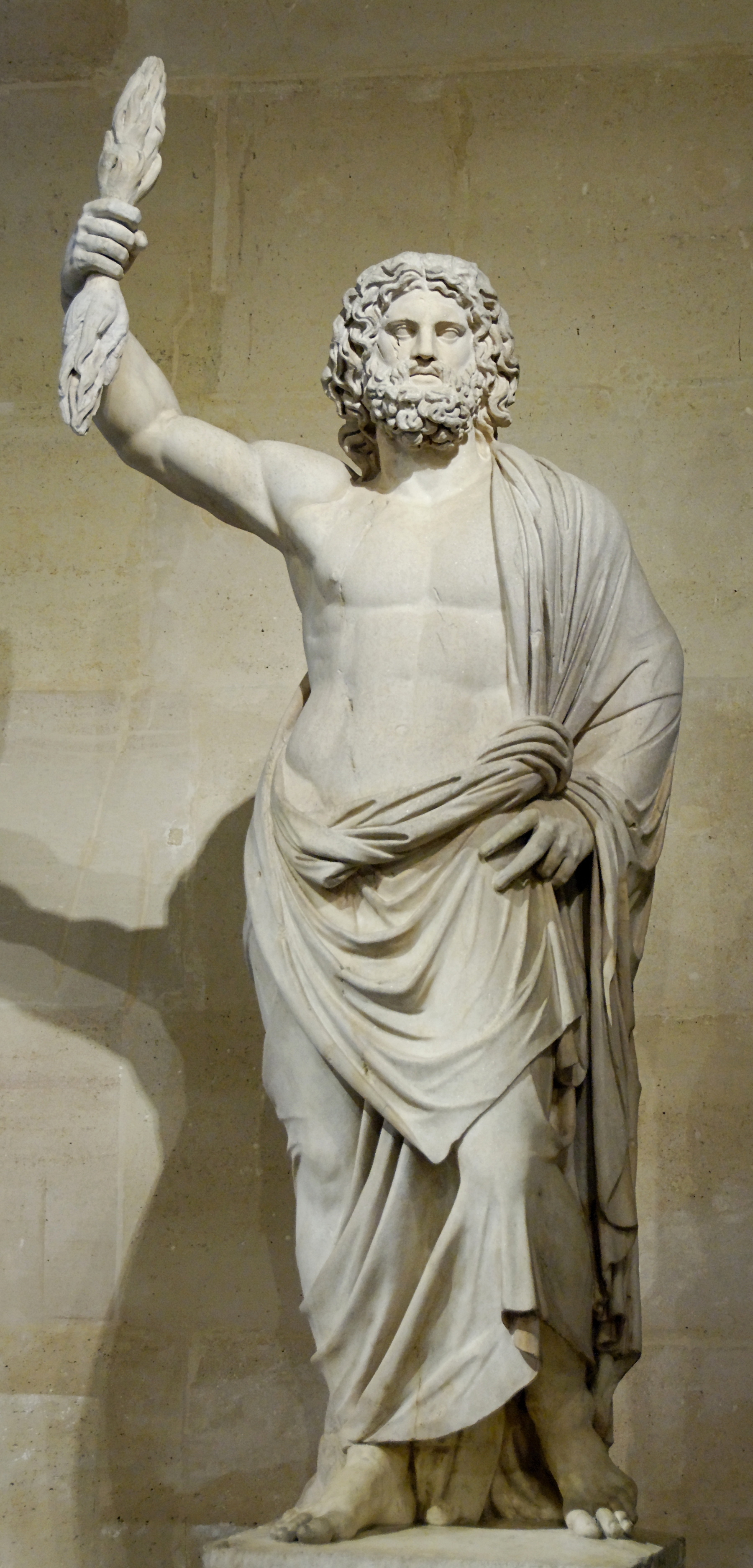
He wrote a poem called the Cretica, The Cretan.  It was a poem about Zeus, king of the gods.  In it, the king of Crete tells Zeus that the Cretans have lied by building a tomb to Zeus.  However, King Minos knows that Zeus is eternal and needs no tomb, because “in you we live and move and have our being.”

Two things interest me about the poem.  One, he doesn’t charge them with a mistake; he charges them with lying.  Given the nature of the issue, I’m not sure who they could be lying to except themselves.  Two, his proof is not data to be analyzed, but existence on the whole.  In you we live, we are active, we exist.  Without you, someone has to explain life arising from inanimate matter, motion, and a universe that has somehow come to be.

Hasn’t it always been the case that when one claims that God is dead, whether a Roman centurion stationed outside of Jesus’ tomb or Friedrich Nietzsche stationed on the doorstep of the 20th century, we’re taking part in a grand self-deception that is corrected by reality itself?  God is the ground on which we stand, and I cannot deny him any more surely than I can stay in mid-jump.  Without God, there’s no reason why there should be a universe rather than not, and no explanation for how something came from nothing.  Without God, there is no explanation for the constant motion in which life is immersed, motion which pushes us, as Sartre said, inevitably towards moral crisis and commitment.  And without God, there is no explanation for how inanimate matter produced consciousness and mental properties, as even atheist philosopher Thomas Nagel has admitted.

The Apostle Paul quotes Epimenides (Acts 17:28) when he engaged the Athenian philosophers on Mars Hill.  He’s proof-texting from their own library.  It’s as if to say, “You already know God is there.  Your own poets have said so.  Your own prophet would call you a liar for denying it.”

I think the charge of lying may be harsh, though technically correct.  I might use a different word for it.  It’s a coping mechanism.  The reality is that crashes are startling and leave us resentful of a fragile world in which they happen.  Denying the possibility of a good, overseeing father figure may be a way of voicing resentment.  It’s fear boiling over into rage.  But at the end of the deny, it’s still just a denial of reality.  Without God, there’s no one to be mad at.

What about Zeus?

A friend of mine is a pastor-in-the-making who is interning at a church and exploring all the questions of ministry that pastors-in-the-making get.  Recently he told me that someone had suggested that ancient cultures had invented goImageds, and Christianity was just one more invention.  That seems to me a shallow and unnuanced take, and I think reality is a little more complex.  It seems that if God had created us for himself, we would naturally be inclined to seek him out. After all, all creation points towards him (Psalm 19), and his existence is so clear that we are “without excuse” for not believing (Romans 1:20).  He is actually not far from any one of us (Acts 17:27), and he rewards our seeking (Matthew 7:7).  So given that we’ve been built with a GPS that points us back to him, it seems that a host of ancient gods would not be disproof of Christianity, but rather proof all the more.  If we’re made for God, it makes sense that we would reach out for him and try to grasp him, and where we can’t find him, we would make up substitutes.  The ancient pantheons are not grounds for dismissal of Christianity.  They’re only the groundwork for true revelation.  The fact that we guessed repeatedly and sometimes close doesn’t mean that Christianity’s similarities to other religions prove it false, only that Christianity in fact satisfies our deepest longings and proves to be the the bullseye around which we had been misfiring.  Ancient religions were simply set-up to the real thing and proof that we were hardwired for the God who would soon reveal himself to us.

These are the kind of speculations captured in Hardwired: Finding the God You Already Know.

The Atheist Who Loved God

In chapter 6 of The God Delusion, angry atheist and former scientist Richard Dawkins claims to explain where morality comes from for the atheist as a rebuttal to the charge that atheists cannot be moral.  What he produces is a bizarre intertwining of straw men and other fallacies.  What Dawkins flirts with, and fails to address, is the actual moral argument for the existence of God.

The moral argument goes simply:

Without God, objective moral values do not exist.

Objective moral values do exist.

Therefore, God exists.

But Dawkins fails to address the real moral argument for God’s existence.  First I’ll summarize chapter 6, then I’ll review whether or not the moral argument for God’s existence withstands Dawkins’ critique.

SUMMARY OF CHAPTER 6 OF THE GOD DELUSION

Dawkins begins the chapter by battling people who write hateful comments on atheistic websites.  This is the worst kind of straw man argument.  Instead of taking on any serious kind of theism or religious behavior, he cites inflammatory examples of people who obviously don’t hold to Jesus’ teachings while they attack atheists.  It’s important to note that what Dawkins is doing here is misleading.  It is not a scholarly engagement with meaningful ideas.  It’s no more meaningful than entering into a debate with a middle schooler in a comment thread on YouTube.  This goes on for 5 pages.

Dawkins then proceeds to the argument that morality could develop through evolution.  The “selfish gene,” the gene that survives for generations, does best by programming the organism that carries it to survive.  In some contexts, survival is best promoted by kin altruism, where a society of beings protect one another.  Likewise, reciprocity, in which genes program organisms to return favors for favors, is a beneficial trait for survival.  Or again, generosity may be assumed to allow certain members of a species to show dominance over others, proving that he is the one who is better off and can give more, which is likewise beneficial.  As a consequence of these evolutionary possibilities, morality can exist without God.

Yet when these natural instincts lead us to accidentally care for kin that are not genetically related to us, they are “misfirings.” Dawkins himself even points out that adoption is a human form of genes misfiring, though he claims that he doesn’t mean this to be pejorative.  Yet caring for someone who is in pain but who is not genetically related to us is an example of these “blessed, precious mistakes.”

Here Dawkins starts to betray himself.  He calls compassion and generosity “noble,” but clearly the word is meaningless.

Then it gets worse.  He cites another researcher who claims that morality has a “universal grammar” because it is hardwired into our brains through this evolutionary process.  In other words, we share the same biology, and as a result we all have similar moral inclinations.  Dawkins is here attempting to have the cake of objective moral beliefs and eat it too by saying there is nothing fundamentally binding about them.  They too must be “misfirings,” though Dawkins fails to point this out.  He still wants them to be “noble,” though they are clearly nothing more than accidents.  He uses several hypothetical examples to show that we can have moral feelings that aren’t grounded in clear principles.

Finally he gets to the real moral argument, and totally biffs it.  Again, as he is fond of straw men, he poses the question in such a way that the adherent is portrayed as being moral only to earn rewards from God.  Dawkins then mocks this as petty.  He dodges entirely the fact that moral objectivity is grounded in God’s design for humanity, rather than in simple rewards.  Moral objectivity derives from our beginning, not our end, our creation, not our judgment.

He flubs again when he cites an example of how a near riot broke out when the Montreal police went on strike.  “the majority of Montreal presumably believed in God,” Dawkins asserts.  “Why didn’t the fear of God restrain them…?  This is positively ridiculous.  Canada has for decades been a post-Christian culture, and the claim that a majority of Montreal believed in God is ridiculous.  Furthermore, the bank robberies and looting that took place can hardly be attributed to the majority of Montreal.  Dawkins completely misrepresents this event to prove his own convoluted conclusions.  He does the same thing again when he quotes a study that says crime is higher in states where religiosity is higher.  This is the fallacy of composition – the claim that something that is true of the whole must be true of the parts.  A larger religious population in a state does not imply that all people within the state are religious, nor that the events, good or bad, that happen within that state are a direct result of whomever is the majority of the population.  Here, Dawkins’ ignorance is laughable.  It’s embarrassing to see a supposed scholar come out with something that would have failed him on a freshman philosophy exam.

Perhaps Dawkins realizes that he is losing ground here, because he starts to waiver.  “Even if it were true that we need God to be moral….” Then a page later, “it is tempting to agree with my hypothetical apologist that absolutist morals are usually driven by religion.”

So then he leaps to the other side, “Fortunately, however, morals do not have to be absolute.”

And having now admitted that, Dawkins throws a rod.  He spends the next several paragraphs deriding patriotism for leading to war.  Then he just trails off into criticizing the formation of religious holy books.

THE MORAL ARGUMENT

Let’s see how the moral argument survived.

Premise 1:  Without God, objective moral values do not exist.  Dawkins supports this premise.  He clearly admits that moral inclinations are misfirings aimed at personal survival.  In A River Out of Eden, Dawkins puts it simply: “There is at bottom no design, no purpose, no evil, no good, nothing but pitiless indifference.  We are machines for propagating DNA.”

Premise 2: Objective moral values do exist.  Well strangely, Dawkins supports this claim too.  Nobility is objectively good.  He believes that crime is objectively wrong and chides religious states for having too much of it.  He believes the bloodshed and war that result from patriotism are wrong, and ironically, he believes that consequentialist morality is objectively better than absolutist morality, a claim which he makes absolutely!

Image

His criticisms of God elsewhere in the book come from his belief that the actions of God in the Bible are objectively wrong.  So while I don’t know that Dawkins would own up to it, all of his seething rhetoric is filled with the belief in objective moral principles that he believes should apply to everyone.

If the two premises are true, the conclusion is logically unavoidable.  God exists.  Binding objective moral values cannot exist in a simply material world.  They must come from design and purpose, and specifically, from a purposeful designer.

So tonight I give thanks for Richard Dawkins, the atheist who proved the existence of God.

The Miracle of Atheism

Image

In my last post, which was well received by everyone, I showed that human thought is system dependent on a non-material foundation, so much so that theism is simply a better grounding for human thought than non-theism.  Non-theism is fundamentally self-contradictory.

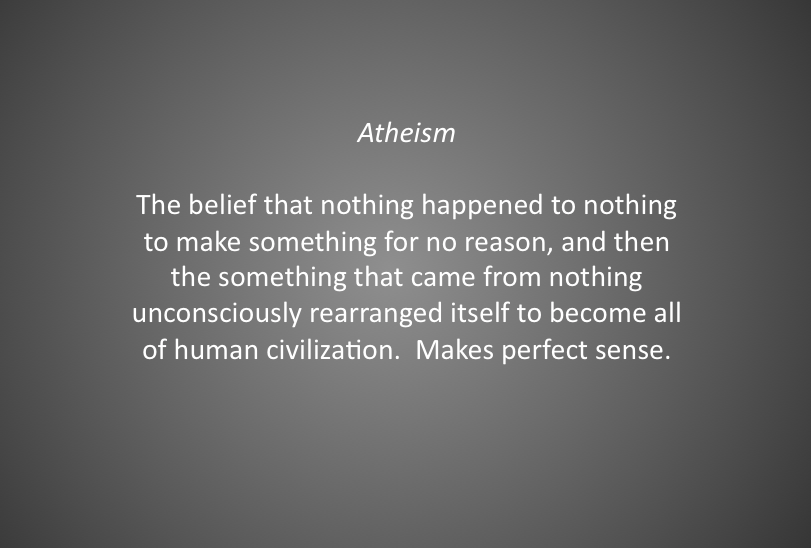
Likewise, atheism necessitates a belief in miracles, rendering atheism self-referentially inconsistent on a number of levels.  There are at least three miracles in which all atheists believe.

1)  Atheists believe that you can get something from nothing.  Flying in the face of all physical evidence, atheists must believe that the universe sprang from nothing without cause.  There is very little current debate about whether or not the universe had a beginning.  But the claim that the universe could pop into existence from nothing seems to be the only cosmic hope of atheists.  There’s simply no evidence that this happens in the material world.  And so in choosing to believe in that which is impossible in a simply material world proves that atheists believe in at least this one miracle.

2)  Atheists believe that will can arise from non-will.  This is also miraculous.  There is a significant blind spot in the atheist evolutionary account of human development, which is the anthropomorphism of inanimate matter.  Natural selection weeds out that which is least likely to survive, and the drive to survive and replicate propagates the strong.  However, this “drive” is fundamentally a description of a conscious will, which the atheist uses to describe everything, down to single celled organisms.  The problem is simply that conscious will doesn’t exist in single celled organisms.  Order couldn’t grow out of chaos through the selfishness of genes, because genes don’t have a concept of self.  So the atheist is also committed to a miraculous foundation for design.

3)  Everyone knows that humans are conscious beings, and that minds arise uniquely from brains.  But think about how odd this actually is.  There are all kinds of meat in the world.  Your fingers are made of meat, but they aren’t thinking.  The bologna in my fridge is meat, and it is not thinking.  Consciousness is not at all necessitated by a material world, so much so that atheist philosopher Colin McGinn has thrown his hands up in the air and said that we don’t currently have the cognitive nor scientific capacity to grasp why consciousness exists.  That is simply a atheism of the gaps which acknowledges the miracle of consciousness.

So just as I showed in the last post that human thought rests undeniably on an immaterial, moral foundation, so also atheism rests on a kind of suspended disbelief.  And suspended disbelief by any other name is still faith.  So those who reject the supernatural can do so only on the basis of miracles, and atheism has again proven itself not only implausible, but impossible.

“For since the creation of the world God’s invisible qualities, his eternal power and divine nature, have been clearly seen, being understood from what has been made, so that people are without excuse.” Romans 1:20

Everyone Believes

One of the things that fascinates me about modern defenders of the Christian faith is how casually they begin in the wrong place.  They start with the assumption that their listeners are objective and analytical and can be persuaded by facts.  I doubt this is true.  Then they assume their role is one of defense attorney who presents a reliable case sufficient to free God from the atheist’s accusations.  I know this isn’t true.

The Bible starts in a completely different place, saying we are “without excuse” for not believing (Romans 1:20).  The atheist needs a defense attorney.

And what’s most surprising about this to me is that the guy who says he doesn’t believe in God has already shown that he depends upon a world in which God does exist in three ways.

First, when one says, “God does not exist,” that person is assuming that the purpose of communication is to tell the truth.  They assume that they are somehow morally obligated to try to reflect what they think accurately, and they assume the person to whom they are speaking is doing the same.  But this moral undergirding is suspicious.  If God doesn’t exist, morality is at best a mistaken byproduct of blind evolution.  So long as survival of the fittest is the only goal, there’s really no objective moral obligation.  I can tell the truth if I want and not if I don’t.  But when we say, “God does not exist,” we’re assuming that communication in general rests on a real obligation to tell the truth, which is a moral claim.  It’s just strange to me that we act as though objective morals should exist, when a universe without God doesn’t require objective morality.

Second, when you say, “God does not exist,” you are assuming that the thoughts in your head accurately reflect the world around you.  You really think that in the universe, there is not a God, and that your perception of that world is accurate.  But there’s a problem.  In a godless universe, everything is simply matter.  Everything is made up of colliding particles.  Our brains in our heads are just a collection of particles that have come to function in certain ways.  But there’s nothing objective that obligates the particles in our heads to give us an accurate picture of the real world (this is sort of the red pill here).  It’s the same as the first point in a way – nothing objectively obligates brains to “tell the truth,” or to work in a way that is objectively accurate.  Yet when someone says, “God does not exist,” there is a fundamental assumption that brains and sensory organs must work accurately.  Descartes, Berkeley, and company knew that they had to ground their philosophies in the assumed existence of God before they could begin talking about what they did and didn’t know about the world.  But the assumption that our senses are right isn’t necessary in a godless material universe.

Third, when you say “God does not exist,” you are trusting that communication actually works.  You are trusting that the ideas in one person’s head can be translated into language, perceived consistently, and received accurately.  Deconstructionists like Foucault would say that this misrepresents they way language actually works, as truths are simply the falsehoods that have been hardened by the long baking process of history.  Derrida would observe that the place where we assume big ideas are connected to particular expressions of those ideas (where “forms” are stamped into “particulars”) is a lot more fuzzy than we assume when we talk to each other.  Again, a material universe with no guiding conscience would not necessitate that words  have meaning or that language is effective.  These things require something more purposeful than the blind movements of particles.

So when someone says “I don’t believe in God,” they are trusting that we are bound by the objective moral obligation to tell the truth, that our brains are bound to purposefully reveal accurate information, and that communication can be infused with objective meaning, none of which should necessarily exist in a godless universe.  That person is acting like God is there at exactly the moment she says he isn’t.

So ironically, the person who says “God does not exist” is actually proving that God does.

Explore this and other curiosities in my book Hardwired: Finding the God You Already Know, available this September from Abingdon Press.