I remember teaching my daughter how to ride a bike. She wobbled up and down the cul-de-sac as I ran close behind, holding onto the back of the seat. When she was ready, I let go. The first time we did it, the ride ended in a crash and tears. But she got back up and tried again.
I ran beside her calling, “We can do it this time!”
As I prepare my little church for 2024, an election year, a year fraught with the potential for conflict, I find myself running alongside the church calling, “We can do it this time!”
We didn’t do great in 2020, when most everyone caved in to anger and anxiety, conspiracy and mutiny. Some people responded with grace and charity, but not most of us. The church honestly has not done great for several decades, in which people who call themselves followers of Jesus have joined in secular mud-slinging and turning a blind eye to the sins of their own parties and candidates.
But I think we can do it this time!
I’m spending time reading the words of Jesus captured in Matthew 5-7, the Sermon on the Mount. His teachings are powerfully counter-intuitive and counter-cultural. I am envisioning a people who are “Sermon on the Mount Christians,” Christians who behave as though these teachings were the only thing they ever heard Jesus say. Can you imagine a Church in which people refuse to call other people fools, refuse to cheat on their spouses, refuse to break promises, and refuse to get revenge? I can imagine it, but I realize there is a group of people out there who can’t – the secular public who has watched the Church fail at these things through all of recent memory.
What if, this year, we pledge to be a people of grace in seasons where win-lose decisions threaten to divide our country and our culture? What if, in 2024, we tried to be Sermon on the Mount Christians?
***
Stay tuned for my new book, “Jesus Is Not King,” a Christian look at political engagement.
Not too many years ago, one of the primary condenders for the presidential election was a Mormon, today one is a Hindu, and there are elected officials who, presumably, could run for highest office and who are Muslims. The Hindu candidate has said repeatedly that it matters that there is a God, and he recently tweeted, “We share a common creed.” The problem I have with the ecclesiastical melting pot is that whether you look at this in terms of philosophy of religion, history, ethics, or sociology, we’re not talking about the same God, and that really matters.
This comes as a counter-intuitive shock to the average Joe who assumes all religions go roughly in the same category, the way apples, bananas, and apricots are all in the same row of the grocery store. Pick your favorite flavor; they all serve a related nutritional purpose. But no one who actively practices a faith and knows a good deal about alternate faiths thinks this way. Similar does not mean the same.
It’s like this. Two people might compare notes about their childhood experiences. One says, “When I was a kid, there was this guy in the house who was always there, and we called him ‘Dad.'”
“My house too!” her friend responds. “We had a guy like that and we called him ‘Dad.’ Maybe it was the same guy?”
“Well,” says the first, “my dad provided for me and wore out-of-date clothing and thought his jokes were all funny.”
“Mine too! We must be talking about the same guy! Isn’t that amazing? We have the same dad!”
“Well,” the first one continues, “my dad taught me that when someone does something wrong to you, you should love them anyway.”
“Oh,” says the second, a little bit mystified. “My dad told me that when someone does something wrong to you, you should punch them in the nose.”
Similar doesn’t mean the same. This also applies in matters of faith. Multiple faiths may talk about a God who created the world, who dictates principles for living, and who will be our judge in the end. But that doesn’t mean a shared identity; that only proves similarity. If one God tells you to love your enemies and another one tells you to get revenge, you are talking about different personalities, different “parents,” different gods.
Average Joe in the produce aisle may still not care about this. He’s going to pick his favorite fruit and leave you alone when you pick yours. Likewise, he’s going to care very little about the fruit preference of the person we elect president of the United States. The rub here is that gods dictate ethical norms the way parents set rules in the home. Not all gods have the same personality, and consequently, they do not share the same set of ethical principles.
Christianity is a faith that teaches the ultimate dignity and worth of every individual, regardless of their level of accomplishment, their intelligence, their moral uprightness, their able-bodiedness, and any other category into which we want to parse them. Jesus loves us all. America still enjoys the residue of a culture largely influenced by the teachings of Jesus. If you have a heart-to-heart conversation with someone who has been simmering in Confucian ideology, you find that there are sticking points at which you simply don’t share a common worldview, particularly as it concerns ethics. I invited a friend who was new to America to serve at a homeless ministry some years ago. They had never seen one before. They asked with incredulity, “You give all these groceries away for free?” They had been taught that if you gave your things away, there might come a time where you would not have enough for yourself, and you would starve. Those who have truly imbibed the values of Jesus believe that we should give to all who ask, that God can rain bread down from the sky, that we who sacrifice will receive much more in this life, and in the life to come, eternity.
In fact, it was on the basis of theology that the founders in America crafted some of the ethical mores which they prescribed. When Thomas Jefferson argued that there were unalienable rights bestowed by a Creator, he was borrowing from the British philosopher John Locke. Locke had argued with extensive citation from the Bible for the freedom of religious practice and liberty for the people. There is a direct line from the teachings of Jesus to Locke to Jefferson, and thus to the governing principles of America. In fact, one of the harshest critics of American independence from the monarchy was another British philosopher named Jeremy Bentham. Bentham was an atheist. He refered to the rights of dignity and freedom of each individual as “nonsense on stilts.” The nonsense was the idea that indivuals deserved freedom, and the stilts was the theology upon which such values were based. As an atheist, he believed only in doing what is best for the greatest number of people; sometimes the minority had to be overruled or ignored.
So put in place a leader who believes in a territorial god who advocates violent self-defense and ultimate conquest and you have the makings of a dictatorship. Put in place a leader who believes that the ultimate goal of humanity is to lose one’s identity to be subsumed into something universal, and you have the makings of something more negligent. Put in place a leader who really believes in Jesus, and you should have the makings of a nation which upholds the belief that every human being is of ultimate worth, that our country should do what’s best for everyone in the world so much as is possible. Gods create ethical systems. The objects of worship our elected leaders revere are not inconsequential.
Of course, if history is any indicator, we can rest assured that a generally blasé approach to faith and a hypocritical approach to ethics is all we will ever get from our politicians, so we needn’t worry too much nor get our hopes up. God is going to be a distant Creator who bestows only loosely prescribed unalienable rights, and nothing more. When it comes to the religious beliefs of our leaders, you say tomato, I say tomato.
There are three hypodermic shifts that are going on in the American circulatory system as we enter this next election season. On the surface, it’s the same story as always. We do this every four years. There are primarily two parties every time. The issues they are debating are unlikely to be any different than four years ago, and only moderately different than forty years ago. The rhetoric hasn’t changed much.
But under the skin, there are three philosophical shifts that have gone on in the ethical decision making of Christian voters, a bloc that became noteworthy in the late 70s, grew in influence until the first decade of the 20th century, and seem to be on the wane since. My sense is most Christians haven’t noticed, though the shifts are of tectonic importance.
A shift from character to consequences. If you watch the debate between Jimmy Carter and Ronald Reagan in 1980, you watch two civil, gracious candidates disagree over the substance of issues facing voters. They were both, I think I can assert, Christian men, though neither faultless. Carter was a devout Baptist who wore his faith on his sleeve. Reagan had led a prayer at the end of his acceptance speech at the RNC. Both had been Sunday school teachers. Their faith claims appealed to Christian voters. Today, however, the devout Christian marks the ballot with one hand and pinches her nose with the other. There is a recognized undercurrent among religious voters that you have to put up with whomever your party puts forward, because while they not be a person of character, at least they will deliver the final outcome on whatever social issues are most important to the voter. We’ve moved from a “character counts” voter to an “end justifies the means” voter. We’ve switched from virtue ethics to consequentialism. Carter was elected as a moral correction to the Watergate mess. Reagan spoke openly about ending racism, fighting Roe v. Wade, and even of “maintaining one’s virtue.” I don’t hear voters looking for character this cycle, and when one candidate happens to try to make such an appeal, we rarely believe them anymore. My problem with this is that it is not characteristic of the ethics of Jesus. Jesus would never say that the end justifies the means.
A shift from favoring one to disfavoring the other. This may not entirely be a shift, so much as a recurrent pattern in national sentiments, but we’re definitely at the bottom of this cycle. There is very little general enthusiasm among devout Christians for any potential candidates this year, as there was mixed to little enthusiasm four years ago and eight years ago. We’ve become far to comfortable with the “lesser of two evils” being the only option. This is one area in which we are truly bipartisan – I don’t hear a lot of eagerness for one’s own party from the Christian who votes on either side. And after a third election like this, it increasingly feels like a trend and a norm rather than an off year. Again, what bothers me is that you will not find Jesus ever commending the lesser of two evils, and I’m not sure we’ve noticed that we’ve slipped away from the ethics of Jesus in our political thinking.
A shift from public civility to public shame. Again, the Reagan/Carter debate is such a contrast to the mud-slinging, name-calling, slandering oration that has become not only acceptable but desired by an American audience. Jerry Springer aired from 1991-2018, and there may be more causation than correlation between what he made acceptable and what we now accept. Facebook launched in 2004, Twitter in 2006. Our ability to have immediate, uninhibited access to an often anonymous field of public debate (or just outright slugfest) is probably also a catalyst. But wherever it comes from, the fact that an audience of Christian voters not only witnesses this incivility but is now being shaped by it and willingly participates in it is a horrendous judgment on the moral fiber of American Christians. I just don’t hear a lot of Christ coming out of a lot of Christians, at least the loudest ones.
I’m cognizant of all of this as we face a second round of debates among the Republican candidates this week. I’ll be looking for how much or little attention the candidates give to matters of faith as an indication of how much they think it means to the voting public. I’m watching the ethical demeanor of the debate and to what degree candidates will openly contradict their own previous statements and hurl nasty insults at their rivals. Mostly, I’ll be looking for character. Whether we ask the President to be one or not, they serve as a moral exemplar for our children, and we are tacitly informing our children how important morals are every time we elect one.
An old object lesson that floats around ministry circles observes that when you squeeze an orange, orange juice comes out, and when you squeeze an apple, apple juice comes out, but what comes out when you squeeze a Christian? When the pressures and stresses of the world, pandemics and political crises, put pressures on followers of Jesus, what do they produce? If the analogy holds, something of Christ should come out. Jesus’ love should come out of a squeezed disciple of Jesus. The fruit of the Spirit – love, joy, peace – should ooze from the one who is Spirit-filled.
Surely, we’ve had three and a half years of evidence that this largely is not what happens to followers of Jesus in America. We every bit as much as our secular neighbors produced anger, anxiety, and fear. The consequent and ongoing shrinking of the Church only makes sense. When, in the midst of crisis, Christians flock to conspiracy theories and obvious lies and demonstrate no particular confidence in the power of divine providence, why would anyone believe us when we say that two thousand years ago a man walked on water? But in the coming season, the Church will again be asked the question, “What’s inside of you?” Maybe we can produce a different answer.
Perhaps, as 2024 looms, we ought to think about the likely cultural climate with our intended ends in mind. It will be another year of political turmoil and conflict being produced by world leaders who ought to act like models of civility but who instead act like spoiled children. That is of little concern. What matters is how Christians respond. A card player is not good because the deal is good; a card player is good because of what she does with the hand. We have some probable sense of what the next season will deal us, so the question then becomes, how shall we play it?
I’ve begun to pray that as the polarizing conflicts of American society begin to again force people to take sides, the Church will sound like the voice of Jesus. Imagine a Church where we care so much about profound ethical issues that we insist that they must be discussed, and yet, where we are so committed to the absolute dignity of the individual and the love that God bestows on every one, that we insist that our conversations leave people feeling cherished, regardless of political affiliation, religious doctrine, or agreement. Imagine an institution famed for Inquisitions, witch trials, and heretic executions reaching a midlife conversion itself, so that for the rest of its history, it is known for being the circle of grace that its founder originally meant for it to be.
Some of us, as of this week, now face a moral dilemma.
Temptation and Fall
Now the serpent was more crafty than any of the wild animals the Lord God had made. He said to the woman, “Did God really say, ‘You must not eat from any tree in the garden’?”
The temptation that caused the fall of humanity in the Jewish narrative came in the form of unnecessary food. They already had all they needed. But this food promised to allow them to sort out right and wrong for themselves, to create their own system of weights and measures, so they no longer had to depend on God to provide for them.
Daily Bread
As the Israelites marched through the desert, away from Egyptian slave-drivers and towards a homeland, the tension between God and his people was again food.
“If only we had died by the Lord’s hand in Egypt! There we sat around pots of meat and ate all the food we wanted, but you have brought us out into this desert to starve this entire assembly to death.”
Then the Lord said to Moses, “I will rain down bread from heaven for you.”
God proved again that he could provide for them exactly what they needed, supernaturally. Bread fell from the sky. They called in “Manna,” which meant, “What is this stuff?” They were told to collect each morning only enough for the day. If the Israelites took more than what they needed for a day, it would rot. They didn’t have to store up. In this way, God called them back into dependence and rewarded them with providence.
The Bread of Life
Jesus draws on the lessons of his heritage. He says things like:
Do not worry about your life, what you will eat or drink.
Man shall not live on bread alone, but on every word that comes from the mouth of God.
He teaches his disciples to pray:
Give us this day our daily bread.
And he says of himself:
I am the bread of life; whoever comes to me will never go hungry.
It is perhaps more than coincidence that his birthplace, Bethlehem, is a Hebrew word that means “House of Bread.”
The most natural, healthy relationship between God and humanity is when we are dependent every day for our basic needs, and we live without fear that a good Father will provide for us when we ask him.
Hoarding and Sharing
Instead, in crisis, we stockpile food that we don’t need, escalating anxiety and tension in our communities. That leads us to the moral dilemma.
If you have taken more resources than you need this last week, in fear not only of a virus which is not particularly remarkable, but also in anticipation of the fear of your neighbors, you now have a moral imperative. This is from the Lord, not me.
If you over-bought this week, take food to your neighbors. Give it to them and say, “I’m trying an experiment here. I’m giving this to you to see if Jesus will take care of me.” What will happen is that you will experience the relief of knowing that a good and powerful God watches over you. You will be set free from a spirit of fear. You’ll experience the joy of providing for others. You’ll make new friends. You’ll live a story that will be worth telling.
The other choice is to continue running with the herd, and exposing sins of which we will have to repent in the next generation.
The choices here are between faith and fear, panic and peace.
You know what will really convince the world that Jesus is the good and loving Lord of all creation? It would be if all of his children absolutely go insane whenever there is a public crisis and then lead the way in running, hiding, blaming others, and over-reacting.
About Coronavirus
Here are three things Christians ought to be thinking about as the world reacts to aspreading sickness.
1. Don’t go crazy.
Every year in the US alone, the flu kills on average 30,000 people. In the 2018-19
flu season, it killed 61,000. The coronavirus has killed 3,000 in the world, out of 7.7 billion. It is admittedly stronger than the flu, but it is not the medical version of a nuclear bomb. The stock market is spiraling, organizations are cancelling conferences and gatherings, and Japan and Italy have temporarily closed their schools. Whereas the mass of humanity is led by animal instincts, Christians are bearers of the Spirit of God and ought to swim against the current, not get swept up in it. We have not been given a Spirit of timidity, but of power, of love, and of self-discipline. The Christian response is not, “Where can I hide?”, it’s “God is bigger than this.”
2. Ask the right questions.
The first questions I hear as a pastor is whether or not churches are safe places to gather and whether we should all stay home. At least we should receive the eucharist through a doubly-secured air-lock, and the Pastor can stand behind that thick plexiglass like the bank teller. The first question that the Spirit would have Christians ask would be, “If it gets bad, how will we help?” Danger is the opportunity for the Christian to demonstrate faith, not fear. Crisis is the opportunity for the Christian to demonstrate compassion, not cowardice. First questions first – no matter what the state of the world, followers of Jesus don’t run and hide.
3. Be wise.
Coronavirus-response is not going to be the modern, bio-chemical equivalent of snake-handling. Everyone should practice good hygiene – wash your hands, sneeze on your elbow, and don’t go to school if you’re sick, even if there’s a math test. These rules should apply during the ordinary flu season, and not just because it kills 30,000 Americans a year, but because it’s gross when you sneeze on your hand and then hold it out saying, “Nice sermon today, Pastor.” Thank you for that.
I went to a prayer meeting tonight. During the session, a guy was supposed to pray for me while I prayed – both of us silent. As I prayed, I saw images of the stained glass in our sanctuary, and then bigger images of stained glass like the Rose Window in Notre Dame. When we finished, I asked him if he heard anything in prayer.
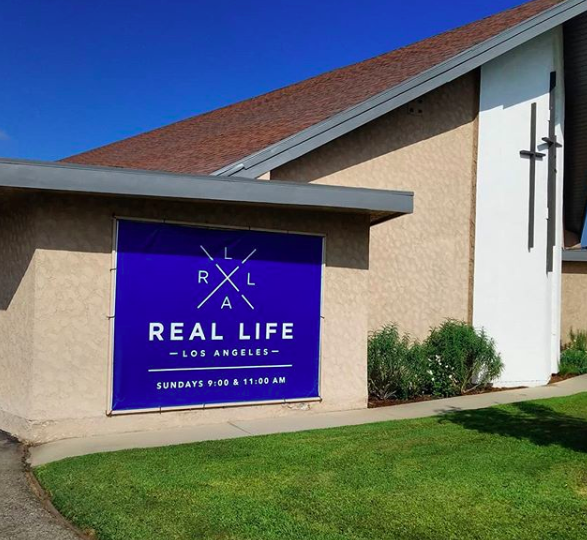
He said, “I saw a crazy amount of color. There was color everywhere, like splashed on the walls. Then I saw cans of paint all around, and Jesus picked up a can of paint and began to pour it. And he was waiting on you to pick a color. You hesitated, and you took a long time to pick it. But when you finally picked one and poured it alongside his, it was royal blue. You two painted a big wall together, and on the wall I saw the word ‘LIFE’ in all caps and in white. Then you two sat on the wall enjoying what you had done together.
There’s a little event that happened in 1633 which is an important conversation piece in Christianity today. There was a guy named Galileo who studied the stars and who wanted the world to look through his new telescope. Apparently, he said, we’ve got it wrong. The earth goes around the sun and not vice versa.
The Catholic Church of his day was doing a little investigation of its own now called The Spanish Inquisition, in which they were forcing people to accept Christian doctrine or face torture. They read the passage in the Bible, Joshua 10:13, that says that the sun stopped in the sky. Well, the sun can’t very well stop if the sun isn’t the one that’s moving. So they told Galileo to take back his doctrine, which he did.
To this day, that story is told to high school students to emphasize the fact that religious legends can be destructive tools that oppose the pursuit of truth.
One of the most destructive things a Christian can do is make decisions out of fear. Fear doesn’t help you determine facts. And fear-based decisions will make your worldview look ridiculous to thoughtful people. We should have let Galileo’s telescope enlarge our view of the biblical text.
I want to address what I think is one of the most grave ills of the Church in this generation. And that is – that the Church is filled with educated people who don’t know what learning is for.
Education is Worship
The standard American church is filled with people whose decisions about education have been informed by their socio-economic standing and not by their theology. We learn because it pays – through qualifications, jobs, and the consequent salaries. We don’t learn as a form of worship. I would suggest that education is not a means to a material end – it is an expression of worship.
Did God give you your brain to make money, or did God give you your brain to explore the creation that he has made, to marvel at its beauty, to mold it into works of art, engineering, and medicine, and to find him in it, because, indeed, he is not far from any one of us (Acts 17:27)? The mental life is designed for reflection and contemplation, not to be used as a tool for material gain. It’s more like an incubator than a hammer; it allows things to grow within it rather than pounding out the world around it.
I was in a two-week long retreat with Dallas Willard and twenty other pastors at the Sierra Madre retreat center. Dallas began the conversation by saying, “You often think of Jesus as loving, as holy, and as powerful. But do you ever think of him as smart? Because Jesus was smart.”
What would society look like if people saw the Christian church and immediately thought – “They really know their stuff!”? “They are truth seekers, and they are not lazy. They read. They study. They write. They teach. Their people are at the heads of every department in academia.” If it came to a debate between a Christian and an atheist, you could trust that the Christian was well-studied and not just quoting the Bible at people.
I hold out to you that that’s not just how it could be, it’s how it should be, and it could be so in a single generation, if we will take this message seriously. There are four things we can do to turn the tides on this failure, and I’ll lay those out in a next blog, but for now, I just want to impress upon you one thing: education is a form of worship.
What Will The Kids Think?
I remember going to a church camp when I was in high school, a fiery Baptist camp held in deep in the woods in the Texas hills, so that no one could get away. And I remember asking a guest preacher a string of questions about faith and science. Midway through my questions he got tired, and just scolded me, “Jim, sometimes you just need to stop asking questions and believe.”
That’s a bunch of trash.
Pursuit of truth leads to Jesus, and if you stop asking questions, you won’t end up at Jesus, you’ll end up with an idol.
Don’t be afraid of where the pursuit of truth will lead you if you believe in the guy who said, “I am the truth.” To pursue truth is to pursue Jesus.
If you want something to wring your parental anxieties out of you, try this. If you raise your kids with a kind of fundamentalism that requires them to hide their heads in the sand, one day your kids will get out in the world, and they will listen to the news, they will talk to their peers, they may go to college, and they will realize that brilliant minds have come to believe in things that are different than what they’ve heard from you. If you tell them that the Christian faith hangs on their rejection of the findings of science, you will put them in the position of holding onto ideas so rigidly that their ideas will one day break them. Kids aren’t leaving the faith because of Darwinism. They’re leaving the faith because parents, churches, and pastors are telling them that Christianity and science are opposed to one another, and they have to choose either science or Christianity. They’re going to choose the one that is most serious about the pursuit of truth.
Shouldn’t that be the Church? Shouldn’t we be the ones to love truth more than our secular friends?
Let’s recall a teaching of Jesus that he said was more important than all the rest – Love God with all your heart, with all your soul, and with all your mind.
When I’m seeking to discern what God is calling me to, there are a few biblically-based signs that tell me really clearly that I’m on the right path. For anyone who is searching for a job, praying over a move, or considering a significant change, these are worth reviewing.
The places to which we are called usually involve these six factors.
Joy: Calling brings you joy. Jesus said that he promises us abundant life. The guy who turned water into wine at a wedding isn’t amassing an army of the miserable. (John 2:1-12, John 10:10)
Service: While calling brings us joy, it’s something that we do to make the world a better place, and specifically to love other people. This ensures that the joy calling brings us is not merely selfishness, and that we don’t gain the world only to lose our souls. (Mt. 16:24-27)
Gifting: Calling uses the gifts that God has given us. Some people are made to be teachers, some to be administrators, some to heal and some to help. Calling employs exactly that mix of tools that we carry in our belts. It shows us that we were made for a purpose and that we serve a valuable role in the world. (1 Cor. 12, Rom. 12, Eph. 4)
Inadequacy: Despite the fact that we may be gifted for calling, a true calling from God is always bigger than we could handle on our own. God told Gideon to whittle down his army to the point that it was unwise to enter into battle, and that inadequacy served to prevent Gideon from taking credit when he actually won. (Jdg. 7)
Confirmation: The community around you, the people who know you best, ought to confirm that you’re on the right path. Our friends sometimes know us better than we know ourselves. To forge ahead when everyone around us tells us we’re on the wrong path is foolhardy. It’s exactly like dating. When friends tell someone that she’s dating the wrong guy, the friends are always right. She may say, “You just don’t know him like I do. He told me that when he plays video games all day, he’s only thinking of me.” But the friends can see the situation objectively, and if the friends say, “no,” the friends know what they’re talking about. (Gal. 2:1-3)
Commitment: Nonetheless, calling is that thing you’re going to do no matter what. Even if no one around you confirmed it, it’s that thing you can’t live without doing. There is a church denomination that used to ask its pastoral candidates one final question before they could be ordained. After batteries of tests, exams, theological essays, and psychological interviews, the last question each candidate was asked was, “If we told you we wouldn’t ordain you, what would you do?” There was only one acceptable answer, and every candidate was expected to say the same thing in a sort of litany. “I’ll preach it anyway,” was the correct response. Calling is like that. I’ll do it no matter what. (Gal. 1:11-17)
So those are the six criteria I use to evaluate whether or not I’m on the right path as I pursue my calling. As you can see, they exist in three pairs, and each of the two members of each pair stand in tension with one another: joy but service, gifts but inadequacy, confirmation but commitment. It’s in exactly that tension that calling seems to balance. I’ve encouraged a lot of people to pray over these six things when they make decisions. I’d encourage you to as well, or share it with a friend who is making big decisions.
The contemporary American Church has forgotten itself, both the letter and the Spirit.
There are three contending voices in the modern Church concerning the letter, concerning the role of Scripture in the Church. First, the letter has been lost among modern megachurches who forego exegesis to such a degree that it is not clear how, if at all, the Bible undergirds the proclamation of the church. The text is at most a theme upon which the pastor riffs, a pastor whose voice trumps that of Scripture. His tone and content need not reflect those of the letter; the Bible is there only as a source of material among the many anecdotes from the pastor’s family life, his sporting loves, and illustrations clearly mined from some website. Were one to only learn the Bible from these pastors, one might reasonably assume the book is a practical guide to successful work and marriage, a therapeutic relief to stress and anxiety, and a promise of material rewards that are just around the corner.
I listened to a great big pastor in a great big church not long ago who said he “had enough people in the cheap seats.” It was time for serious discipleship, he insisted. His only text for the next 45 minutes was John 3:16, which he read and then never mentioned to again. I came to realize that the reference to the cost of the seats was meant to point out that many people attended but didn’t tithe.
These churches have largely surpassed and replaced the second voice, the dying stream of liberal Protestantism which practiced a sleight-of-hand exegesis, using the Bible, but only so as to give the educated the clergy the opportunity to cleverly reveal that it didn’t mean what it seemed to say. Mainline Protestantism is now settling into a well-deserved retirement.
Third, the last refuge of the Bible is American fundamentalism. Unfortunately, what we find here tends to be the people who know the words but not the meaning. They want to debate how long were the days of creation and whether or not life could have evolved, just as their predecessors were energized against the heliocentric universe. Here, conversation is consumed by creed. They read the Bible, but only so they can weaponize it.
We’ve forgotten that the Bible is God’s word, and thus it’s worth learning. We’ve forgotten that it’s living and active, rather than static and dogmatic.
Likewise, the Church has forgotten the Spirit. The early church spread for one reason – Jesus was a wonder-worker. People weren’t traveling for miles to hear a good speaker; they were coming to see paralytics walk. People weren’t praying to make themselves feel better; they were praying because someone was answering back. They were sufficiently convinced that God was present that they gave away their money with reckless abandon. Honestly, what might it take for you to do something like that? It takes a miracle.
I envision a church of the letter and the Spirit, where we embrace the Scriptures enough to care about what they say to us, and the way they say it. I envision a church where miracles come to be as natural as they are super. And I don’t think any of this is unreasonable or far-fetched. I think this is what Jesus meant from the very beginning.








 To this day, that story is told to high school students to emphasize the fact that religious legends can be destructive tools that oppose the pursuit of truth.


 Hardwired