
Nate Watkins put together this video, adapted from a page in my book, “God Scent” (2006). My next book, “Hardwired,” will be published by Abingdon Press in September.
Category: Uncategorized
Azusa and Calvary
A note to my 6 year old son: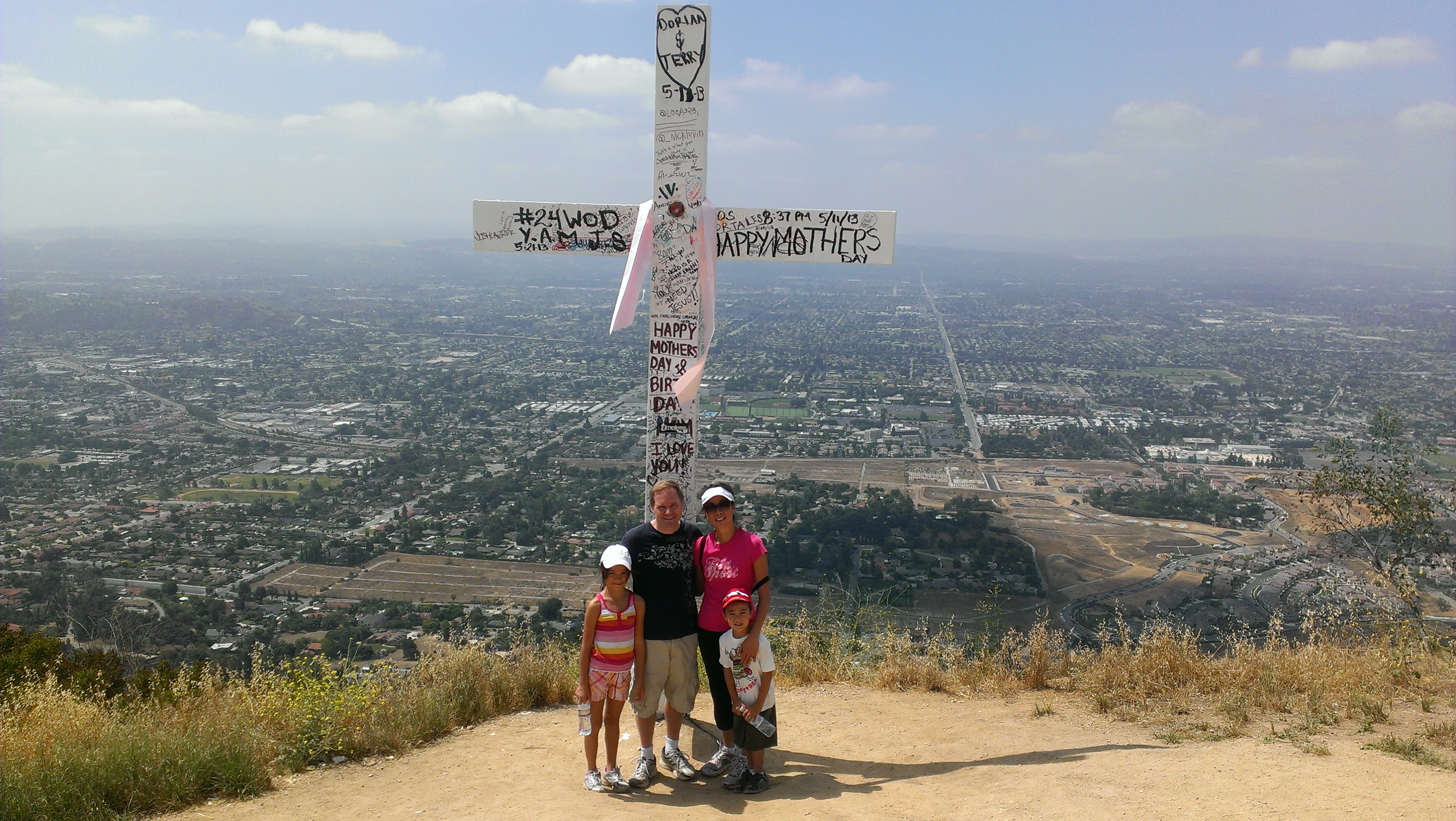
This weekend we climbed a mountain. Quite literally, we hiked the Garcia Trail up at the back of Azusa, up past the overly proud, white “A” emblazoned on the hill, up to the cross that is frequented daily by students from the expanding Christian college next door.
“I’ll never do that again,” you told me, as did your sister.
It was slow going. You were afraid of the sheer cliff that sat alongside the narrow path, and though you were never in any danger, the higher we got, the more you sounded like a kid mounting a diving board. We had to hold hands most of the way to the top. Your sister was not much better. It was a complaint parade with grunts like a timpani and whines like a clarinet, with stops under every shady overhang we could find.
On the way down you and I walked a few feet in front of the girls. I told you about being a leader and being brave, and how when times are hard, your family needs you to be a brave leader.
“Hm,” you said. I think it was assent.
I wonder how much these moments will sink in over time.
Up at the top, the cross is ironically graffitied. I’m not sure who decided that was appropriate. It overlooks a vast 180 degree panorama of LA, all the way to Catalina island, and on the other side an equally sized panorama of national forests, spotted with reservoirs. Cars wind through a lonely valley road, far enough away to seem like a silent movie of a leaf floating down a river.
Here I’m struck with an irony that we climbed to the cross. I mean I get it, but it’s all wrong. That first cross initially sat atop a hill, and placing them on top of hills today is sort of an implicit declaration of superiority and finality. Jesus’ cross and our crosses are the parentheses that swallow all the history in between. But theologically, it’s all wrong. We don’t climb to the cross; it descends to us. The whole point of the cross was that our climbing up was ineffectual, and so he climbed down. The cross was ultimately replacing our useless ladders with his working one. So I’m afraid I’ve emblazoned on your memory an image of intense perseverance that earns you a view of the cross, when what I want you to know is that the perseverance was all on his part.
I wish I had told you that too, but perhaps this will make more sense later.
Mother’s Day
 She brings us to life with love and screams and sustains our bodies with her own. She wipes, bandages, combs, and cuddles, and cuts off crusts. She has the soothing voice of the nurse, the methodical voice of a teacher, the barking sergeant’s voice, and the tired weepy voice of one who has been stretched too thin. We huddle terrified as she clashes with Dad, follow eagerly as she negotiates our groceries, laugh when she teaches us jokes and how to joke. She was the one who corrected college essays as easily as she baked cookies. She resented the flippancy of our individuation from her as surely as she prayed for it. Now in years going by we send two dollar paper cards that are unfamiliar with her work and speak nothing of her worth, and she says thank you for remembering.
Islamic Violence
 Americans are finally waking up to the fact that Islam is a worldwide phenomenon, and not just “over there,” although we seem to believe we are the first to have discovered this and are going at it like Marco Polo. American media commentary about Islam would make you think that you were listening to the first broadcast from the moon. “What’s it like?” America asks. “We will tell you,” says the news.
For my part, I’ve read the Koran twice cover to cover, which is far less than many Muslims, and far more than most Christians.
The million dollar question today is whether or not Islam is inherently violent. “Is it?” you are asking. “I will tell you,” says I.
There are two popular lines. One is the ranting and insistent “Yes!” which has on its side a vast array of very obvious evidence, namely, that some of the most terrorist-producing countries are Muslim. Muslim countries are not good to women. Honor killings are still practiced in some Muslim countries. The people who point this out usually do so without much nuance.
The second popular voice is a more calm but less sensible, “No.” It’s the claim that Muslims are just people like everyone else who have a peaceful religion like Christianity or Buddhism. They’re misrepresented by extremists the way sophomoric cynics try to group all Christians with Westboro Baptist Church. This view is based on hope.
The Koran came to be when Muhammed entrenched the ethical code of the 7th century Arabian desert in an eternal religious being whom he claimed was speaking to him. Thus Muslim ethics will always be tied to the nature of daily life in that cultural context. In that context, if a tribe attacked your tribe, and you did not retaliate, you signaled weakness. Thus the rival tribe would feel empowered to attack again, to take your women as property, to drive your people away. “An eye for an eye” is the teaching of the Koran. Forgiveness is encouraged only insofar as it causes a person to reform. But territorial defense is essential.
Is that violent? Sort of. It’s also sort of basic, common-sense justice that you would expect of a culture that isn’t governed by a bureaucratic legal system. It’s not the same as the Christian ethic of turning the other cheek and repaying evil with good. It’s not the same as Christianity, and the two are not just different paths to the same God. But it also isn’t crazy.
The problem is that masses of Muslims throughout the world are told that the West has already taken eyes and teeth from them in wars of incursion. The sexual morality we dispense through our movies and our scandalous celebrities is fairly convincing proof that we’re not reforming. So in a cross-section of the Muslim world, there is a wholesale belief that the West has attacked. If they don’t respond in kind in some way, it will signify weakness and allow for further offense. That’s just the way of the desert. So rather than demonizing Islam, take its ethic for what it is: pre-Enlightenment myopia. Combine that with abject poverty and you have something that is potentially volatile. However, it isn’t of necessity violent.
They
 There’s a trend I’ve noticed, one that I’m sure psychologists have categorized and codified, but I don’t know what they call it.
When people see something horrible, or wicked, or deviant, we come up with a grouping for those responsible for said malfeasance. We call people “crazy” in order to create a safe, fenced in group from which we have just separated ourselves. In childhood there are “bad guys,” which is an awfully neat line for an incredibly undefined population. More than one commentator pointed out that the American media used “insurgents” for what we called, during the American Revolution, “patriots.” Categorizing gives power to the one who makes the categories. It gives us the power to protect ourselves.
In the wake of the terrorist act at the Boston marathon, there is now a desperate longing for explanation. What degree of mad ideologizing could lead to such an act of hatred? People are already eagerly anticipating a category into which that person can be put. We will most likely brand this person with some variation on “zealous” or “disturbed.”
But what’s strange to me with this particular event is the urgency I’ve seen from a number of voices to say “Humanity isn’t like this.” There seems to be an express desire to make sure than humanism itself is defended. Comedian Patton Oswalt tweeted a commentary on this which got widely circulated, and he uses language like “a fraction of a fraction of a percent of the population” and “a tiny sliver” versus “a vast majority.” The culprit is a lack of tolerance, and the guilty party is not most of us, because humanity is not “inherently evil.”
At some point each of us will need to wake up to the fact that we can’t create enough categories of brokenness to make ourselves a safe exception. We are in the broken category, the untrustworthy category, the hateful category, and the evil category. Some degree of socialization and behavior modification may keep us out of the Lord of the Flies, but it’s not our inherent capacity to choose to be good.
There’s only one category that we ought to strive for, and that category is “forgiven.” It will keep us from the kind of hubris that we use to take power over others, write them off, and separate ourselves from them. Forgiven is a fundamentally evangelical category – it always makes room for someone else.
Rob Bell’s Mental Furniture

Rob Bell gave a lecture tonight at First Baptist Church of Pasadena to promote his new book, “What We Talk About When We Talk About God.” He kept repeating a phrase that was incredibly revealing.
THE CROWD
The crowd was about 300 people, almost all students of Fuller Seminary, which had promoted the event. I should say, in the world of hipsters, hats are apparently completely out after having been completely in for about a year. The crowd was maybe 50/50 on the gender split, mostly around 30 years old, and heavily Caucasian. An one hat.
The hour long lecture was a funny and warm-hearted verbal rendition of the first chapter of Bell’s book. Literally almost word-per-word in some sections, with all the same punchlines. For first timers, it was a lot of fun. For anyone who had read the book, it was like watching the same episode of “Everybody Loves Raymond” for the second day in a row. You’re like, “Yeah, I remember that being funny.”
QUESTION TIME
At the end, in a Q&A period, a couple of students asked some really smart questions. They asked them humbly and hesitantly, so I’m not sure if everyone understood how sharp they were. One person observed that Bell keeps talking about the God who is “ahead of us, pulling us forward.” In Bell’s cosmology, God’s primary goal is progress. God is working to get us to “the next step,” and there’s no judgment for being in your present place (I’m not sure if these means theologically, morally, or in terms of mental health). “What about the fact that the Bible seems like it’s behind us then?” the student asked. Bell rambled on this one. He said that the Bible was in fact progressive for its time, which only left open the possibility that it’s not progressive in our time. Rather than linear answers that addressed the questions, Bell tended to float around verbally to different illustrations which were not always on topic.
Another student followed up, “Let’s say you have a friend who is a spiritual seeker who reads about Joshua killing the Canaanites,” he began. “Who picked that text?” Bell teased. Then he answered that “You can just start with Jesus and work your way back from there.” He referred the student to a British theologian whose name he couldn’t remember who argues that it wasn’t actually genocide (I think he’s referring to Christopher Wright, though Wright actually says that the Canaanite slaughter was as bad as it sounds, and God was just accommodating that context). Bell simply dodged the question.
THE BIG ISSUE
Which brings me to absolutely the most interesting part of the night. Several times Bell referred to doctrinal accuracy with the phrase, “Getting the mental furniture in order.” He said, “Instead of trying to get the mental furniture in order, which you’re never going to do…”, we should instead gather around the eucharist and make sure everyone’s needs are met. What’s shocking about this is that Bell isn’t taking his own advice. Bell very clearly thinks he understands God’s nature, and very clearly thinks that “the institutional church” is getting it wrong. He says that if we believed (aka got the mental furniture in order) that God was with us, for us, and ahead of us, this generation would be more interested in God.
This is just contradictory. If getting God right is important, we can’t very well dismiss doctrine. Bell threw in an aside, “Sure, some doctrines are helpful.” But he seems to be missing the heart of the exercise that he himself is taking part in, which is the revision of doctrine. He’s absolutely right about what’s at stake – a mistaken understanding of God turns people away from God. The problem is that the God who is always leading people towards progress without judgment isn’t an entirely accurate picture of the biblical image of God. Bell has moved the furniture while denying that the placement of the furniture matters.
The upside of Rob Bell is that he really believes that people need love. He thinks that they need to know Jesus. He just doesn’t seem to think Jesus jibes with the God of the Bible, including the God that Jesus himself describes. Bell needs to have a come-to-Jesus talk with himself where he admits that he has intentionally ordered the mental furniture to arrive at his present theology. Then he might realize that he’s got the furniture in the wrong places. And maybe then we’ll find the hat rack.
In The Mix
 I’m digging through drawers at my parents’ house, looking for stole-me-downs [(n.) stuff you take home from your parents’ house], and I’ve come across a pile of old papers and photographs. They are valuable the way a foreign currency is valuable – only to the person who comes from the same place. The place is my childhood, a country of one. I’m the only traveler who would look at these and think I had found something worth keeping.
There are letters I wrote to my mom from camp, newspaper clippings of a diatribe I wrote to the Editor in high school, yellowed pictures of a school play. I found things I drew when I was daydreaming. It’s all wrapped in a dust sarcophagus that makes me sneeze.
So much goes into the making of an adult. In this country, typically tens of thousands of dollars of expense, schooling, training, coaching, discipline. If the ingredients of a recipe cost this much and the cooking took this long, you would expect an extraordinary meal. You kind of think most adults should be marvelous instead of mundane. Maybe we are. Maybe we are simply so surrounded by one another that we take each other for granted.
I’m mixing a couple of recipes of my own. We take pictures of them with Gramma and Grampa, which will in this generation will never yellow. They will go in a digital file somewhere, numbered, and be forgotten for a generation. They will not make anyone sneeze when they’re discovered.
There are certain key ingredients. Today I took them to church. At the lunch table, we talk about the faith. We talk about what Jesus thinks and what the Bible says. We talk about what it means to be good. In my room, I’ve found notes from the first Bible study I joined in college. Someone made sure that was part of my recipe along the way. I’m making it the most important part of theirs.
To me, the recipe is worth every penny. If I accomplish nothing else, I hope that my children are my masterpiece. Somewhere deep in my soul I find a longing to make sure that they have everything they need and become everything they want to be. I am crafting a work that will last forever.
Oh Well, Rob Bell
 I always liked Rob Bell’s call narrative. He says that when he was young, he felt like God told him, “Just teach this book.” Forever after, that was to be his call. Now he has the chance to do it on a wider scale than ever before. His latest book, “What We Talk About When We Talk About God” was the best chance yet, because the controversy surrounding his last book, “Love Wins,” made him virtually a household name.
What Bell Could Have Done
Bell is now poised in exactly the place every evangelist should want to be: hated by religious teachers, loved by the masses, and enjoying a wide (and lucrative) voice in the public sphere, from which he can preach the gospel without hindrance. And he honestly starts to do that. He talks about a God who loves us, a God who took on flesh as Jesus, a God who gives us hope. He acts like he might intend to entice a modern Millennial audience to follow the God whom they’ve always heretofore been told is an oppressor.
What Bell Did
He starts to but doesn’t follow through. Because when it comes to an obligation to respond to God, he can’t say anything more that lots of people are kind of spiritual (chapter 1). When it comes to miracles, he can’t say anything more specific than that everything is wonderfully miraculous (chapter 2). When it comes to God revealing himself, he can’t say anything more than that the biblical writers were coming up with flawed analogies (chapter 3). When it comes to the Holy Spirit, he here wanders around quite a bit (chapter 4), establishing little more than that life is mysterious and “we” have a sense that history is progressing somewhere. He finally comes to Jesus, whom he dives into without any explanation of why I should be interested in Jesus more than Buddha or Muhammed, and why I should believe the Bible is at all reliable (chapter 5). Chapter 6 doesn’t fall within the realm of traditional Christian theological doctrines. The chapter simply asserts that God is “progressive.” Finally, in the last chapter, Bell is supposed to tell us what to do with this progressive, hope-inspiring God who never does anything to make us unhappy, but instead is in the business of blowing our minds. This final, punchline chapter just doesn’t hold together. He tells the story of the sheep and the goats, but strangely leaves out the goats. Then he tells the story of a comedic friend who pretends to be a priest and take confession, which shows how much we need to confess. Then he tells a story about a yoga class in which women weep because they are integrating their bodies with their “being.” Then he talks about how our brains react when we watch each other. Then he talks about communion, the purpose of which is to open our eyes to the fact that God is everywhere bringing everything together.
This isn’t even liberalism. This is pantheistic mush. This is Spinoza and Hegel reheated and dumbed down.
The enemy throughout the book is a group of wildly construed straw men. They are Christians who protest against peace and hate questions and are out of date and oppose progress. Who are these people? Well, they’re not Rob Bell, that’s for sure. He’s way too cool for them.
What Bell Didn’t Do
What Bell doesn’t do is tell us why on earth anyone should trust the biblical revelation of Jesus once the cultural ship sails towards secularism. Bell thinks he’s an evolutionary step above the biblical writers. He credits the explicit self-revelation of God to the writers’ personal impressions. When they make moral judgments on issues like homosexuality, Bell knows they’re wrong and that God’s revelation has progressed. Yet it’s not clear why the gospel writers’ impressions of Jesus aren’t also projections. After all, miracles may just be their antiquated means of describing what they saw. Bell’s use of Scripture generally is not deferential. He riffs off of it but doesn’t submit to it. He’s moved from exegesis to allusion.
Let me use a surfing metaphor, since Bell’s new book is rife with images of water skiing, surfing, and sunbathing from the beaches of southern California, where he now spends most of his time. Let’s say someone drifts out on a surfboard to enjoy the sun. Then they keep drifting. Then they take a nap. When they wake up, still on the board, land is nowhere in sight. Now that person is still alive and still floating, but prospects aren’t all that good.
Bell has cut himself loose from a local church, from the accountability of community, from the necessity of responding to critics, and from the canon of Scripture. Now he’s drifting. His still alive. Hey, maybe he’s enjoying the sun. But he’s getting further away. And prospects aren’t good. And sadly, he has a little fleet of floating followers.
In Bell’s mind, all of this is progress. He’s moved from the hard work of pastoring in the harsh climate of Grand Rapids to the relaxing life of writing books in Laguna Beach. In fact, Bell is now charging 50 people at a time $500 to spend 2 days with him, which includes casual conversation and a few hours of surfing. He’s about to do this for the fourth time. That, ladies and gentlemen, is $100,000 in 8 days to be covered in the dust of your rabbi. To which land is he anchored? Not to his original call narrative.
Rather than joining the Bell critics who use the clicheic promise not to drink his Kool-Aid, I’d recommend a metaphor a bit more in keeping with the substance of Bell’s theological work. Don’t eat the cotton candy.
My Hope for the Pope
 The new Pope may not be any different than the old pope, or the pope before that one. But if you want to consider the signs, there are some fascinating and promising potentials here. Two things of note, both firsts.
He’s a Jesuit. Jesuits are known for three things: founding universities, evangelizing non-Chrisitians, and fighting with corrupt authorities that need to be reformed (specifically, with Rome). There has never been a Jesuit Pope before.
Secondly, he chose the name Francis. This is a touch ironic, because he’s not Franciscan. And no pope in the over 800 years since Francis lived has chosen that name. Maybe because it’s hard to sit on the Vatican’s estimated over $10 billion and bear the name of the guy who chose poverty. But it’s a promising choice. It’s a second sign of the possibility of reform. He may mean to signal that he’s going in with the intention of cleaning up some long-standing messes, and maybe particularly the church’s ambiguous relationship with Jesus’ awfully clear teachings about money. And if the RCC has a chance of impacting the next generation, it will be through those who value truth and evangelism more than money.
We’ll see.
60 means to spiritual growth

A lot of Christians float around church wishing there was something more to faith than just sitting in a pew. Discipleship is bottlenecked by professional church staffs who take care of all the ministry needs and have no higher aspirations for parishioners than attendance. Here are 60 questions we can ask ourselves when we want to grow deep, and they can be used as goals for spiritual growth. Add one at the bottom if you have one!
- Do you know the Bible?
- Have you led a Bible study?
- Do you know how to pray?
- Have you taught someone to pray?
- Do you keep the Sabbath?
- Do you worship?
- Have you been baptized?
- Do you receive communion?
- Have you led anyone to faith?
10. Are you mentoring a younger Christian?
11. Do you help the poor?
12. Have you tutored someone who can’t read?
13. Have you been on a mission project?
14. Have you visited the hospitalized?
15. Have you visited the imprisoned?
16. Have you counseled the desperate?
17. Have you encouraged the despairing?
18. Have you supported a child in a developing nation?
19. Do you tithe?
20. Have you eliminated poverty in your community?
21. Do you give gifts anonymously?
22. Have you been on a silent retreat?
23. Have you confessed your sins to God?
24. Have you confessed your sins to someone else?
25. Do you have a mentor?
26. Have you written down your story of faith?
27. Have you written an article?
28. Have you written a song?
29. Have you written a book?
30. Have you taught a class?
31. Have you preached a sermon?
32. Have you preached in the open air?
33. Have you planted a church?
34. Have you baptized someone?
35. Have you served communion?
36. Have you spoken at a funeral?
37. Have you put yourself at risk for Jesus?
38. Have you suffered persecution?
39. Have you befriended an awful person?
40. Have you forgiven the person who hurt you most?
41. Have you received someone’s confession?
42. Do you understand grace?
43. Do you memorize Scripture?
44. Do you fast?
45. Have you prayed for someone’s healing?
46. Have you spoken in tongues?
47. Have you prayed that someone would be free from spiritual bondage?
48. If you are single, do you practice chastity?
49. Do you keep your promises?
50. Do you tell the truth?
51. Do you have self-control over your sexual desires?
52. Do you read Christian writings?
53. Do you know the history of the Christian Church?
54. Have you debated difficult questions of theology?
55. Have you given all that you have to the poor?
56. Does prayer come naturally?
57. Have you given up on being famous?
58. Are you known for your love?
59. Do people who want to avoid Jesus have trouble avoiding him when you’re around?
60. Does every day count?
 Hardwired