
We celebrate Palm Sunday with children and branches and a lot of noise. But shouldn’t it be the saddest of days? Good Friday, at least, is obvious. Palm Sunday is ironic, because the murderous crowd is patting him on the back on the way to the gallows. When did it become a celebration for the church? Why did it not convert from an excited and subversive Passover to a day of mourning for the subversion of Jesus in the early days of the Church?
Category: Uncategorized
The Perfect Haiku
the perfect haiku
leaves us nothing more to say
this one is not the
-jm

Professor Jesus
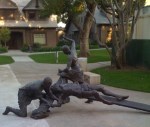
There’s an overstated statue of the crucifixion in the middle of the campus of Fuller Theological Seminary. It looks ridiculous. It’s a guy with hammer held high over the agonizing, contorted body of Jesus. Behind him are a manicured lawn and the beautiful arts and crafts homes of Old Pasadena that Fuller has turned into offices. Students sit in front of Jesus and eat sandwiches. It’s Mel Gibson ridiculous. But I sat and stared at it today, eating a sandwich, and I appreciated it for the first time.
It’s a stark contrast to Professor Jesus, who most of the seminary students are getting to know. It’s almost an ironic contrast. Professor Jesus has taught the seminarians to behave civilly, respect other cultures, be nice, be green, think theologically, exegete the culture, and market the church. They will analyze Jesus, dissect him, reassemble him, and leave after three years prepared to pull him out of their pockets and hand him out to a world that needs him, like a tourist passing candy out the window of his car to children while waiting to cross back at the Tecate border.
In contrast to that, there’s a bloody mess right in front of you.
David Augsburger
You’re probably not supposed to say this about your seminary professor, but…
I like the way Dr. David Augsburger’s eyebrows are caught in a permanent, sympathetic tilt, because they match his gracious personality. Some people have angry faces, and then you discover that they are sweet. But Augsburger tells you who he is when you see him coming, and then you get to find out that he really does care about how you’re feeling as much as you suspect he will.
Augsburger’s class on the soul gives an interesting tilt of another kind, on a long and variously used concept. The soul in the old world was a ghost in the machine of sorts, and the modern world clings to that as the straw man through which the concept (and thus religion) is to be rejected entirely. Steven Pinker, in The Blank Slate, thinks himself profound for having rehashed it (he is profound for completely different reasons, but his caricature of the soul is not part of that). The empiricists first dismissed the soul, most clearly in David Hume, as something impossibly intangible and improbable. The soul is a fairy tale, they assume to have proved.
Dallas Willard saved my soul, in a sense: my concept of the soul. Willard, a professor of philosophy, took the terminology of modern phenomenologists

and rebranded the soul. Because of Willard, I became open to understanding the soul as the projection of sustained identity created by consciousness. You exist only in relation. So even if ever cell in your body changes, even if you are struck with severe amnesia and lose “who you are,” even if your worldly belongings are stripped from you, nonetheless, we have sustained a perception of “you,” and that constancy is your soul. And yes, that “we” includes God.
Augsburger is not an epistemologist. Not that he doesn’t think about such things, only that they never rise above a curiosity for him. For him, the soul is the holistic view of a personhood which presupposes the eternal value of the individual. Thus, when he approaches, he honestly has the look of someone who has just watched a treasure chest being opened and is honestly and pleasantly surprised.
What They Didn’t Say in Seminary
Having finished my D.Min. at Fuller, I now can say with pride that I have been a small part in the world’s most influential seminary. I loved my experience there, and I love that I continue to live within close enough proximity to the campus that I can continue to take part in the offerings of Fuller Theological Seminary. I earned my M.Div. elsewhere, and admittedly do not know the course offerings for the Fuller M.Div. students, so this is not a review of Fuller’s programs.
But, now 12 years out of the M.Div. program, having served in 5 churches (before and after seminary), I do have enough experience in ministry to know where my original seminary education could have been better. The disconnect between what I learned and what I needed is pretty wide. Every book I read on church leadership by seasoned veterans of ministry only heightens my awareness of the fact that seminary wasn’t desperate to prepare me for ministry.
So in retrospect, here are the ten classes they should have offered in seminary:
1. Personnel Management
2. Vision Casting and Strategic Planning
3. Non-profit Financial Management
4. Change Management
5. Reviving a Stalled Church (most pastors are going to end up doing just that)
6. The Pastoral Role and Congregational Expectations (how to define yourself and set boundaries)
7. The Dynamics of the Associate Pastoral Role
8. Marketing (because most pastors just assume it works by magic)
9. The Intersection of Christ and Culture
10. When to Go (on how to gracefully leave a church, since most pastors do it more than once)
My seminary never got anywhere near any of these topics for reasons I still can’t fathom. To dodge them because they are too secular is no better than telling students they should just pray and read their Bibles instead of going to seminary.
Bored to Death
According to a report to be released this April in the International Journal of Epidemiology, boredom can be scientifically linked to depression. Depression, it is widely known, can be linked to a number of medical problems including heart disease, which can be fatal. Therefore, it is possible that one could literally be bored to death. I think it is only right and fitting that we begin to file lawsuits against boring churches for anticipated damages.
The Conservative-Evangelical Oxymoron
I realize that a category that has been bandied about in American culture for a couple of decades is an impossibility. A cross-section of Christians have been calling themselves “conservative-evangelicals.” I guess I’ve resolved to the fact that never the two shall meet.
Evangelical means desiring to bear good news to the world. It’s the guy who understands his daily life as a mission to follow Jesus, and, specifically, to talk about him with people who don’t know him. Paul was fundamentally evangelical. It means being willing to adapt and experiment in order to get into the context of those who don’t know Jesus. The evangelical will learn languages, change clothes, hang out where he’s never hung out before.
The conservative is just the opposite. The conservative wants things the same. The conservative is not going to learn a new language, he’s going to tell others that if they want in, they have to learn his language. He’s not going to change clothes. He doesn’t adapt, because adaptation is for the liberals.
I wonder how many once evangelical churches out there have eroded into conservativism. I know we used to use the terms together, but they are as far apart as “passionate” and “cowardly.”
How Preaching Works
I watched Pastor Adam Donner of Glenkirk Church preach a homily this weekend at a memorial service that was one of the best of its genre. Adam had a conversational, over-the-back-fence kind of tone. If he had notes in front of him, I couldn’t see them. Occasionally he would pause, make eye contact with someone in the audience, and then tell a story about that person in particular and that person’s relationship with the man whose life we were honoring. It was uniquely personal and comfortable for what can be so painful for a family. On top of that, he really told me about Jesus. And not just about Jesus, but about what it’s like to kind of be unsure about who Jesus is and then to come close to Jesus for the first time. It was a uniquely strong moment in preaching, but seemingly so casual and comfortable.
So here’s the grand generalization about preaching. In this post-60’s hippie apocalypse we know as postmodernity, that’s exactly what preaching should be. Doug Pagitt has written a singularly awful book about preaching, announcing simply that preaching doesn’t work. I would say it doesn’t work if you don’t know why you’re doing it. But Adam knew it this weekend. In a world where children are not taught a

basic respect for authority, or worse, much the opposite, preaching still functions extremely well. But only if you talk in a normal voice instead of the voice your seminary professors used, talk to the people you’re looking at, by name, instead of people in your blogosphere, wear jeans instead of a suit, lose the pulpit, speak from your own failures rather than know-it-all-ness, and hurt with people who hurt.
Preaching hasn’t gone anywhere. I’ve seen it recently. It just isn’t what your parents listened to anymore.
Wonder
I’ve read the systems of the great builders of human thought, and even the most complex of them are reductionistic.  Humanity is basically rationality, or basically a free laborer, or a libido. In the sciences, there is a dream of one day creating a unified system that encompasses all the sciences. I think it’s a horrible idea. In the arts, there is an unspoken dream of creating a unified system that summarizes human nature. One day, bragged a modern geneticist, we will be able to publish you on a disk. Equally horrible. And impossible. Poetry doesn’t come in ones and zeros.
Fundamental to human nature is wonder, and wonder is unquantifiable. It can’t be computerized. It can’t be encompassed in a system that explains what we are, because wonder is a reaching at beyond what we are.
There has been a creative theological debate over what it means to be made in the image of God. Some have said that the human animal can reason, to a greater degree than other animals, which makes us special, and thus in the image of God. A few modern theologians have said that God is three in one, a being in community, and so the imago dei is our ability to live in community with one another. I think that fundamentality, the place where we are most like God is in our ability to wonder. If there’s one thing in us that bears resemblance to him, that’s it. Stars…volcanoes…rainbows…birds, remember, were all made out of nothing but God’s imagination.
What happened to you?
We’ve all had that experience where we see someone we haven’t seen in a long while and notice that they’ve changed. If it’s a child, the change is all the more pronounced, and we’re all the more amazed. But I kind of wonder why that is.  Human beings being amazed by time is kind of like fish being amazed by water. We exist in time. We’re in it all the time. It should be pretty ordinary. A fish doesn’t notice water, I suspect, because it was made for it. We notice time, I think, because we weren’t made for it. We were made for eternity, and everything temporal ultimately jumps out at us as surprising. We have mid-life crises because all of a sudden we are forced to say, “Wait a minute! None of this feels right!” And indeed, it isn’t.
 Hardwired