Mentoring as Memory Making

father_child_fishingI can remember my grandmother showing me how to bait a hook, and my grandfather teaching me how to distinguish the tension in the line that is caused by a river’s current from the pull of a snagged trout.  I don’t mean I remember the idea.  I mean I can see in my head some clear pictures of them teaching me – of a silver fish in the bottom of a gray bucket, of a yellow kernel of corn in my hand next to the hook, of Granddad smoking his pipe on the bank.  That was almost 40 years ago.  40 years ago, I had thousands of experiences each day, but that one I can still picture.

I can remember my youth pastor teaching me how to read the Bible.  We were having a Bible study in a dusty upper room of a church, back when churches still had libraries, and we sat on the floor in a circle, and he showed me how to think through the biblical text.  We were reading Isaiah.  The carpet was green.  I can see us sitting there.

I can remember a leader in my college ministry at church teaching me how to articulate a rational defense of the Christian faith. We sat in the basement of his house watching VHS tapes of William Lane Craig debating other scholars.  We would pause the tape to debate the points that he made, and also to talk about our girlfriends and our desired careers and the news.  I can remember the very intense look my friend would get when he mulled over philosophical questions.  He’s now a philosophy professor who teaches at the same school as Craig.  I picked up a book in a theological library the other day because I saw my friend had written one of the chapters, and he had written about a subject I remember us arguing about one night.

Mentoring is not the act of an expert passing on a field of expertise.  It’s the moment that someone who is passionate about one of their interests stops to show why it matters to someone else.  What matters in that transaction is not that someone with a professional certification educates someone else.  What matters is that a memory is made when two hearts and minds gather around a topic of a similar interest.

Imagine what would happen if everyone who is passionate about Jesus took just a moment this week to talk with someone else about what Jesus has done for their marriage, their morals, the meaning of their lives, their parenting, their friendships, their prayer life, or their inner peace.  Imagine if all they did was share a question they wondered about concerning Jesus so that two people could wonder it together.  Mentoring is making memories that Jesus can use for the rest of someone’s life, and everyone who follows Jesus ought to be a mentor.

This week can pass by forgotten, or it can live on in someone’s memories for the next 40 years.

It Only Takes One

If I could study any of the biblical cities, I’d study Ephesus. I’d study it because it was a burgeoning, multi-ethnic, religiously diverse metropolis. I’d study it because it’s the best preserved of the ancient cities, having been vacated by a majority of the population after a wicked bout of malaria. And I’d study it because, through it, a couple of Christians changed the world. 

Imagine that if you decided to teach the faith to one person, you would create out of your city a hub of Christian teaching, writing, and thinking for the next hundred years. Imagine that if you decided to teach the faith to one person, one day people would talk about your city the way they talk about Salt Lake City – you know, “it’s ok to visit, but there sure are a lot of Mormons there.” Substitute “Christians” – that’s what a single mentoring relationship can do.

Ephesus
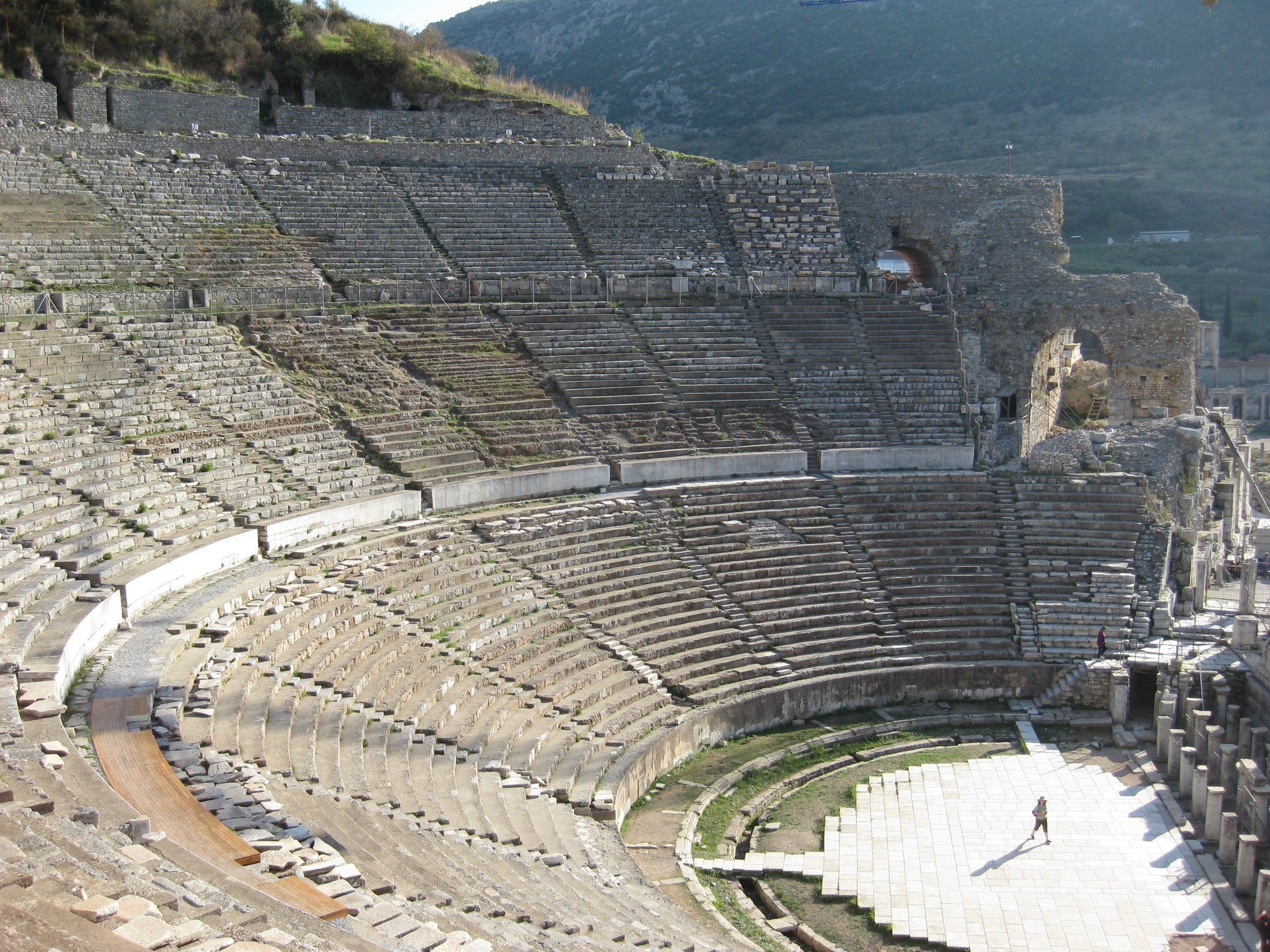
The theater in Ephesus, where Paul preached (Acts 19)

At Ephesus, Paul went and preached, staying 3 years and beginning a church. He appointed Elders and empowered saints. Then he left. But while he was there, he mentored Timothy, his “son” in the faith, to whom he passed on the best of what he knew.

John, the disciple of Jesus, settle there and became a pastor. He led the church, continuing to pass the faith on. We know of just a few names of individuals who moved from rural and distant parts to the big city, and that changed the city.

Ephesus became one of the centers of the Christian church in the centuries to come. By the 5th century, when the Roman Emperor wanted to call together a council of the bishops of the church, he called them to Ephesus.

It’s not inconceivable that any American city could have such a legacy. It only took one or two people gathering, engaging, loving, and teaching. Anyone can do that, in any city. Why can’t it be your city? Why can’t it be mine?

Three, Two, One

A snow-capped couple used to sit next to me in a café, clucking away with each other and passing friends. The first time I noticed them, I was trying to read Athanasius’ “On the Incarnation,” but couldn’t pay attention. I was privately amused at the way they loved each other, giggling as they finished each other’s sentences and offering to get up one for another, because at their age, it was too much of a commitment for them both to stand up.

I was conscious of my eavesdropping, but not of the effect they were having on me. They became part of the aesthetic of the café – the warm, sun-filled widows, the robust, walnut-toned coffee, and the happy old couple as familiar as the furniture. They were always there.

Until one day I saw her alone. When I stopped to ask, I withered to hear of his passing. She was thereafter different than she had been before, as was the café.

cloverThat couple for me is a better metaphor for the Trinitarian God than most of the go-to illustrations. St. Patrick notably used the three leaf clover to explain the Trinity to the pagan Irish, but his metaphor was flawed, because if you pull a leaf off of it, you still have a deformed clover, but a clover nonetheless. A widow is something fundamentally different than a spouse. One does not merely lose a spouse, one loses spousehood. When we love and are beloved, to lose love changes our identity.

Imagine the Trinity not as a mechanical philosophical concept requiring technical definitions of “substance” and “nature,” but rather a being who is so infused with and exuding love that the Father, Son, and Spirit are giddy at finishing each other’s sentences, that within the nature of the one God is a love so overwhelming that it must be reciprocated. Trinity is love immune the frailties of human love. It’s love made perfect, love like the first time a baby laughs, love like a wedding, love like a hero dying to save someone else. Imagine a love so urgent it can’t resist exposing itself to the risk of betrayal and brutality. It will pay the cost if only to love one more. Imagine a kind of love that promises a day when inseparable lovers are reunited, because that’s how a good story is supposed to end.

A friend of mine who is a missionary in a Muslim country tells me that she sometimes tells Muslims that there is “love if,” “love because,” and “love despite” – you can love someone if they will do something for you, because they have done something for you, or despite anything that they do for you. She has been told more than once by the people to whom she ministers that “love despite” isn’t real.

Imagine love despite. That’s a better description of Trinity that most of our metaphors.

Son of God Movie Review

Son of GodYesterday I was invited to Saddleback Church to preview the forthcoming movie Son of God, produced by the same people who created The Bible series for the History Channel last year, Mark Burnett and Roma Downey, who were both present for the screening.  I’d strongly recommend you put this on your list of movies to see when it releases on February 28th.

In terms of production value, it’s the best one of its genre.  The Jesus Film pales in comparison, looking almost like a homemade movie compared to Son of God.  The 1977 epic Jesus of Nazareth (over 6 hours long) was powerful for its time, but awfully hard to sit through.  The Passion of the Christ, which, coincidentally, released exactly 10 years ago on Feb. 25, 2004, did not tell the story of the life of Jesus, but really honed in on the pathos of his final week.  There really isn’t a modern day video retelling of the life of Jesus as good as Son of God.  More flamboyant retellings, like The Last Temptation and Jesus of Montreal, really fall outside the mainstream and look more like a sectarian reinterpretation of the story.

The movie doesn’t stray far from the biblical narrative, though it fleshes out some of the narrative behind the Roman occupation, and it emphasizes the way Jesus was an offense both to Romans and Pharisees.  Many of the lines are paraphrases of the words of Jesus and the biblical characters, but the movie isn’t indulgent in its adaptation.  It leaves a lot out, but after two and a half hours, it would have been hard to meaningfully include more and still accommodate the modern attention span.

For that reason, you need to see it.  Take your kids.  Take your unbelieving friends.  Take your small group and let it guide a discussion of which parts of the life of Jesus you tend to pay the most and least attention to.

The only criticism I have of the movie are just in the nature of the genre.  Many of the characters are white people with British accents and perfect teeth.  Of course, I don’t think American English would be any more authentic, and the only way around these cliches would be to do as The Passion and have the whole thing in Aramaic.  Some of the dialogue is oddly lilting, and the soundtrack is a bit melodramatic.  The costuming is a silly blend of immaculately clean robes in a rainbow of colors.  Still, the actor who plays Jesus, Diogo Morgado, is a nice variation on his predecessors.  Rather than pale and somber, he often appears amused.  You can’t help liking him from the beginning.  And to be honest, the cliches are at about the level of presentation that most Americans expect and even want from a story set in the ancient world.  We have the same caricatures when it comes to stories about ancient Greece, Rome, and Egypt.

So take the movie for what it’s meant to be.  It’s not simply entertainment, and it’s not intended to offer a new slant on the biblical narrative.  It’s fundamentally an evangelical tool for retelling the gospel again in a modern language.  And anytime Christ and culture meet, it’s a good opportunity for Christians to enter into conversation with a world that has heard different representations of Christianity and still wants to see the real thing.

hardwired cover


Please check out my book!  – – – – – – ->


Unintelligent by Design

DarwinOne of the criticisms I’m regularly seeing in discussions of evolution is that those who claim that life shows signs of intelligent design are relying on a “god of the gaps” argument.  The charge is that where they cannot explain how something happened, they’re just answering “God,” without any further intellectual curiosity or explanatory possibilities.  In fact, I’ve heard several skeptics call it “Intelligent Design of the gaps.”

But it occurs to me that if something shows signs of being designed by an intelligent mind, and a skeptic says that such an explanation doesn’t count, what he means is that intelligence isn’t a thing.  Intelligence doesn’t have explanatory power.  You can’t point to something and say that it’s obviously the work of an intelligent mind.  If that’s true, the skeptic of intelligent design must literally be saying that intelligence doesn’t, in and of itself, exist.  There must be something behind the appearance of intelligence which isn’t itself intelligence.  The skeptic literally won’t stop looking until he’s found something unintelligent.

It’s a little bit difficult to give credence to an idea being forwarded by someone who from the outset dismisses things that look intelligent.


My sense for how our design points us towards a designer is in my book Hardwired: Finding the God You Already Know.

Debate, Doubt, and Darwin

Image

Not long ago I posted a review of Darwin’s Doubt which went viral and provoked the response of a fiery graduate student.  The review and pursuant conversation actually provoked a conversation of its own.

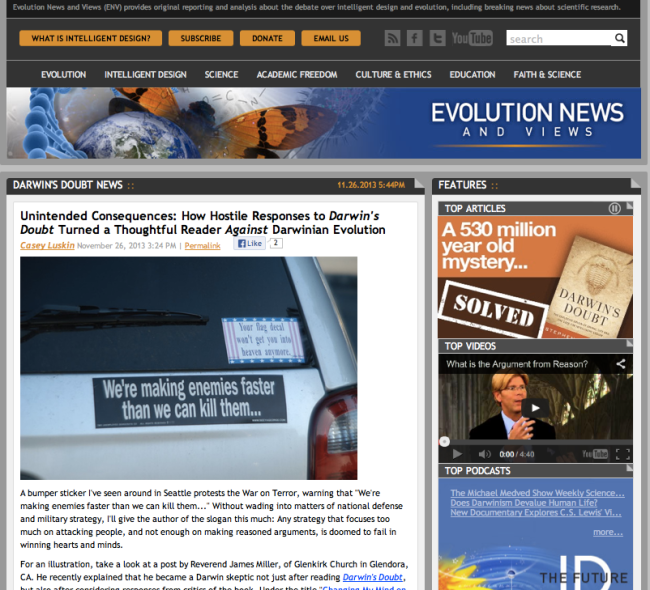
A bumper sticker I’ve seen around in Seattle protests the War on Terror, warning that “We’re making enemies faster than we can kill them…” Without wading into matters of national defense and military strategy, I’ll give the author of the slogan this much: Any strategy that focuses too much on attacking people, and not enough on making reasoned arguments, is doomed to fail in winning hearts and minds.

For an illustration, take a look at a post by Reverend James Miller, of Glenkirk Church in Glendora, CA. He recently explained….

Read the rest here….

A Philosophy Lecture

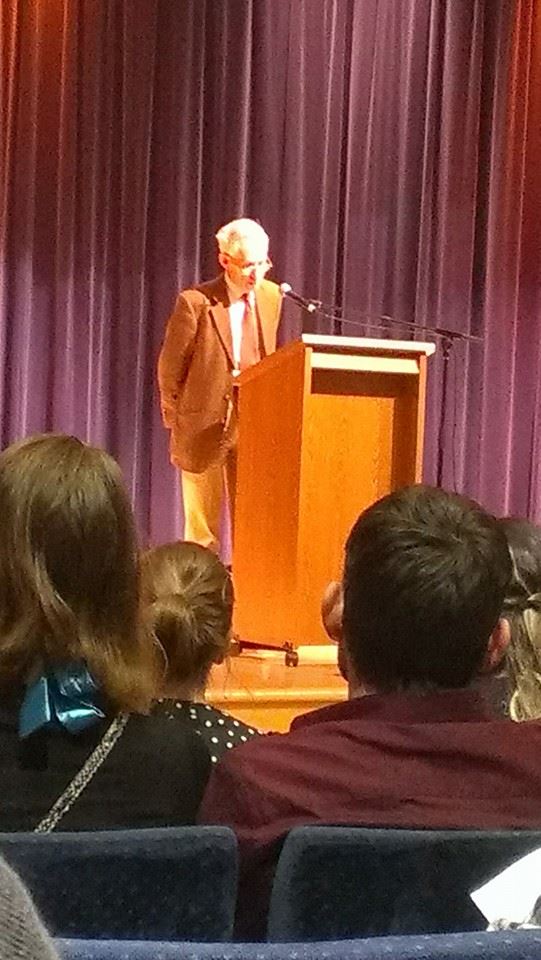
ImageSo I was sitting and listening to Richard Swinburne, the Oxford professor who is perhaps the leading voice in philosophy of religion among Christians worldwide, and I was getting knots in my stomach.  I didn’t want to stand up and ask questions, because I felt like a kindergartner who had wandered into a class on nuclear physics.  But something just wasn’t sitting right with me.

Swinburne believes that morals exist, regardless of the existence of God.  God clarifies morality, and sometimes makes obligatory things that are only neutral otherwise, but morality is just a real thing that everyone knows about.

So when the nice man stood there waiting for questions, and the glazed-over undergraduates with limited experience in philosophy had nothing to say, I felt worse for him than I did about myself, and I went to the microphone.

“If there are logically necessary moral principles,” I began, “then how do you respond to the sweepingly popular atheism in the West that uses those morals to critique the canonical God, who does things like telling Abraham to kill Isaac?” To be honest, there were probably a lot of “ums” and “uhs” in there too.

What Swinburne did next was dumfounding.  He said that the early church used an analogical reading of Scripture to make the difficult texts jibe with Christian morality.  For instance, he said, citing Psalm 137, the early church took the “children of Babylon” to be our evil desires, and the “rock” against which they were to be bashed was of course Jesus.  So some texts don’t have to be interpreted literally.

So there was my answer – difficult passages of Scripture can be written off with flowery and virtually nonsensical interpretations.

That interaction brought me back for his second lecture the next night.  I wasn’t disappointed.  He talked about how it’s beneficial to be governed by Christian moral principles, like the fact that men should be the decision-makers in their marriages and homosexuals shouldn’t marry.

So I hopped up to the microphone again.  “If we believe that passages that don’t jibe with Christian morality can be interpreted analogically,” he nodded as I spoke, “and you’ve said that humanity seems to be progressing morally over time through a process of reflective equilibrium, why can’t we analogically interpret the passages that now run counter to increasingly widespread thinking in the modern Church?”

His answer was a long one, which wove its way through the correct way to analogically read Scripture to the process of canonization to Augustine to the nature of modern ethical thinking.  I’m not quite sure what the conclusion was.

But here’s the deal – on those places where I agree with Swinburne, I come to my views based on a literal reading of Scripture.  Analogically divorcing the God of the Scripture from moral principles that seem more intuitively appealing is just going to create a false, albeit nice, God.  It’s an idol of intuition.  And it’s going to be impossible to hold onto rigid, literal biblical principles on human sexuality while writing off a God who doesn’t behave the way we want him to.

Morality is determined and dictated by the God who can command Abraham to sacrifice his son.  He can tell us who to marry and who not to.  Morals cannot fundamentally exist without God, because morality is, and only is, what God makes it.  The minute we try to soften that God with flowery interpretations of Scripture, we lose God all together.  Without God, we are highly evolved puddles of primordial ooze, and morality is a joke.

Then again, admittedly, I’m not qualified to challenge a mind like Swinburne, and an hour’s lecture with brief Q&A isn’t sufficient to plumb a man’s thoughts.

Changing My Mind on Darwin

ImageSo I’ve changed my mind about Darwinism.  I guess I have to tell you where my mind was to tell you where it now is.

I’ve never invested much study in evolution because I was neither threatened by it theologically nor enchanted by it philosophically.  The biology teachers taught it to me.  I can explain it.  As a follower of Jesus, I can see a viable explanation for how God could do it that way.  I’m also not overly confident that science is fueled by objective curiosity rather than passionate self-interest and ideology, money and power.  Science is motivated reasoning on its best days.

When I listen to militant Christians talk about Darwinism, it’s pretty clear they aren’t scientists, don’t know what they’re talking about, and aren’t even open-minded enough to think about the subject.  When I listen to militant Darwinists, it’s pretty clear that they aren’t scientists, don’t know what they’re talking about, and aren’t even open-minded enough to think about the subject.  I guess there are just so many fundamentalists in this debate on both sides, I’ve stayed away from it entirely.  I read a few books about it years ago and felt like there were a few intelligent people arguing for and against, surrounded by a cacophony of lunatics.

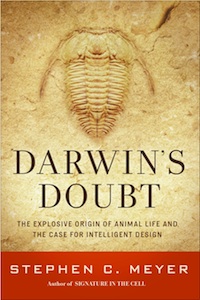
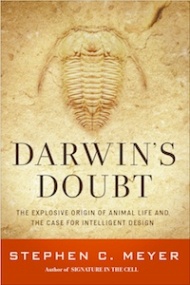
I’ve just read Stephen Meyer’s Darwin’s Doubt.  Meyer is a Cambridge PhD in philosophy of science.  He hangs out with the Intelligent Design people.  His writing is fluid, detailed, and reasonable.  He seems to know what he’s talking about.

The book makes the case for the fact that the fossil record doesn’t support Darwinism.  The sudden appearance of new phyla without sufficient time for the mutation and selection process to work is simply unaccounted for by the rocks.

The problem is that when Meyer says things like, “the Precambrian fossil record simply does not document the gradual emergence of the crucial distinguishing characteristics of the Cambrian animals,” how on earth should I know if he’s right?  I don’t have time to immerse myself in paleontology.  I’ll never be an expert.  I just have four hundred pages of articulate, self-assured, well-documented evidence for Meyer’s case.

So here’s how I find my way into a conversation on subjects that are not my primary field of study.  I read the reviews that are antagonistic to the source and just look at the logic that’s employed.  I find that this often gives me the best read on a work.  If the critics are sincere, the reviews are usually precise.

The New Yorker’s review began with a genetic fallacy, presented arguments that Meyer had refuted without mentioning that Meyer had addressed them, and then deferred to another blogger for the scientific content of the review.  It then called Meyer “absurd,” which, given how shoddy the review actually is, was an absurd thing to do.

Then I read the review from which the New Yorker piece got its “science,” which was actually written by a grad student at Berkeley.  Now I have to say that Berkeley is, in fact, one of my fields of expertise, and I know exactly how Berkeley grad students go about their “work.”  Somehow Berkeley selects the crazies and the militants who show the most promise and then teaches them that knowledge is a completely subjective power tool which should be manipulated by those on an ideological crusade to undermine authority.  I’m not kidding.  I went to Berkeley.  That’s what we did.

What’s interesting about the grad student’s review is that it was posted 24 hours after the release of Meyer’s book, and it’s filled with snark.  He’s not having an intelligent conversation, he’s insulting Meyer in order to defend something religiously.  In a later, defensive review, the grad student says that he read the book “during lunch.” He read over 400 pages of scientific material during lunch, and then posted an insulting review.  He says his detractors are just “slow readers.” People who win speed reading competitions tend to cover 1,000 words per minute (maybe 4 pages) with 50% comprehension.  That level of comprehension is almost useless, and it becomes less useful the more information-rich the content.  A book of Meyer’s size would have taken an hour and forty minutes at that pace, with minimal retention, and that’s if you’re not, oh, say, eating lunch.  On top of that, the review is almost 10,000 words long, which would take some time to write, making it highly suspicious that the review was written after the book was read and not before, in anticipation of the book’s release.

See, this is how I know who to trust in academic communities.  The charlatans have no character.  You read the grad student’s defenses of his review (and they sound a little panicked), and you realize that he has been following Christians around and arguing with them for years with an inquisitor’s zeal.  There’s a personal agenda here, and his approach to new information on the subject is anything but scientific.

Now I start to smell a rat, and I change tactics.  Now I really want Meyer to be wrong.  I want one, good, solid review by an objective thinker, maybe even a Christian, who can debunk Meyer.

So then I read Donald Prothero’s review.  He’s a paleontologist and a scholar.  It begins with a caricature and a smear, saying that anyone who questions evolution suffers from confirmation bias (explain Thomas Nagel?).  He then says they have PhD’s in the wrong fields and thus aren’t qualified to discuss evolution (Meyer, again, studied philosophy of science).  Then he launches into unsubstantiated accusations, saying there are errors on every page.  He says Meyer claims the Cambrian explosion happened “all at once.” Now look, I just read Meyer, and he doesn’t say that at all.  This isn’t a mistake.  This is a lie.  The truth comes out as he goes on to refer to Meyer’s religion as a “fairy tale.” Again, I haven’t found a scientific mind.  I’ve found another fundamentalist.

Now I start to sweat.  A host of scientists have endorsed the book (http://www.darwinsdoubt.com/blurbs/).  I want one to reject it on perfectly level-headed grounds, with no patronizing rhetoric.

Another definitive work on the Cambrian Explosion came out in January of this year.  Called The Cambrian Explosion, it attempts to give a scientific explanation for how so much variety erupted in such a short time.  The authors say “the Cambrian explosion can be considered an adaptive radiation only by stretching the term beyond all recognition.” That means the evolutionists are saying the fossil evidence doesn’t bolster evolution in this particular era.

The New York Times ran a science article last month that said that scientists will spend the coming years trying to figure out what combination of environmental triggers caused the Cambrian explosion.  It doesn’t mention Meyer.  It also seems to leave a big, open question mark about why we need to defend Darwinism at points where the evidence leans away from it.

So now I’ve changed my mind.  I don’t think the fossil evidence does support the current representation of Darwinism.  I think there are some otherwise well-trained scientists who are freaking out, and doing it in widely public and observable ways.  Their lack of command of reason is a tell-tale sign that their motives for defending their orthodoxy are not scientific.  And I believe the failure of the scientific communities to engage in this conversation in a rational way is a manifestation of power brokering rather than honest intellectual engagement.

Could humanity have evolved?  Sure.  But the case isn’t as strong as they told me in biology class.

Interviewed for Truth Matters

Image

Recently I was able to interview James Miller, author of the new apologetics book Hardwired.

Me: What moved you to write Hardwired?

James Miller: I have a real passion for students who grow up in the Church but who aren’t prepared to answer the tough questions that will come their way in college.  My prayer is that Hardwired will help engage some of their deepest quandaries.  I already have two agnostic friends who are reading it.

Me: You wrote, “No one has to convince you that you’re home”. I believe that this sums up Hardwired. Could you briefly explain this statement?

JM: There’s a feeling of resonance…

Read the rest here.