Euthyphro Redux

Socrates: Why the long face, Euthyphro?

Euthyphro: Our previous conversation has made me come to realize there can be no actual virtue, Socrates, nor a god.

Socrates: Gads!  Why not, friend?

Euthyphro: Because if virtue is good because the gods command it, it is merely their arbitrary will.  And if they command it because it is objectively good, then the gods themselves are subject to something greater than themselves.  Thus I conclude that there is no value, and probably no gods anyway.

Socrates: You’ve clearly left port without a sail, sad companion.  With what will you replace the gods and value then?

Euthyphro: With Nature, Socrates, and with Reason.  Nature has brought us into being over the long course of time, and Reason is the pinnacle of our being.

Socrates: That’s a thinker.  I wonder, though, if I might ask you a question about that?

Euthyphro: I’d kind of prefer that you not.

Socrates:  Is reason objectively accurate because it has been created by nature to be so, or did nature create it to be so because it’s objectively accurate?  If nature created it to be so because it’s objectively accurate, then something other than nature brought its objectivity into being.  If it is accurate because it is created by nature, then nature’s dictation of it is merely arbitrary, the bouncing around of particles, rendering it not actually objective.  Yet obviously reason works objectively, or else we couldn’t have this conversation.  From whence then, comes reason?

Euthyphro: You know I hate you, don’t you, Socrates?


“Therefore any evolutionary account of the place of reason presupposes reason’s validity and cannot confirm it without circularity.” – Thomas Nagel, Mind and Cosmos, p. 81.

Atheist Richard Dawkins “has lost”

In a provocative commentary entitled “Richard Dawkins Has Lost: meet the new atheists,” writer Theo Hobson alludes to how compelling the moral argument is.  In recent posts, I’ve presented it’s strongest formulation, and despite nitpicking and name-calling, I think the argument has spoken for itself.  Hobson observes that modern atheists are wrestling with morality: “Rejecting religion is no sure path to virtue; it is more likely to lead to complacent self-regard, or ideological arrogance.” He goes on to describe how secular humanists today have become squeamish about Dawkins’ arrogance and venom, and instead are turning to more nuanced and subdued appeals for humanism.  Once such nuance is the casual admission that atheists are still desperate to find a foundational, unifying moral ground.


Studies have reported that “the single biggest predictor of whether someone will be charitable is their religious participation.”

Amoral Atheism

I’ve been discussing the moral argument for the existence of God lately which goes simply:

If God does not exist, objective morals do not exist.

Objective morals do exist.

Therefore, God exists.

A quick and standard rejoinder has been, “So you’re saying atheists can’t be moral?” Now on its face, the question is a straw man, and a poorly phrased one at that.  What the question should be is, “Does the moral argument imply that atheists cannot behave in socially well-adapted way?” Or in other words, “Can’t atheists be nice folks?” And of course the answer to that (irrelevant) question is “no.”

But it raises another question that is not addressed by the moral argument.  That question is, “Can atheists rationally commit to binding behavioral obligations that they are not free to violate without hypocrisy or deceit?” In other words, is there anything that rationally makes atheists be nice folks.  And the answer to that is a solid “no.”

ImageWithout God, the universe is a mysterious accident.  Life is an accident.  The fact that we can contemplate our existence and wonder about our purpose is a horrible disfigurement of human nature brought on by runaway genetic mutation.  Thinking about purpose in a world that has none can only lead to despair.  As a result, our deaths are meaningless conclusions to the senseless banging together of the particles that comprised our bodies.  If we die young, it is neither right nor wrong.  If our lives accomplish nothing, it is neither right nor wrong.  If we hurt others or are hurt ourselves, there is nothing fundamentally right or wrong about the hurting.  Wanting to improve humanity is a silly misfiring of genetic inclinations to preserve ourselves, all of which will be rendered utterly stupid when the universe eventually expands to the point of its inevitable heat death.

So must the atheist be nice?  By no means!  And it is not wrong for him to be mean, because in the atheist conception, there is no real right or wrong.  There is only impulse, social contract, and group think.

These questions would come a lot more clear if we would start defining morality as a logically obligatory set of behavior-governing principles, at which point we could say definitively that atheists cannot be moral.  They can only be nice.  And their reasons for doing so may as well likewise die an early heat death.

Can atheists be moral?  Not by this definition.  They can go along with the group will of the day, constantly open to the option of abandoning public consensus for the sake of personal gain or pleasure.  And the most casual study of human behavior will show how likely that possibility is.

Atheists v. Evidence

ImageIn recent posts on arguments for theism, I’ve been both fascinated and befuddled by responses from atheist critics.  The particular approach that I’ve taken is to show that rational and moral adults act as though God exists even while they may ironically deny his existence.  I have yet to receive any meaningful rejoinders.  But there is one response that I have received consistently, which is, in so many words, “You haven’t offered any evidence for God.”

Now what’s befuddling about this is that, in fact, I have.  The moral argument, for instance, is actually deductive evidence for the existence of God.  The argument goes:

If there is no God, objective moral values don’t exist.

Objective moral values do exist.

Therefore God exists.

What I’ve said is that everyone, including atheists, generally subscribe to the first premise, and all but the mentally ill subscribe to the second.  In fact, atheists usually complain about God on the grounds of moral principles that they believe hold objectively to all people at all times, including God.  So in fact, I hardly need to prove the existence of God to an atheist – everyone already lives as though God is there.

What’s befuddling is how many atheists over-confidently assert that I haven’t offered any evidence.  What they mean is “empirical evidence,” or evidence that can be tested by the senses.  What I’ve offered is rational or philosophical evidence.  But what I’ve offered actually does qualify as evidence.  Insisting on empirical evidence is in fact self-refuting, because there is no empirical evidence to prove that things can only be believed on the basis of empirical evidence.  This was the now well-documented failure of verificationism and logical positivism, which have lost their followership.

So I believe I’ve offered a solid if not irrefutable proof of the existence of God.  The onus is on the atheist to demonstrate how on earth he could come up with a moral critique of God on the basis of a material world that generates no objective moral values.

The Atheist Who Loved God

In chapter 6 of The God Delusion, angry atheist and former scientist Richard Dawkins claims to explain where morality comes from for the atheist as a rebuttal to the charge that atheists cannot be moral.  What he produces is a bizarre intertwining of straw men and other fallacies.  What Dawkins flirts with, and fails to address, is the actual moral argument for the existence of God.

The moral argument goes simply:

Without God, objective moral values do not exist.

Objective moral values do exist.

Therefore, God exists.

But Dawkins fails to address the real moral argument for God’s existence.  First I’ll summarize chapter 6, then I’ll review whether or not the moral argument for God’s existence withstands Dawkins’ critique.

SUMMARY OF CHAPTER 6 OF THE GOD DELUSION

Dawkins begins the chapter by battling people who write hateful comments on atheistic websites.  This is the worst kind of straw man argument.  Instead of taking on any serious kind of theism or religious behavior, he cites inflammatory examples of people who obviously don’t hold to Jesus’ teachings while they attack atheists.  It’s important to note that what Dawkins is doing here is misleading.  It is not a scholarly engagement with meaningful ideas.  It’s no more meaningful than entering into a debate with a middle schooler in a comment thread on YouTube.  This goes on for 5 pages.

Dawkins then proceeds to the argument that morality could develop through evolution.  The “selfish gene,” the gene that survives for generations, does best by programming the organism that carries it to survive.  In some contexts, survival is best promoted by kin altruism, where a society of beings protect one another.  Likewise, reciprocity, in which genes program organisms to return favors for favors, is a beneficial trait for survival.  Or again, generosity may be assumed to allow certain members of a species to show dominance over others, proving that he is the one who is better off and can give more, which is likewise beneficial.  As a consequence of these evolutionary possibilities, morality can exist without God.

Yet when these natural instincts lead us to accidentally care for kin that are not genetically related to us, they are “misfirings.” Dawkins himself even points out that adoption is a human form of genes misfiring, though he claims that he doesn’t mean this to be pejorative.  Yet caring for someone who is in pain but who is not genetically related to us is an example of these “blessed, precious mistakes.”

Here Dawkins starts to betray himself.  He calls compassion and generosity “noble,” but clearly the word is meaningless.

Then it gets worse.  He cites another researcher who claims that morality has a “universal grammar” because it is hardwired into our brains through this evolutionary process.  In other words, we share the same biology, and as a result we all have similar moral inclinations.  Dawkins is here attempting to have the cake of objective moral beliefs and eat it too by saying there is nothing fundamentally binding about them.  They too must be “misfirings,” though Dawkins fails to point this out.  He still wants them to be “noble,” though they are clearly nothing more than accidents.  He uses several hypothetical examples to show that we can have moral feelings that aren’t grounded in clear principles.

Finally he gets to the real moral argument, and totally biffs it.  Again, as he is fond of straw men, he poses the question in such a way that the adherent is portrayed as being moral only to earn rewards from God.  Dawkins then mocks this as petty.  He dodges entirely the fact that moral objectivity is grounded in God’s design for humanity, rather than in simple rewards.  Moral objectivity derives from our beginning, not our end, our creation, not our judgment.

He flubs again when he cites an example of how a near riot broke out when the Montreal police went on strike.  “the majority of Montreal presumably believed in God,” Dawkins asserts.  “Why didn’t the fear of God restrain them…?  This is positively ridiculous.  Canada has for decades been a post-Christian culture, and the claim that a majority of Montreal believed in God is ridiculous.  Furthermore, the bank robberies and looting that took place can hardly be attributed to the majority of Montreal.  Dawkins completely misrepresents this event to prove his own convoluted conclusions.  He does the same thing again when he quotes a study that says crime is higher in states where religiosity is higher.  This is the fallacy of composition – the claim that something that is true of the whole must be true of the parts.  A larger religious population in a state does not imply that all people within the state are religious, nor that the events, good or bad, that happen within that state are a direct result of whomever is the majority of the population.  Here, Dawkins’ ignorance is laughable.  It’s embarrassing to see a supposed scholar come out with something that would have failed him on a freshman philosophy exam.

Perhaps Dawkins realizes that he is losing ground here, because he starts to waiver.  “Even if it were true that we need God to be moral….” Then a page later, “it is tempting to agree with my hypothetical apologist that absolutist morals are usually driven by religion.”

So then he leaps to the other side, “Fortunately, however, morals do not have to be absolute.”

And having now admitted that, Dawkins throws a rod.  He spends the next several paragraphs deriding patriotism for leading to war.  Then he just trails off into criticizing the formation of religious holy books.

THE MORAL ARGUMENT

Let’s see how the moral argument survived.

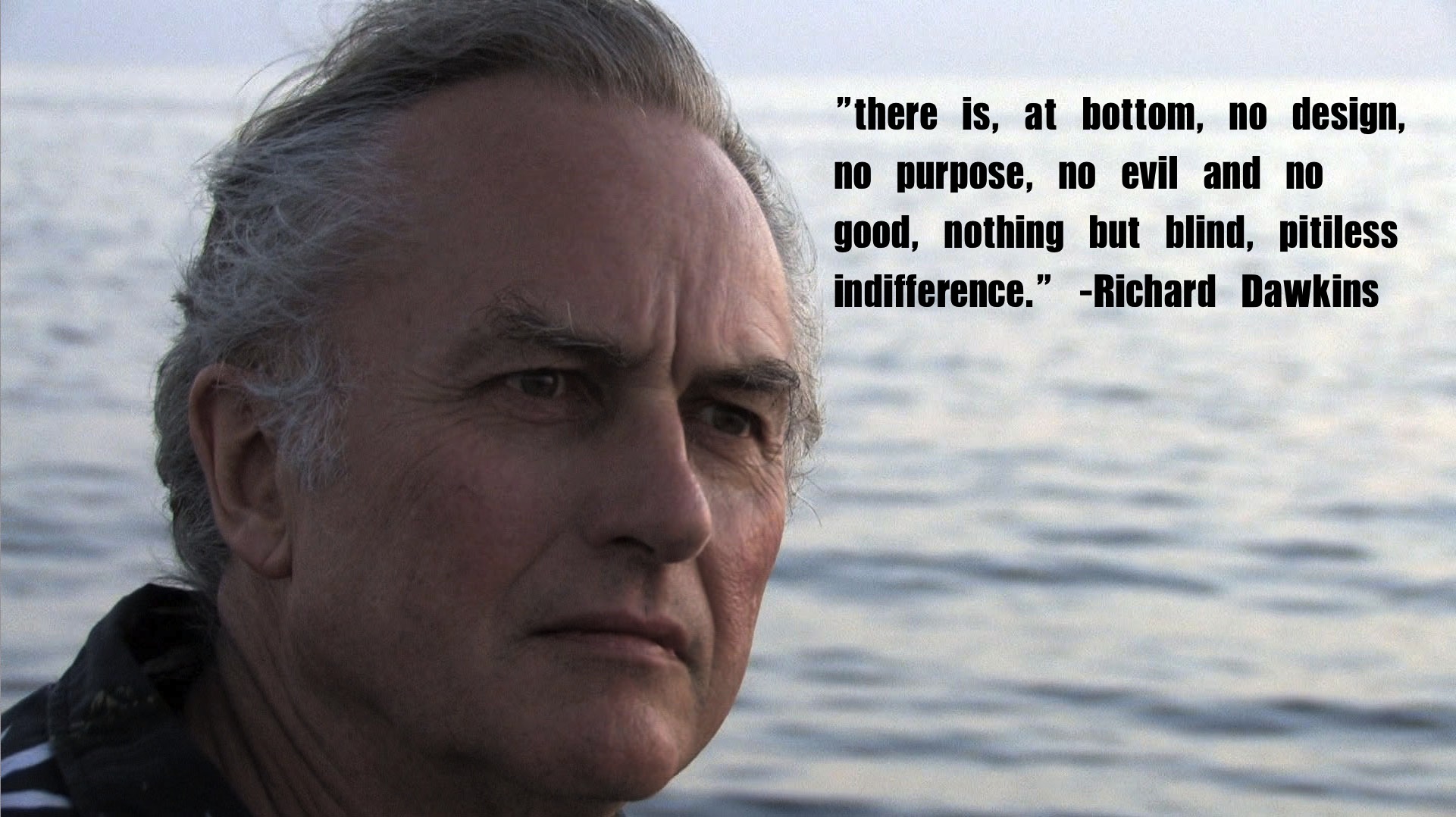
Premise 1:  Without God, objective moral values do not exist.  Dawkins supports this premise.  He clearly admits that moral inclinations are misfirings aimed at personal survival.  In A River Out of Eden, Dawkins puts it simply: “There is at bottom no design, no purpose, no evil, no good, nothing but pitiless indifference.  We are machines for propagating DNA.”

Premise 2: Objective moral values do exist.  Well strangely, Dawkins supports this claim too.  Nobility is objectively good.  He believes that crime is objectively wrong and chides religious states for having too much of it.  He believes the bloodshed and war that result from patriotism are wrong, and ironically, he believes that consequentialist morality is objectively better than absolutist morality, a claim which he makes absolutely!
Image

His criticisms of God elsewhere in the book come from his belief that the actions of God in the Bible are objectively wrong.  So while I don’t know that Dawkins would own up to it, all of his seething rhetoric is filled with the belief in objective moral principles that he believes should apply to everyone.

If the two premises are true, the conclusion is logically unavoidable.  God exists.  Binding objective moral values cannot exist in a simply material world.  They must come from design and purpose, and specifically, from a purposeful designer.

So tonight I give thanks for Richard Dawkins, the atheist who proved the existence of God.

Everyone Believes

One of the things that fascinates me about modern defenders of the Christian faith is how casually they begin in the wrong place.  They start with the assumption that their listeners are objective and analytical and can be persuaded by facts.  I doubt this is true.  Then they assume their role is one of defense attorney who presents a reliable case sufficient to free God from the atheist’s accusations.  I know this isn’t true.

The Bible starts in a completely different place, saying we are “without excuse” for not believing (Romans 1:20).  The atheist needs a defense attorney.

And what’s most surprising about this to me is that the guy who says he doesn’t believe in God has already shown that he depends upon a world in which God does exist in three ways.

First, when one says, “God does not exist,” that person is assuming that the purpose of communication is to tell the truth.  They assume that they are somehow morally obligated to try to reflect what they think accurately, and they assume the person to whom they are speaking is doing the same.  But this moral undergirding is suspicious.  If God doesn’t exist, morality is at best a mistaken byproduct of blind evolution.  So long as survival of the fittest is the only goal, there’s really no objective moral obligation.  I can tell the truth if I want and not if I don’t.  But when we say, “God does not exist,” we’re assuming that communication in general rests on a real obligation to tell the truth, which is a moral claim.  It’s just strange to me that we act as though objective morals should exist, when a universe without God doesn’t require objective morality.

Second, when you say, “God does not exist,” you are assuming that the thoughts in your head accurately reflect the world around you.  You really think that in the universe, there is not a God, and that your perception of that world is accurate.  But there’s a problem.  In a godless universe, everything is simply matter.  Everything is made up of colliding particles.  Our brains in our heads are just a collection of particles that have come to function in certain ways.  But there’s nothing objective that obligates the particles in our heads to give us an accurate picture of the real world (this is sort of the red pill here).  It’s the same as the first point in a way – nothing objectively obligates brains to “tell the truth,” or to work in a way that is objectively accurate.  Yet when someone says, “God does not exist,” there is a fundamental assumption that brains and sensory organs must work accurately.  Descartes, Berkeley, and company knew that they had to ground their philosophies in the assumed existence of God before they could begin talking about what they did and didn’t know about the world.  But the assumption that our senses are right isn’t necessary in a godless material universe.

Third, when you say “God does not exist,” you are trusting that communication actually works.  You are trusting that the ideas in one person’s head can be translated into language, perceived consistently, and received accurately.  Deconstructionists like Foucault would say that this misrepresents they way language actually works, as truths are simply the falsehoods that have been hardened by the long baking process of history.  Derrida would observe that the place where we assume big ideas are connected to particular expressions of those ideas (where “forms” are stamped into “particulars”) is a lot more fuzzy than we assume when we talk to each other.  Again, a material universe with no guiding conscience would not necessitate that words  have meaning or that language is effective.  These things require something more purposeful than the blind movements of particles.

So when someone says “I don’t believe in God,” they are trusting that we are bound by the objective moral obligation to tell the truth, that our brains are bound to purposefully reveal accurate information, and that communication can be infused with objective meaning, none of which should necessarily exist in a godless universe.  That person is acting like God is there at exactly the moment she says he isn’t.

So ironically, the person who says “God does not exist” is actually proving that God does.

Explore this and other curiosities in my book Hardwired: Finding the God You Already Know, available this September from Abingdon Press.

Rob Bell’s Mental Furniture

Image
Talking about Talking About God

Rob Bell gave a lecture tonight at First Baptist Church of Pasadena to promote his new book, “What We Talk About When We Talk About God.”  He kept repeating a phrase that was incredibly revealing.


THE CROWD

The crowd was about 300 people, almost all students of Fuller Seminary, which had promoted the event.  I should say, in the world of hipsters, hats are apparently completely out after having been completely in for about a year.  The crowd was maybe 50/50 on the gender split, mostly around 30 years old, and heavily Caucasian.  An one hat.

The hour long lecture was a funny and warm-hearted verbal rendition of the first chapter of Bell’s book.  Literally almost word-per-word in some sections, with all the same punchlines.  For first timers, it was a lot of fun.  For anyone who had read the book, it was like watching the same episode of “Everybody Loves Raymond” for the second day in a row.  You’re like, “Yeah, I remember that being funny.”


QUESTION TIME

At the end, in a Q&A period, a couple of students asked some really smart questions.  They asked them humbly and hesitantly, so I’m not sure if everyone understood how sharp they were.  One person observed that Bell keeps talking about the God who is “ahead of us, pulling us forward.” In Bell’s cosmology, God’s primary goal is progress.  God is working to get us to “the next step,” and there’s no judgment for being in your present place (I’m not sure if these means theologically, morally, or in terms of mental health).  “What about the fact that the Bible seems like it’s behind us then?” the student asked.  Bell rambled on this one.  He said that the Bible was in fact progressive for its time, which only left open the possibility that it’s not progressive in our time.  Rather than linear answers that addressed the questions, Bell tended to float around verbally to different illustrations which were not always on topic.

Another student followed up, “Let’s say you have a friend who is a spiritual seeker who reads about Joshua killing the Canaanites,” he began.  “Who picked that text?” Bell teased.  Then he answered that “You can just start with Jesus and work your way back from there.” He referred the student to a British theologian whose name he couldn’t remember who argues that it wasn’t actually genocide (I think he’s referring to Christopher Wright, though Wright actually says that the Canaanite slaughter was as bad as it sounds, and God was just accommodating that context). Bell simply dodged the question.


THE BIG ISSUE

Which brings me to absolutely the most interesting part of the night.  Several times Bell referred to doctrinal accuracy with the phrase, “Getting the mental furniture in order.” He said, “Instead of trying to get the mental furniture in order, which you’re never going to do…”, we should instead gather around the eucharist and make sure everyone’s needs are met.  What’s shocking about this is that Bell isn’t taking his own advice.  Bell very clearly thinks he understands God’s nature, and very clearly thinks that “the institutional church” is getting it wrong.  He says that if we believed (aka got the mental furniture in order) that God was with us, for us, and ahead of us, this generation would be more interested in God.

This is just contradictory.  If getting God right is important, we can’t very well dismiss doctrine.  Bell threw in an aside, “Sure, some doctrines are helpful.” But he seems to be missing the heart of the exercise that he himself is taking part in, which is the revision of doctrine.  He’s absolutely right about what’s at stake – a mistaken understanding of God turns people away from God.  The problem is that the God who is always leading people towards progress without judgment isn’t an entirely accurate picture of the biblical image of God.  Bell has moved the furniture while denying that the placement of the furniture matters.

The upside of Rob Bell is that he really believes that people need love.  He thinks that they need to know Jesus.  He just doesn’t seem to think Jesus jibes with the God of the Bible, including the God that Jesus himself describes.  Bell needs to have a come-to-Jesus talk with himself where he admits that he has intentionally ordered the mental furniture to arrive at his present theology.  Then he might realize that he’s got the furniture in the wrong places.  And maybe then we’ll find the hat rack.