Son of God Movie Review

Son of GodYesterday I was invited to Saddleback Church to preview the forthcoming movie Son of God, produced by the same people who created The Bible series for the History Channel last year, Mark Burnett and Roma Downey, who were both present for the screening.  I’d strongly recommend you put this on your list of movies to see when it releases on February 28th.

In terms of production value, it’s the best one of its genre.  The Jesus Film pales in comparison, looking almost like a homemade movie compared to Son of God.  The 1977 epic Jesus of Nazareth (over 6 hours long) was powerful for its time, but awfully hard to sit through.  The Passion of the Christ, which, coincidentally, released exactly 10 years ago on Feb. 25, 2004, did not tell the story of the life of Jesus, but really honed in on the pathos of his final week.  There really isn’t a modern day video retelling of the life of Jesus as good as Son of God.  More flamboyant retellings, like The Last Temptation and Jesus of Montreal, really fall outside the mainstream and look more like a sectarian reinterpretation of the story.

The movie doesn’t stray far from the biblical narrative, though it fleshes out some of the narrative behind the Roman occupation, and it emphasizes the way Jesus was an offense both to Romans and Pharisees.  Many of the lines are paraphrases of the words of Jesus and the biblical characters, but the movie isn’t indulgent in its adaptation.  It leaves a lot out, but after two and a half hours, it would have been hard to meaningfully include more and still accommodate the modern attention span.

For that reason, you need to see it.  Take your kids.  Take your unbelieving friends.  Take your small group and let it guide a discussion of which parts of the life of Jesus you tend to pay the most and least attention to.

The only criticism I have of the movie are just in the nature of the genre.  Many of the characters are white people with British accents and perfect teeth.  Of course, I don’t think American English would be any more authentic, and the only way around these cliches would be to do as The Passion and have the whole thing in Aramaic.  Some of the dialogue is oddly lilting, and the soundtrack is a bit melodramatic.  The costuming is a silly blend of immaculately clean robes in a rainbow of colors.  Still, the actor who plays Jesus, Diogo Morgado, is a nice variation on his predecessors.  Rather than pale and somber, he often appears amused.  You can’t help liking him from the beginning.  And to be honest, the cliches are at about the level of presentation that most Americans expect and even want from a story set in the ancient world.  We have the same caricatures when it comes to stories about ancient Greece, Rome, and Egypt.

So take the movie for what it’s meant to be.  It’s not simply entertainment, and it’s not intended to offer a new slant on the biblical narrative.  It’s fundamentally an evangelical tool for retelling the gospel again in a modern language.  And anytime Christ and culture meet, it’s a good opportunity for Christians to enter into conversation with a world that has heard different representations of Christianity and still wants to see the real thing.

hardwired cover


Please check out my book!  – – – – – – ->
 

Churches and Their Rules

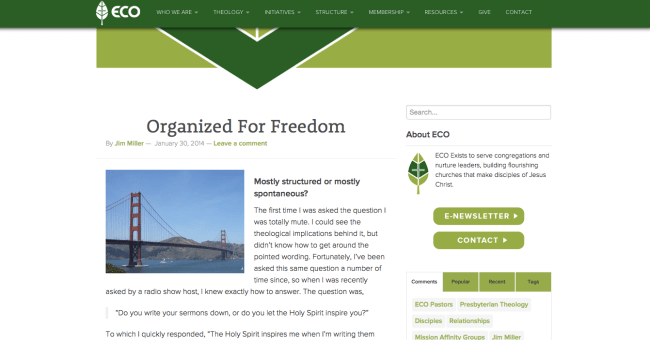
ECO blog

This is a blog post that appeared on the ECO blog.


The first time I was asked the question I was totally mute. I could see the theological implications behind it, but didn’t know how to get around the pointed wording. Fortunately, I’ve been asked this same question a number of time since, so when I was recently asked by a radio show host, I knew exactly how to answer. The question was,

“Do you write your sermons down, or do you let the Holy Spirit inspire you?”

To which I quickly responded, “The Holy Spirit inspires me when I’m writing them down.”

There is a standing tension between those who….

Read more here.

Unintelligent by Design

DarwinOne of the criticisms I’m regularly seeing in discussions of evolution is that those who claim that life shows signs of intelligent design are relying on a “god of the gaps” argument.  The charge is that where they cannot explain how something happened, they’re just answering “God,” without any further intellectual curiosity or explanatory possibilities.  In fact, I’ve heard several skeptics call it “Intelligent Design of the gaps.”

But it occurs to me that if something shows signs of being designed by an intelligent mind, and a skeptic says that such an explanation doesn’t count, what he means is that intelligence isn’t a thing.  Intelligence doesn’t have explanatory power.  You can’t point to something and say that it’s obviously the work of an intelligent mind.  If that’s true, the skeptic of intelligent design must literally be saying that intelligence doesn’t, in and of itself, exist.  There must be something behind the appearance of intelligence which isn’t itself intelligence.  The skeptic literally won’t stop looking until he’s found something unintelligent.

It’s a little bit difficult to give credence to an idea being forwarded by someone who from the outset dismisses things that look intelligent.


My sense for how our design points us towards a designer is in my book Hardwired: Finding the God You Already Know.

Invisible Things

The gravestone of Immanuel Kant reads, “Two things fill the mind with ever new and increasing admiration and awe, the more often and steadily we reflect upon them: the starry heavens above me and the moral law within me.”

Today I visited the Getty Villa, a museum in Pacific Palisades.  On display was the Cyrus Cylinder, a 2500 year old clay cylinder Cylindercovered in cuneiform writing.  An edict of King Cyrus, it prescribes freedom of worship and the release of slaves from the conquered Babylon.  This was the king who set the Jews free from slavery to go and rebuild Jerusalem (Ezra 1:1-4).  The cylinder is a statement from the ancient world that we have a deep intuition that life and liberty are inherently valuable.

Later, my family and I stopped by the Santa Monica beach and watched the sunset.  I turned to my son and said, “Which is older, the Cyrus Cylinder or the ocean?” He said, “The ocean.”  Then he paused hesitantly and added, “Is that right?” And for a six year old, it is right.  But for a Sunsettheologian, the answer is, “It was a tie.” The beauty of moral values deeply impressed on the human heart and the beauty of a well-painted sunset sprang from one and the same mind before the world began.  I am constantly aware of a compelling morality that makes me conscientious and an awe-inspiring beauty that leaves me breathless.  Both make me look  from the shore, across the waters, at something that seems too far away to see, yet something that I can’t stop looking for.

Xmas and Christmas: A Lost Chapter from Herodotus

Xmasa Christmas essay by C.S. Lewis

And beyond this there lies in the ocean, turned towards the west and north, the island of Niatirb which Hecataeus indeed declares to be the same size and shape as Sicily, but it is larger, though in calling it triangular a man would not miss the mark. It is densely inhabited by men who wear clothes not very different from the other barbarians who occupy the north western parts of Europe though they do not agree with them in language. These islanders, surpassing all the men of whom we know in patience and endurance, use the following customs.

In the middle of winter when fogs and rains most abound they have a great festival which they call Exmas and for fifty days they prepare for it in the fashion I shall describe. First of all, every citizen is obliged to send to each of his friends and relations a square piece of hard paper stamped with a picture, which in their speech is called an Exmas-card. But the pictures represent birds sitting on branches, or trees with a dark green prickly leaf, or else men in such garments as the Niatirbians believe that their ancestors wore two hundred years ago riding in coaches such as their ancestors used, or houses with snow on their roofs. And the Niatirbians are unwilling to say what these pictures have to do with the festival; guarding (as I suppose) some sacred mystery. And because all men must send these cards the marketplace is filled with the crowd of those buying them, so that there is great labour and weariness.

But having bought as many as they suppose to be sufficient, they return to their houses and find there the like cards which others have sent to them. And when they find cards from any to whom they also have sent cards, they throw them away and give thanks to the gods that this labour at least is over for another year. But when they find cards from any to whom they have not sent, then they beat their breasts and wail and utter curses against the sender; and, having sufficiently lamented their misfortune, they put on their boots again and go out into the fog and rain and buy a card for him also. And let this account suffice about Exmas-cards.

They also send gifts to one another, suffering the same things about the gifts as about the cards, or even worse. For every citizen has to guess the value of the gift which every friend will send to him so that he may send one of equal value, whether he can afford it or not. And they buy as gifts for one another such things as no man ever bought for himself. For the sellers, understanding the custom, put forth all kinds of trumpery, and whatever, being useless and ridiculous, they have been unable to sell throughout the year they now sell as an Exmas gift. And though the Niatirbians profess themselves to lack sufficient necessary things, such as metal, leather, wood and paper, yet an incredible quantity of these things is wasted every year, being made into the gifts.

But during these fifty days the oldest, poorest, and most miserable of the citizens put on false beards and red robes and walk about the market-place; being disguised (in my opinion) as Cronos. And the sellers of gifts no less than the purchaser’s become pale and weary, because of the crowds and the fog, so that any man who came into a Niatirbian city at this season would think some great public calamity had fallen on Niatirb. This fifty days of preparation is called in their barbarian speech the Exmas Rush.

But when the day of the festival comes, then most of the citizens, being exhausted with the Rush, lie in bed till noon. But in the evening they eat five times as much supper as on other days and, crowning themselves with crowns of paper, they become intoxicated. And on the day after Exmas they are very grave, being internally disordered by the supper and the drinking and reckoning how much they have spent on gifts and on the wine. For wine is so dear among the Niatirbians that a man must swallow the worth of a talent before he is well intoxicated.

Such, then, are their customs about the Exmas. But the few among the Niatirbians have also a festival, separate and to themselves, called Crissmas, which is on the same day as Exmas. And those who keep Crissmas, doing the opposite to the majority of the Niatirbians, rise early on that day with shining faces and go before sunrise to certain temples where they partake of a sacred feast. And in most of the temples they set out images of a fair woman with a new-born Child on her knees and certain animals and shepherds adoring the Child. (The reason of these images is given in a certain sacred story which I know but do not repeat.)

But I myself conversed with a priest in one of these temples and asked him why they kept Crissmas on the same day as Exmas; for it appeared to me inconvenient. But the priest replied, “It is not lawful, O stranger, for us to change the date of Chrissmas, but would that Zeus would put it into the minds of the Niatirbians to keep Exmas at some other time or not to keep it at all. For Exmas and the Rush distract the minds even of the few from sacred things. And we indeed are glad that men should make merry at Crissmas; but in Exmas there is no merriment left.” And when I asked him why they endured the Rush, he replied, “It is, O Stranger, a racket”; using (as I suppose) the words of some oracle and speaking unintelligibly to me (for a racket is an instrument which the barbarians use in a game called tennis).

But what Hecataeus says, that Exmas and Crissmas are the same, is not credible. For first, the pictures which are stamped on the Exmas-cards have nothing to do with the sacred story which the priests tell about Crissmas. And secondly, the most part of the Niatirbians, not believing the religion of the few, nevertheless send the gifts and cards and participate in the Rush and drink, wearing paper caps. But it is not likely that men, even being barbarians, should suffer so many and great things in honour of a god they do not believe in. And now, enough about Niatirb.

hardwired cover


Check out my book!  —>

Book Review: “Hardwired: Finding the God You Already Know” by James Miller

J.W. Wartick's avatarJ.W. Wartick - Reconstructing Faith

hardwired-jmIrreverent. That’s how I would describe Hardwired by James Miller in one word. Miller appeared unimpressed by Natural Theology, and perhaps even less impressed by current scholarly apologetics. Yet this is, unabashedly, an apologetics work. It’s just not the type that many readers would expect going in. Miller’s approach is presuppositional: that is, he sought to discuss the questions about faith by analyzing those things that people already assume or know.
Illustrative was his comment early on in the work. Miller was approached by a mother who was heartbroken over her son leaving the faith. She asked him, “‘How do I convince him there is a God?'” Miller’s answer is indicative of his apologetic method: “He already believes in God.” This startling statement forms the basis for the rest of the book. Miller’s approach revolved around showing people the God they “already know.”

How might one justify this outlandish…

View original post 1,379 more words

Debate, Doubt, and Darwin

Image

Not long ago I posted a review of Darwin’s Doubt which went viral and provoked the response of a fiery graduate student.  The review and pursuant conversation actually provoked a conversation of its own.

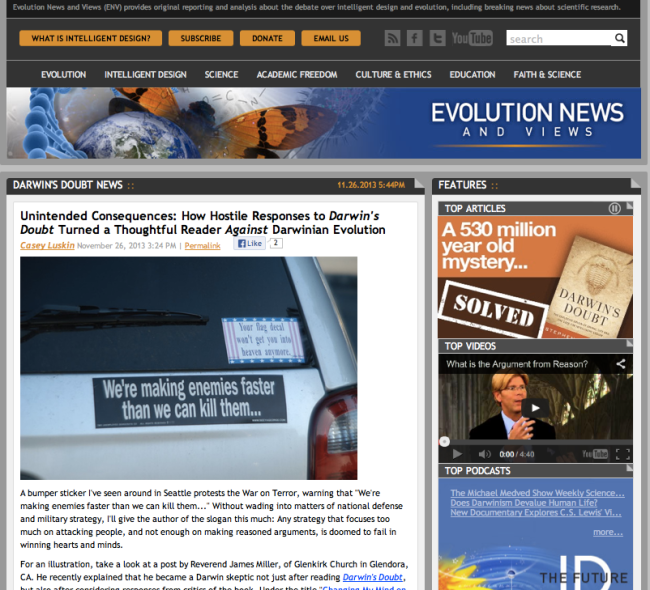
A bumper sticker I’ve seen around in Seattle protests the War on Terror, warning that “We’re making enemies faster than we can kill them…” Without wading into matters of national defense and military strategy, I’ll give the author of the slogan this much: Any strategy that focuses too much on attacking people, and not enough on making reasoned arguments, is doomed to fail in winning hearts and minds.

For an illustration, take a look at a post by Reverend James Miller, of Glenkirk Church in Glendora, CA. He recently explained….

Read the rest here….

Muddy Morality

Image

This article was posted on the Download Youth Ministry blog, one of the most well-read youth ministry websites out there.

One of the most and least popular Sunday school classes I ever taught involved a lot of mud.  “Most” popular, I say, because the students always remembered it.  “Least” popular, because their parents weren’t all that happy with the results.

Early on Sunday morning, I walked out onto the church lawn with a hose.  This was one of those formal churches, where the girls where frilly dresses and the boys wore handsome suits.  On the front lawn of the church that day, I made a mud puddle.  And by “puddle,” I mean lake….

Read the rest here.

Everyone Knows God Is There

MMI knew there was a college guy out there somewhere settling into a dorm, scoping out the weekend nightlife, and generally not thinking about the fact that his flippant comment about church had brought his mother to my doorstep. She caught me on the patio after church almost in tears. She told me her son was in his first year at college and had given up on everything she had taught him about faith. Years of Sunday school instruction had amounted to firm agnosticism. So many childhood bedtime prayers had now resulted in an adulthood of sleeping in on the weekends. She described recent conversations and arguments and e-mails, which had concluded in a closed door.

“How do I convince him that there is a God?” she asked….


Read the rest here.