When is a thought not a thought?

ImageI’m not sure if everyone follows this, so forgive me if this is abstract.  I just kind of find it hilarious and awfully compelling.

If you don’t believe in God, you believe the world is fundamentally matter and that life came about through the process of evolution.  Evolution requires only the survival of the fittest, and survival simply comes about through 4 things: fighting, fleeing, feeding, and reproduction.  That’s it.  At no point along the way do your thoughts about the world around you actually have to truly represent the world around you.

For instance, an evolutionary psychologist might tell you that mild paranoia actually gives you better chances of survival than realism, so you may have evolved into a kind of paranoia that you now think is an accurate picture of reality.  In other words, your thoughts about what is “true” and “real” simply aren’t, because you’re more likely to survive this way.

That means that when you say “I don’t believe in God,” you are saying that you can’t trust your thoughts to actually reveal reality.  You don’t trust your own thoughts to be true.  As a consequence, your perception that there is no God can’t be trusted to be true, and thus you don’t believe in your own atheism.

If this seems silly on first glance, you might want to give it a second thought.

Hardwired

Philosophers of all stripes are coming to see that scientific methodology can fundamentally undermine itself.

These are the kinds of things I speculate about in

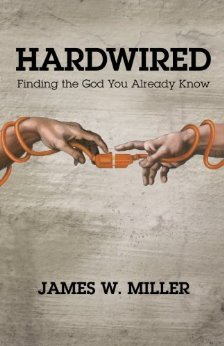
Hardwired: Finding the God You Already Know.

SDG

Watching the sun set over the ocean always feels like the closing curtain to a good play.  Moments like these feel like a sweetly passing sentiment, because we have become so used to God whispering his love that we take it for granted.  We don’t even hear it, a spouse’s “What was that?” to the other who has already left the room.  But the order of the universe is in fact a message from God.

The harmony of creation is a lullaby from a God who is reordering a broken world.  It’s his way of telling us there is still sense in things, even after tragedy.  It’s the strength of the arms that cradle us.  It’s his, “There, there.” Because there is fundamental order “out there,” maybe one day I can have it “in here.”

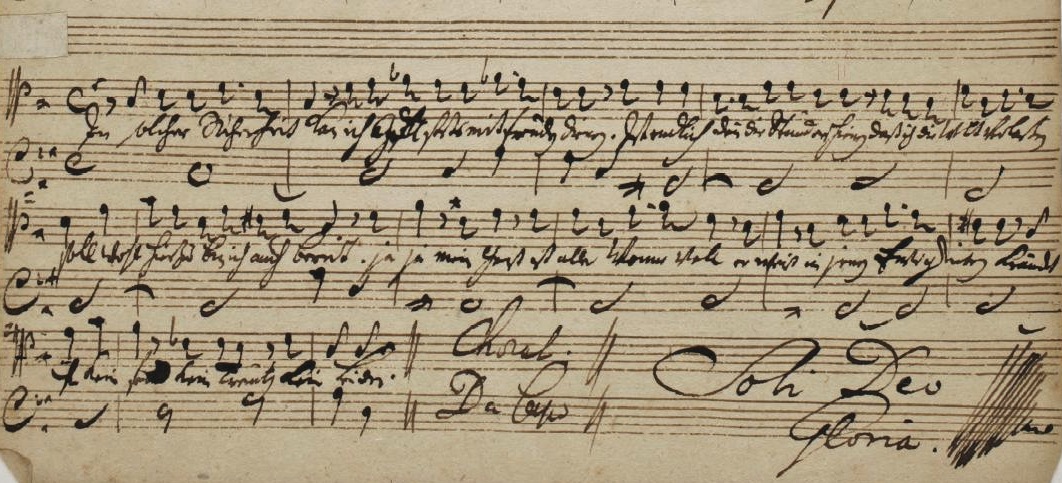
And thus you can hear the love of nature’s harmony in Bach’s Inventions.  He scratched at the top of his compositions, “SDG,” or Soli Deo Gloria: to God alone be the glory.  If he had not written it there, his music would say it by itself, because the fundamental order that beauty captures glorifies God.  SDG is written on the sunset.  The pulsing rhythm of sunrises and sunsets are a visual drumbeat.Image

Creation’s order plays on our natural love of harmony and structure.  That should be a clue to us as to where we come from.  The idea that order could just spring from a primal nothing should strike us as absurd.  Order has to have come from somewhere.  At least when a magician pulls a rabbit out of a hat, there was a hat.  For those who believe the universe just came to be, there is no hat, and no magician.  Science has changed its mind on this one.  Historically, the predominant view was not that the universe came to exist, but that it had always been.  For those who didn’t believe in a Creator, the idea of a moment of creation was too much of an affront.  In fact, Marcus Aurelius called it logically absurd.[1]  “Out of nothing, nothing comes.” Today, we know universally and conversationally about the Big Bang, or in other words, the magically appearing rabbit.  And this fact honestly makes atheists queasy.

Ludwig Wittgenstein described what this feels like. He said that he sometimes had a certain experience which could best be described by saying that “when I have it, I wonder at the existence of the world. I am then inclined to use such phrases as ‘How extraordinary that anything should exist!’ or ‘How extraordinary that the world should exist!’” [2]

And it is extraordinary.  Extraordinary that our hearts long for order.  Extraordinary that we feel like it should be more complete than it is.  And extraordinary that our deepest longings jibe with that which God has promised.  God is a fairly sloppy artist.  He’s left his fingerprints all over the work.

1 The Meditations of Emperor Marcus Aurelius, V.12.

2 Norman Malcolm, Ludwig Wittgenstein: A Memoir (London: Oxford University Press,1958), p. 70.

Is There Hope For Apologetics?

by Dan Stringer

reposted from The Common Loon

July 31, 2013

The Common Loon BooksChurchTheology 4 Comments

HardwiredI remember attending a debate in college between a Christian and an atheist.

Before it started, the room was abuzz with anticipation, like a stadium before kickoff. After the competitors were introduced to applause and scattered boos, they each proceeded to argue forcefully for their belief system, trading punch lines and other rhetorical jabs. Along the way, they interrupted, misquoted and belittled each other’s views. They called each other names and triumphantly scoffed at how misguided the other person was. In their concluding remarks, both sides claimed to have scored the most points, which was curious given the absence of a scoreboard.

I don’t recall anyone being officially declared the winner that night, or if anyone left the room with different beliefs than when they entered. I wonder if the real losers were members of the audience, or at least those of us who had hoped for better.

Over a decade later, I now find myself as a pastor, a vocation predicated on the existence of God. Yet I still have mixed feelings when the subject of apologetics arises. Perhaps I’ve seen it done poorly too many times. Or maybe I’m turned off by the defensive, almost desperate, salesmanship that belittles opposing viewpoints. Or it could be that I can’t stomach the dissonance between apologists’ typical form (rhetorical flourishes and deductive “proofs” designed to score points for God) and their content (the message of God’s love, grace and hope for the world).

Apparently, my friend Jim Miller, also a pastor, has a few mixed feelings about apologetics too. In the opening chapter of his new book Hardwired: Finding the God You Already Know (Abingdon), Jim writes:

Most people who believe in anything, religious or otherwise, did not get there by listening to a debate, and meaningful beliefs do not often rest on academic research. That isn’t to suggest faith and reason are unrelated. There are those who think that God gave reason to humanity the way a father gives a BB gun to his son, telling him, “You can play with that thing all you want. Just don’t point it at me.” To the contrary. In fact, the Scriptures say that God intends for people to come looking for him. He isn’t afraid of our reasoning.

If God isn’t afraid of our reasoning, perhaps he intends for us to search without fear of what we might find (Matthew 7:7-11). While I’m generally not a huge fan of apologetics, I look forward to reading the rest of Jim’s book because he understands that a rational, academic case for God’s presence can only take you so far, especially when everyone uses a different scoreboard. A philosophy buff with an eye for the accessible, Jim doesn’t blast his readers with data and argumentation, but instead helps us catch glimpses of God in our everyday assumptions.

So maybe it’s not a stretch to hope for a better, redeemed approach to apologetics. Rather than trying to dissolve the conversation with a litany of airtight rebuttals to all possible objections, we can set our sights on becoming a different kind of people, the kind of faith community with a capacity to offer helpful responses in the context of authentic relationships when the big questions hit.

Who knows? We might even keep the conversation going.

Death by Explanation

ImageScientists can describe to you the project of finding a “universal theory,” something that explains the whole of existence in its most basic terms.  This generally involves some form of reductionism, usually collapsing the three great sciences into one another.  Biology is to be explained by chemistry, and chemistry is to be explained by physics.  In other words, the activity of our hearts and minds are the firings of neurons and the swirling of chemicals.  Those chemicals are fundamentally the interactions of molecules, which are the interactions of atoms, which are the interactions of protons, neutrons, electrons.  If you slice with a thinner razor, you come to quarks and leptons and bosons.  The universal theory aims at getting to the center of these Russian dolls and explaining how the little one, and the forces that hold them together, governs everything else.

This is a real effort in the sciences.  Darwinism is the greatest reductionist theory in existence, an alternative to a Designer.  Next, scientists are looking for a source for the big bang, trying to come up with a viable alternative to a Creator.  This is a real effort in the sciences – and it really isn’t going to work.

Renee Descartes tried to do the same thing with the mental world.  He tried to break thought down into its smallest, most basic parts.  If he imagined that the world around him didn’t exist, imagined even that the parts of his body didn’t exist, that with which he ultimately left was “I think therefore I am.” The criticism of his theory has always been, “Hey, where did this ‘I’ come from?  What’s the ‘I’ that’s doing the thinking?” In other words, you can’t really separate thinking from the person who is doing it, so it’s hard to say what the tiniest little atom is in the sequence of mental events.  You could try saying, “Thinking happens,” but that doesn’t really explain the fact that thinking is self-conscious.  Our thoughts are part of a bigger story, a narrative, and no one thought can be separated out by itself from the others.  Thoughts can’t be broken into atoms.

The same thing is true in the physical sciences.  The problem with atomistic theory is that nothing in the real world can be dissected down to constituent parts that are actually separated from one another.  The atoms are holding hands.  Physics is a narrative.  The fact that some atoms make up the point where my pencil ends and others make up the point where the paper begins constitutes a story about the atoms that the individual atoms can’t tell on their own.

Ultimately, materialistic, atheistic scientific efforts will keep hacking away at life looking for its smallest unit.  But science is trying to grab hold of mercury.  What it’s trying to contain will always slip away.  Atoms will never by themselves tell the story of existence.  The whole narrative is bigger than the sum of its parts.

The scientific reduction of biology into chemistry and physics tells us as much about life as dissection tells us about what it feels like to fall in love.

The Ground

Image

I remember reading about a man badly injured in a car accident.  When asked about the vehicle that hit him, he said, “I didn’t see the truck, just the crash.”  Sometimes we’re so panicked about the crash, we miss what hit us.

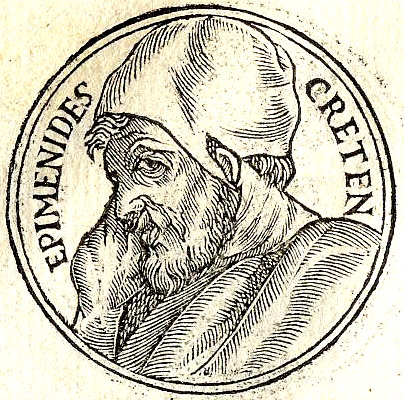
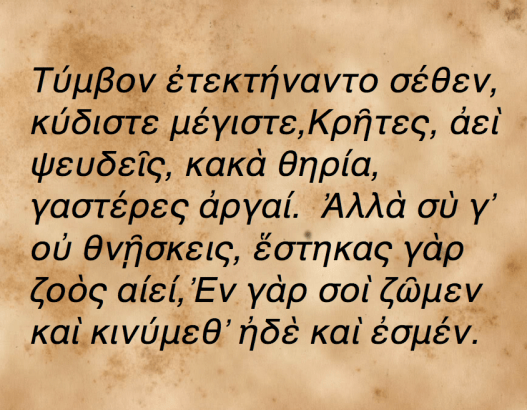
The Greek poet Epimenides saw things that most people miss.  He was hailed as a prophet, and legends about him supersede history – that he slept for 50 years, that he lived for 300, that before he died his body appeared tattooed, and that he saw visions.  However, what little we have of his poetry doesn’t suggest mystical visions so much as common sense.  I wonder if prophets are sometimes just people who saw what hit them.Image

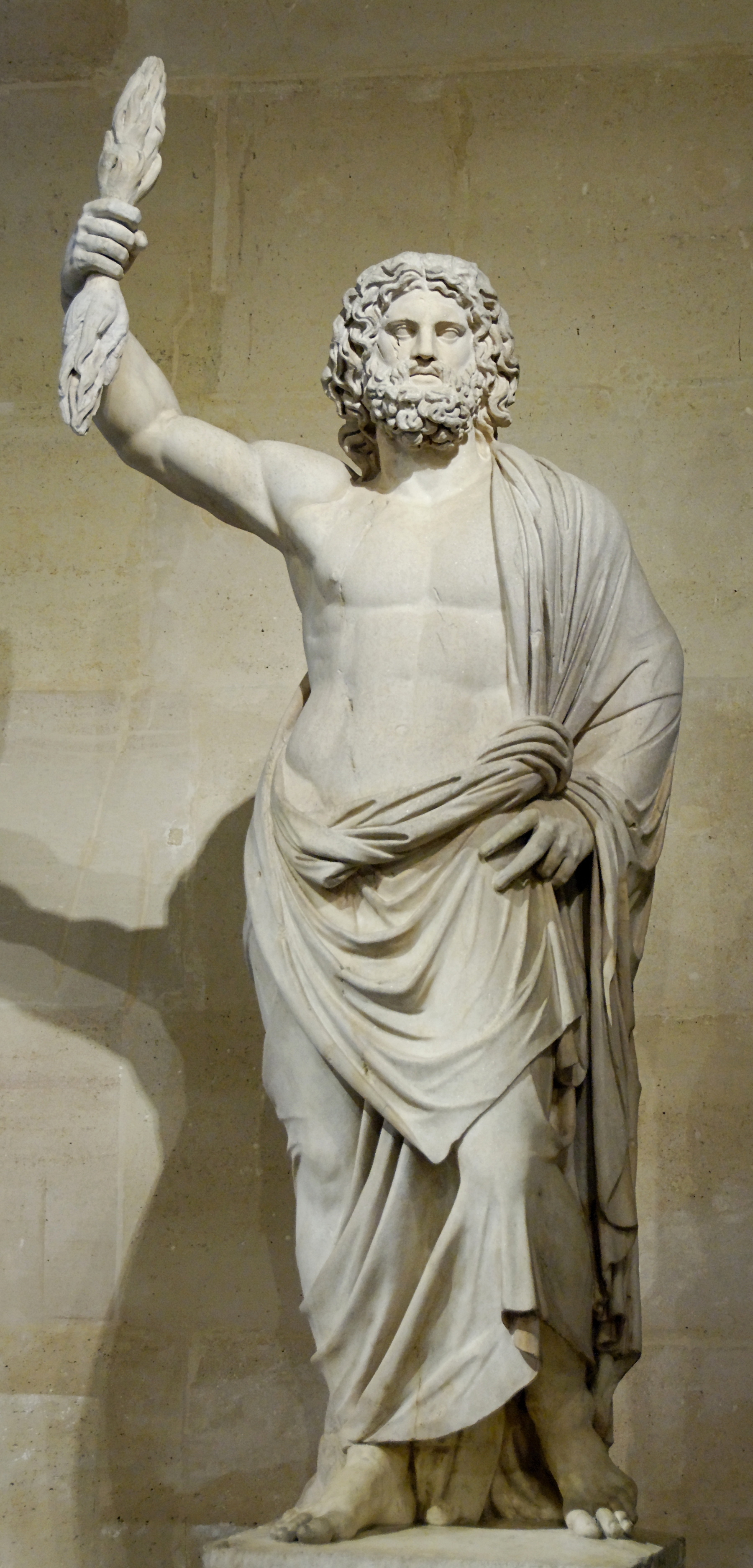
He wrote a poem called the Cretica, The Cretan.  It was a poem about Zeus, king of the gods.  In it, the king of Crete tells Zeus that the Cretans have lied by building a tomb to Zeus.  However, King Minos knows that Zeus is eternal and needs no tomb, because “in you we live and move and have our being.”

Two things interest me about the poem.  One, he doesn’t charge them with a mistake; he charges them with lying.  Given the nature of the issue, I’m not sure who they could be lying to except themselves.  Two, his proof is not data to be analyzed, but existence on the whole.  In you we live, we are active, we exist.  Without you, someone has to explain life arising from inanimate matter, motion, and a universe that has somehow come to be.

Hasn’t it always been the case that when one claims that God is dead, whether a Roman centurion stationed outside of Jesus’ tomb or Friedrich Nietzsche stationed on the doorstep of the 20th century, we’re taking part in a grand self-deception that is corrected by reality itself?  God is the ground on which we stand, and I cannot deny him any more surely than I can stay in mid-jump.  Without God, there’s no reason why there should be a universe rather than not, and no explanation for how something came from nothing.  Without God, there is no explanation for the constant motion in which life is immersed, motion which pushes us, as Sartre said, inevitably towards moral crisis and commitment.  And without God, there is no explanation for how inanimate matter produced consciousness and mental properties, as even atheist philosopher Thomas Nagel has admitted.

The Apostle Paul quotes Epimenides (Acts 17:28) when he engaged the Athenian philosophers on Mars Hill.  He’s proof-texting from their own library.  It’s as if to say, “You already know God is there.  Your own poets have said so.  Your own prophet would call you a liar for denying it.”

I think the charge of lying may be harsh, though technically correct.  I might use a different word for it.  It’s a coping mechanism.  The reality is that crashes are startling and leave us resentful of a fragile world in which they happen.  Denying the possibility of a good, overseeing father figure may be a way of voicing resentment.  It’s fear boiling over into rage.  But at the end of the deny, it’s still just a denial of reality.  Without God, there’s no one to be mad at.

What about Zeus?

A friend of mine is a pastor-in-the-making who is interning at a church and exploring all the questions of ministry that pastors-in-the-making get.  Recently he told me that someone had suggested that ancient cultures had invented goImageds, and Christianity was just one more invention.  That seems to me a shallow and unnuanced take, and I think reality is a little more complex.  It seems that if God had created us for himself, we would naturally be inclined to seek him out. After all, all creation points towards him (Psalm 19), and his existence is so clear that we are “without excuse” for not believing (Romans 1:20).  He is actually not far from any one of us (Acts 17:27), and he rewards our seeking (Matthew 7:7).  So given that we’ve been built with a GPS that points us back to him, it seems that a host of ancient gods would not be disproof of Christianity, but rather proof all the more.  If we’re made for God, it makes sense that we would reach out for him and try to grasp him, and where we can’t find him, we would make up substitutes.  The ancient pantheons are not grounds for dismissal of Christianity.  They’re only the groundwork for true revelation.  The fact that we guessed repeatedly and sometimes close doesn’t mean that Christianity’s similarities to other religions prove it false, only that Christianity in fact satisfies our deepest longings and proves to be the the bullseye around which we had been misfiring.  Ancient religions were simply set-up to the real thing and proof that we were hardwired for the God who would soon reveal himself to us.

These are the kind of speculations captured in Hardwired: Finding the God You Already Know.

A Pastor’s Confessions

As a pastor, I work the weekends, so Friday is the one day of the week I have free.  After I send the kids to school and my wife heads off to her daily projects, I have the run of the place.  So today, in the quiet of my sanctum, with a free morning, I decided to replace the kitchen faucet.

My wife had purchased a faucet of her choosing, which for some reason was a touch-activated type, and thus had an added electronic component located alongside the normal irritating combination of pipes, connectors, rust, and leaks which must be assembled in a place that a yoga instructor couldn’t get to.  I assume she did this for either of the two usual reasons – that she found this one on sale, or that I have done something to anger her.

I regularly tell my congregation that if they sin, they should confess, both as a spiritual exercise that rights their relationship with God and as a therapeutic way of owning up and moving on.  As a consequence, I feel it only appropriate that I model the behaviors I teach, if only in a small way on this blog that hardly anyone reads.

Because I was alone this morning, I said aloud a number of things about a number of people who have done me no wrong, and who really deserve more respect.  Therefore, I would like to apologize to, in no particular order:

  • The former owner of my house
  • His mother
  • The President of the United States
  • Various members of Congress, whose names I don’t actually know, but whom I nicknamed
  • Anyone whose name rhymes with a profanity
  • Anyone whose name begins with the same first letter as a profanity, and thus can be alliterated
  • My dogs
  • The neighbors dogs
  • Most of the zoo animals, particularly the primates
  • Charles Darwin
  • Martin Luther, for encouraging me to sin boldly
  • Other historical figures, both Catholic and Protestant
  • The Romans, for inventing aqueducts
  • The residents of California
  • The French (this is just a go-to for me)

“Remember the Sabbath day by keeping it holy.  Six days you shall labor and do all your work, but the seventh day is a Sabbath to the Lord your God.  On it you shall not do any work.”

Image

hw

  My new book is

  Hardwired: Finding the God You Already Know

  (Abingdon, 2013).

Wedding Details

My sense is that the rising generation is afraid of marriage.  I don’t blame them.  It’s not primarily for selfish reasons (though those are a factor).  It’s because they’re shell shocked after a childhood of divorce and dysfunction.  And then there are the selfish reasons.  Or I talk to young couples who don’t want to have kids, because, for however they word it, they are anxious about moving from a position of independence to a position of vulnerability.

Image

There are a few things that I wouldn’t have learned if I didn’t get married and have kids, and they’re captured in this picture of a couple getting married during flood season in the Philippines.  If I had to pick a picture that pretty much summarizes what life is like, it would be this one.  And part of the reason why I like being married is because it has made me a realist.  Marriage is a good microcosm of all of life.  There’s just no other way to learn these things than to make one’s self vulnerable to relationships.  And my sense for what life is all about comes out in the advice I give to young couples about their weddings before they get married.  I tell them:

  • There’s always a glitch.
  • It’s not about the details, it’s about the relationship you’re building.
  • Whether or not it’s a happy occasion has more to do with your insides than your outsides.
  • How you respond will tell your friends who you are.
  • Life is a mess.  Learn to deal with it.
  • Are their smiles better or worse because of the rain?
  • Why are you complaining about the rain?
  • You can tell a couple is healthy because you know they will one day laugh about the disasters.
  • On the day you die, the few days of your life that counted will not have been sunny; they will be days when you laughed at and loved despite the rain.

hw

My new book is

Hardwired: Finding the God You Already Know

(Abingdon Press, 2013).


Blessed Hypocrisy

You plop down on the beach, the kids go spiraling off to the water like dolphins in a boat’s wake, you take an overdue deep breath and stare at the horizon, and that’s the point at which you realize a thought has been hitchhiking in the boxcar of your prefrontal cortex.  It’s been there for a while, but you haven’t noticed it until now.

I remember in the 80s watching the scandals of the Bakkers and Jimmy Swaggart ripple through the late night comedians and into the minds and mouths of my schoolmates.  I was fairly cognizant of the fact that Christians were generally getting smeared.  I read Elmer Gantry for the first time back then.  And I remember saying, “We’re not all like that!”

Since then I picked up a little hitchhiker.

Now I listen to a rising generation dismissively writing off the church with the under-thought branding, “hypocrites.” But I know that the more they study history and the more they look in the mirror, the more they will regret holding anyone else up to that righteous standard.  Now I hear people accuse Christians of hypocrisy, and I’m inclined to answer, “Absolutely.  We’re all like that.”  Inside the church and out.  We’re all like that.

Proves we need a savior.

The Millennial Spirituality of Starbucks

ImageThey made over my favorite Starbucks recently, closed it down for a month and unveiled a new décor.  The décor is, very much like the old Starbucks, decorative.  It’s intended to be mood altering, soothing, and quietly provocative.  Architecture is a pair of glasses that the room holds up to our face to make sure we see it through its chosen lens.  Every shape and curve in the world around us, down to the intentional squiggles in this font, provoke minute reactions in our hardwiring.

What’s curious to me is where Starbucks just went.  They’ve made a geographical move.

The Tuscan colors were reminiscent of old world Europe.  They were meant to harken back to the historical, so much as it is grandfatherly, to be quaint, to whisk us away to a place with short work days and long naps.  It was meant to be a third space that is not only out of the office, it was out of the country.

The color palate has changed, though only slightly.  It took me a minute to see what they had done.  The colors are now more muted and more beige.  The burnt orange and avocado are gone.  It’s now the color of the desert.  The light covers have been replaced with woven basketry.  And the picture on the wall, formerly a partial nouveau sketch, is now a zen garden curled in sand.  We’ve moved from Italy to India.

Traditionally the Starbucks aesthetic is limited to four options: Heritage (worn and dark), Artisan (hand polished woodwork and exposed steel), Regional Modern (bright and lined with fabric), and Concept (experimental).  What may have changed is that last October the company opened their first store in India, and they are cross-pollinating.  They rapidly expanded in Mumbai and New Dehli, and this month they announced that they are targeting most major cities in India.  Market estimates suggest that they may have tapped into 100 million new customers.

What interests me is not the economics but the spirituality.  American morality and theology have gravitated from Europe to India as well.  The churches of Europe are now dusty museums, and religion that appeals to the modern American mind is accepting, assimilating, non-differentiating, and, taken as a whole, polytheistic.  We prefer the non-committal and the omni-commital to the propositional and precise.  We want living and let-living and getting along.  (The irony being that the non-discriminating can bring little rational opposition to bear on a caste system.)

I don’t know that it lay in the back of the mind of whomever our interior decorator was, and this is literary license rather than observation, but Starbucks just caught the wind of culture and are riding it on a carpet.