
Wonder

I’ve read the systems of the great builders of human thought, and even the most complex of them are reductionistic.  Humanity is basically rationality, or basically a free laborer, or a libido.  In the sciences, there is a dream of one day creating a unified system that encompasses all the sciences.  I think it’s a horrible idea.  In the arts, there is an unspoken dream of creating a unified system that summarizes human nature.  One day, bragged a modern geneticist, we will be able to publish you on a disk.  Equally horrible.  And impossible.  Poetry doesn’t come in ones and zeros.

Fundamental to human nature is wonder, and wonder is unquantifiable.  It can’t be computerized.  It can’t be encompassed in a system that explains what we are, because wonder is a reaching at beyond what we are.

There has been a creative theological debate over what it means to be made in the image of God.  Some have said that the human animal can reason, to a greater degree than other animals, which makes us special, and thus in the image of God.  A few modern theologians have said that God is three in one, a being in community, and so the imago dei is our ability to live in community with one another.  I think that fundamentality, the place where we are most like God is in our ability to wonder.  If there’s one thing in us that bears resemblance to him, that’s it.  Stars…volcanoes…rainbows…birds, remember, were all made out of nothing but God’s imagination.

What happened to you?

We’ve all had that experience where we see someone we haven’t seen in a long while and notice that they’ve changed.  If it’s a child, the change is all the more pronounced, and we’re all the more amazed.  But I kind of wonder why that is.  Human beings being amazed by time is kind of like fish being amazed by water.  We exist in time.  We’re in it all the time.  It should be pretty ordinary.  A fish doesn’t notice water, I suspect, because it was made for it.  We notice time, I think, because we weren’t made for it.  We were made for eternity, and everything temporal ultimately jumps out at us as surprising.  We have mid-life crises because all of a sudden we are forced to say, “Wait a minute!  None of this feels right!” And indeed, it isn’t.
Innoculation

old church

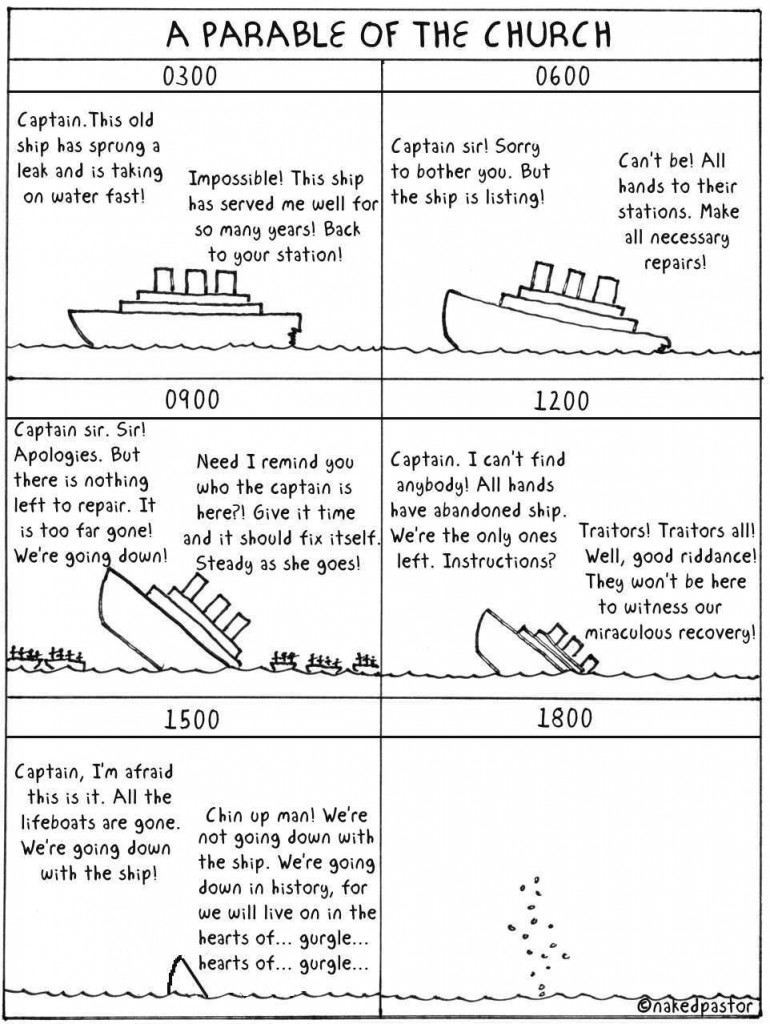
The sad part of the many dying churches around the country is that they don’t seem bothered by the obvious trend.  The pain of change and innovation looked to be too much, so instead they have settled for the numbing morphine of familiarity.  Let’s keep doing things the same way…since it’s going to die anyway, let’s make them comfortable.

Perhaps the surest sign of life in the modern church is that the next generation of ministers is talking about innovation even more than the cutting edge boomers talked about seeker sensitivity.  The shift is from “let’s appeal” to “let’s invent,” which, though it’s still marketing, leans more towards creativity than catering.

The Lost Art of Soul Tending

There’s a story about a monk working at a monastery who didn’t like the abbott.  He wrote a letter to another monk and confessed that he was doubting whether or not God had called him to be a monk.  The other monk wrote back, “You know that you were called if your soul is growing through the trials that God sends you.”  The monk wrote again a few months later, frustrated, asking if he were still called.  The first wrote back saying, “You know you are called to go if it is damaging your soul.”

And therein lies the long lost element of true calling.  Who pays attention to the development of the soul anymore?  Do the job placement offices in seminaries take time to talk to people about the growth and development of their souls, or do they talk about resumes and references?  Would the average pastor have any sense at all of how to measure if his or her soul was growing or decaying?  My sense is that that is a meaningful vocabulary that has been wholly lost.

Grading Church

Ministry is notoriously difficult to quantify.

First, there’s the obvious moral implication: you’re critiquing someone’s good and well-intentioned works.  It would be like Statler and Waldorf offering commentary on Mother Theresa.

Secondly, you have the problem that the standard quantifiers can be deceptive.  If Netflix send out an extra thousand videos this month, they’re doing good business.  If your church gets an extra thousand visitors this month, you might be a Mormon.  Counting dollars becomes nebulous and seedy when you factor in Jesus’ teachings about money.

But consider the other option.  Ministries without measurements just allow the charismatic to make an unchecked killing.  Thanks for the tithe.  So churches can and should have standards of measurement for effectiveness.  I use an X, Y, and Z plane to assess how our church is doing.

X.  Are we growing wider by bringing new people into our mission and retaining our former members?

Y.  Are we growing deeper, as evidenced by people seeking out sources of education and discipleship, such as classes and Bible studies?

Z.  Are we moving forward, as evidenced by people taking part in the active mission of the church, assessing their spiritual gifts and volunteering hours to care for one another and the community?

Stagnation on any of these planes requires immediate attention.  And ultimately, 10 years out of seminary, a leader of a church (assuming they stay in one place) ought to able to demonstrate progress along all three.

Grading Seminary

Hmm.

So if I were a seminary President, I might think that the end game of what I was doing was training people to lead successful churches and ministries.  Right?  I mean, there are added things as well…you’re allowing people to deepen there personal theological perspectives and awareness, training people to be the next round of professors, etc.  But ultimately, you’re training people to lead successful churches and ministries.

So two things occur to me.

One: why don’t seminaries sponsor a survey of their 10 year out graduates to see how many of them are leading successful ministries?  The seminary could define the parameters, but ultimately, that would give the seminary the right to say, “We’re a seminary that’s good at what we do.  We’re effective.” You would think that that would be the ultimate test and ultimate bragging rights of a seminary.  “Our graduates prove to be prepared and  competent.”

Two: why haven’t they?  I mean, I can’t imagine that I, sitting here in my armchair, am the first to have the idea.  Hasn’t some seminary President thought of this before me?  And if they have, why haven’t they proceeded?  Which only further presses the question of whether or not seminary is an essential part of ministry preparation.

That said, I’ve sat through enough sermons that were as deep as the inflatable kiddie pool to rule it out altogether.

To Seminary or not to Seminary

A few expanded thoughts on seminary:

First, it’s time that we let die the illusion that the old models of denominational norms and structures are normative.  They’re not.  Churches really aren’t doing it the way they used to.  And the churches that have their eyes and ears covered are just going to cease to exist.  So the question should not be “Should you go to seminary.” The question should be “Are they going to seminary?”

I got my M.Div from Princeton Theological and my D.Min from Fuller.  And I’m not wholly fond of seminary.

What I love about seminary is the intellectual stimulation that comes from sustained time to reflect on the faith in light of the wiser and smarter who have gone before me.  That, I think, is invaluable.  However, I don’t at all believe that seminary is the only or best way to do that.  If anything, seminary is an entrenched boundary that excludes people from institutional religious structures who don’t have the money to go back to school.  With the birth of the information age, books aren’t contained in libraries anymore, and you can study just as well without tuition.  Someone might respond that you don’t get theological dialogue by studying on your own the way you do on a seminary campus.  But that only makes me wonder why you’re not having those theological dialogues at church.

Worse yet, a number of seminaries have become so disconnected from churches that many of their faculty do not see training people for ministry as the end game.  The fact that you can get an MDiv while learning nothing about leadership, management, finances, counseling, or how to preside at a funeral makes you wonder who’s writing the curriculum.  At least you can say, “I don’t know how to do this” in Hebrew.

I loved that seminary gave me a nuanced view of theology, so that I could not join the great cult leaders of history in assuming that if I had the Bible in one hand and the Holy Spirit in the other I had all I needed to do ministry.  It taught me that wise and well-meaning Christians disagree on some major issues, which, in some small part, contributes to whatever hint of humility I might have.  But again, I don’t know that this study comes best through seminary.  Again, this just sounds like Christians in community with a wide exposure to Christian literature.

All that to say, I don’t wholly write it off, but I haven’t followed in the footsteps of my predecessors who told me that there is no other way.

To Minister or Not to Minister (professionally)

I have a few thoughts on whether or not to take on forms of vocational ministry, rather than maintaining a paying vocation that is not religious in nature while serving in a local church.  Unfortunately for me, no one is asking me what I think.  Fortunately for me, blogging has nothing to do with whether or not anyone is listening.

SEMINARY.  Think really long and hard before you commit the time and money.  I loved Princeton T.S. and Fuller T.S., but I don’t recommend a seminary education without reservation.  Unlike the fundamentalists of my Bible belt youth who told me that it might cause me to lose my faith, I would say that it is more likely to make you lose your relevance.  Seminary by and large teaches you a vast wealth of theological curiosities which may or may not have to do with what you do with most of your time.  Worse yet, it may prepare you to march into the pulpit and talk about a bunch of things that aren’t interesting to anyone except seminary professors (who, by the way, are not in your congregation).

THE PROPHETIC VOICE.  A few people go into ministry because they have a prophetic critique of the church and want to change things.  Then they go into the church planning to stick it to the man, and realize that they are the man (did you know that stands for “management?” because seriously, I used that phrase for years before I realized).  You then find yourself in a state of cognitive dissonance, trying to kick over the ladder you’re standing on.

THE DARK SIDE.  What no one tells you in seminary or otherwise about ministry is that a significant percentage of your work is trying to take the complaints of the either spoiled or dysfunctional (distinct from the truly authentic and well-phrased complaints which are actually helpful) and use them as a vehicle for discipleship.  It’s kind of like using a cat’s claws to scratch it’s back.  A rabid cat.

THE BRIGHT SIDE.  The bright side is that those hours of pining away at a cubicle wondering if your life has any purpose will go away.  You have days where you don’t feel like you’ve done a lot, but you always have the sense that you are contributing to something bigger than yourself.  This is perhaps the biggest benefit of full-time, professional ministry.

THE CALL.  Frankly, if He tells you to do it, there’s a big fish not far behind, so you might as well go.  And this is the final word on the subject.