Do Archaeological Discoveries Discredit Genesis?

CamelNews agencies throughout the world burst into Biblical deconstruction this week with the announcement of a new archaeological find about camels.  The discovery, published in Tel Aviv Journalout of Tel Aviv University, was that domesticated camels didn’t appear on the scene in Israel until around the 9th century BCE.  If this is the case, it means that the Genesis account of Abraham using 10 camels to transport goods (Genesis 24:10) a highly unlikely story.  


Read more here.

Son of God Movie Review

Son of GodYesterday I was invited to Saddleback Church to preview the forthcoming movie Son of God, produced by the same people who created The Bible series for the History Channel last year, Mark Burnett and Roma Downey, who were both present for the screening.  I’d strongly recommend you put this on your list of movies to see when it releases on February 28th.

In terms of production value, it’s the best one of its genre.  The Jesus Film pales in comparison, looking almost like a homemade movie compared to Son of God.  The 1977 epic Jesus of Nazareth (over 6 hours long) was powerful for its time, but awfully hard to sit through.  The Passion of the Christ, which, coincidentally, released exactly 10 years ago on Feb. 25, 2004, did not tell the story of the life of Jesus, but really honed in on the pathos of his final week.  There really isn’t a modern day video retelling of the life of Jesus as good as Son of God.  More flamboyant retellings, like The Last Temptation and Jesus of Montreal, really fall outside the mainstream and look more like a sectarian reinterpretation of the story.

The movie doesn’t stray far from the biblical narrative, though it fleshes out some of the narrative behind the Roman occupation, and it emphasizes the way Jesus was an offense both to Romans and Pharisees.  Many of the lines are paraphrases of the words of Jesus and the biblical characters, but the movie isn’t indulgent in its adaptation.  It leaves a lot out, but after two and a half hours, it would have been hard to meaningfully include more and still accommodate the modern attention span.

For that reason, you need to see it.  Take your kids.  Take your unbelieving friends.  Take your small group and let it guide a discussion of which parts of the life of Jesus you tend to pay the most and least attention to.

The only criticism I have of the movie are just in the nature of the genre.  Many of the characters are white people with British accents and perfect teeth.  Of course, I don’t think American English would be any more authentic, and the only way around these cliches would be to do as The Passion and have the whole thing in Aramaic.  Some of the dialogue is oddly lilting, and the soundtrack is a bit melodramatic.  The costuming is a silly blend of immaculately clean robes in a rainbow of colors.  Still, the actor who plays Jesus, Diogo Morgado, is a nice variation on his predecessors.  Rather than pale and somber, he often appears amused.  You can’t help liking him from the beginning.  And to be honest, the cliches are at about the level of presentation that most Americans expect and even want from a story set in the ancient world.  We have the same caricatures when it comes to stories about ancient Greece, Rome, and Egypt.

So take the movie for what it’s meant to be.  It’s not simply entertainment, and it’s not intended to offer a new slant on the biblical narrative.  It’s fundamentally an evangelical tool for retelling the gospel again in a modern language.  And anytime Christ and culture meet, it’s a good opportunity for Christians to enter into conversation with a world that has heard different representations of Christianity and still wants to see the real thing.

hardwired cover


Please check out my book!  – – – – – – ->


Churches and Their Rules

ECO blog

This is a blog post that appeared on the ECO blog.


The first time I was asked the question I was totally mute. I could see the theological implications behind it, but didn’t know how to get around the pointed wording. Fortunately, I’ve been asked this same question a number of time since, so when I was recently asked by a radio show host, I knew exactly how to answer. The question was,

“Do you write your sermons down, or do you let the Holy Spirit inspire you?”

To which I quickly responded, “The Holy Spirit inspires me when I’m writing them down.”

There is a standing tension between those who….

Read more here.

Unintelligent by Design

DarwinOne of the criticisms I’m regularly seeing in discussions of evolution is that those who claim that life shows signs of intelligent design are relying on a “god of the gaps” argument.  The charge is that where they cannot explain how something happened, they’re just answering “God,” without any further intellectual curiosity or explanatory possibilities.  In fact, I’ve heard several skeptics call it “Intelligent Design of the gaps.”

But it occurs to me that if something shows signs of being designed by an intelligent mind, and a skeptic says that such an explanation doesn’t count, what he means is that intelligence isn’t a thing.  Intelligence doesn’t have explanatory power.  You can’t point to something and say that it’s obviously the work of an intelligent mind.  If that’s true, the skeptic of intelligent design must literally be saying that intelligence doesn’t, in and of itself, exist.  There must be something behind the appearance of intelligence which isn’t itself intelligence.  The skeptic literally won’t stop looking until he’s found something unintelligent.

It’s a little bit difficult to give credence to an idea being forwarded by someone who from the outset dismisses things that look intelligent.


My sense for how our design points us towards a designer is in my book Hardwired: Finding the God You Already Know.

Everyone Knows God Is There

MMI knew there was a college guy out there somewhere settling into a dorm, scoping out the weekend nightlife, and generally not thinking about the fact that his flippant comment about church had brought his mother to my doorstep. She caught me on the patio after church almost in tears. She told me her son was in his first year at college and had given up on everything she had taught him about faith. Years of Sunday school instruction had amounted to firm agnosticism. So many childhood bedtime prayers had now resulted in an adulthood of sleeping in on the weekends. She described recent conversations and arguments and e-mails, which had concluded in a closed door.

“How do I convince him that there is a God?” she asked….


Read the rest here.

Certainly Agnostic

Image

Posted on the Christian Apologetics Alliance

When I offer an apologetics seminar that I call “Know Why You Believe,” I find that the skeptical attendees have a preferred label for themselves.  “So I’m an agnostic,” says the first person to raise his hand, and that is the preface to his question.  A few others nod their heads eagerly.

I’m not sure if I believe him or not.  But I’ve finally come up with a good, brief answer….

Read the rest here.

Changing My Mind on Darwin

ImageSo I’ve changed my mind about Darwinism.  I guess I have to tell you where my mind was to tell you where it now is.

I’ve never invested much study in evolution because I was neither threatened by it theologically nor enchanted by it philosophically.  The biology teachers taught it to me.  I can explain it.  As a follower of Jesus, I can see a viable explanation for how God could do it that way.  I’m also not overly confident that science is fueled by objective curiosity rather than passionate self-interest and ideology, money and power.  Science is motivated reasoning on its best days.

When I listen to militant Christians talk about Darwinism, it’s pretty clear they aren’t scientists, don’t know what they’re talking about, and aren’t even open-minded enough to think about the subject.  When I listen to militant Darwinists, it’s pretty clear that they aren’t scientists, don’t know what they’re talking about, and aren’t even open-minded enough to think about the subject.  I guess there are just so many fundamentalists in this debate on both sides, I’ve stayed away from it entirely.  I read a few books about it years ago and felt like there were a few intelligent people arguing for and against, surrounded by a cacophony of lunatics.

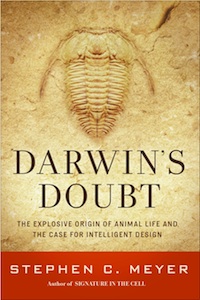
I’ve just read Stephen Meyer’s Darwin’s Doubt.  Meyer is a Cambridge PhD in philosophy of science.  He hangs out with the Intelligent Design people.  His writing is fluid, detailed, and reasonable.  He seems to know what he’s talking about.

The book makes the case for the fact that the fossil record doesn’t support Darwinism.  The sudden appearance of new phyla without sufficient time for the mutation and selection process to work is simply unaccounted for by the rocks.

The problem is that when Meyer says things like, “the Precambrian fossil record simply does not document the gradual emergence of the crucial distinguishing characteristics of the Cambrian animals,” how on earth should I know if he’s right?  I don’t have time to immerse myself in paleontology.  I’ll never be an expert.  I just have four hundred pages of articulate, self-assured, well-documented evidence for Meyer’s case.

So here’s how I find my way into a conversation on subjects that are not my primary field of study.  I read the reviews that are antagonistic to the source and just look at the logic that’s employed.  I find that this often gives me the best read on a work.  If the critics are sincere, the reviews are usually precise.

The New Yorker’s review began with a genetic fallacy, presented arguments that Meyer had refuted without mentioning that Meyer had addressed them, and then deferred to another blogger for the scientific content of the review.  It then called Meyer “absurd,” which, given how shoddy the review actually is, was an absurd thing to do.

Then I read the review from which the New Yorker piece got its “science,” which was actually written by a grad student at Berkeley.  Now I have to say that Berkeley is, in fact, one of my fields of expertise, and I know exactly how Berkeley grad students go about their “work.”  Somehow Berkeley selects the crazies and the militants who show the most promise and then teaches them that knowledge is a completely subjective power tool which should be manipulated by those on an ideological crusade to undermine authority.  I’m not kidding.  I went to Berkeley.  That’s what we did.

What’s interesting about the grad student’s review is that it was posted 24 hours after the release of Meyer’s book, and it’s filled with snark.  He’s not having an intelligent conversation, he’s insulting Meyer in order to defend something religiously.  In a later, defensive review, the grad student says that he read the book “during lunch.” He read over 400 pages of scientific material during lunch, and then posted an insulting review.  He says his detractors are just “slow readers.” People who win speed reading competitions tend to cover 1,000 words per minute (maybe 4 pages) with 50% comprehension.  That level of comprehension is almost useless, and it becomes less useful the more information-rich the content.  A book of Meyer’s size would have taken an hour and forty minutes at that pace, with minimal retention, and that’s if you’re not, oh, say, eating lunch.  On top of that, the review is almost 10,000 words long, which would take some time to write, making it highly suspicious that the review was written after the book was read and not before, in anticipation of the book’s release.

See, this is how I know who to trust in academic communities.  The charlatans have no character.  You read the grad student’s defenses of his review (and they sound a little panicked), and you realize that he has been following Christians around and arguing with them for years with an inquisitor’s zeal.  There’s a personal agenda here, and his approach to new information on the subject is anything but scientific.

Now I start to smell a rat, and I change tactics.  Now I really want Meyer to be wrong.  I want one, good, solid review by an objective thinker, maybe even a Christian, who can debunk Meyer.

So then I read Donald Prothero’s review.  He’s a paleontologist and a scholar.  It begins with a caricature and a smear, saying that anyone who questions evolution suffers from confirmation bias (explain Thomas Nagel?).  He then says they have PhD’s in the wrong fields and thus aren’t qualified to discuss evolution (Meyer, again, studied philosophy of science).  Then he launches into unsubstantiated accusations, saying there are errors on every page.  He says Meyer claims the Cambrian explosion happened “all at once.” Now look, I just read Meyer, and he doesn’t say that at all.  This isn’t a mistake.  This is a lie.  The truth comes out as he goes on to refer to Meyer’s religion as a “fairy tale.” Again, I haven’t found a scientific mind.  I’ve found another fundamentalist.

Now I start to sweat.  A host of scientists have endorsed the book (http://www.darwinsdoubt.com/blurbs/).  I want one to reject it on perfectly level-headed grounds, with no patronizing rhetoric.

Another definitive work on the Cambrian Explosion came out in January of this year.  Called The Cambrian Explosion, it attempts to give a scientific explanation for how so much variety erupted in such a short time.  The authors say “the Cambrian explosion can be considered an adaptive radiation only by stretching the term beyond all recognition.” That means the evolutionists are saying the fossil evidence doesn’t bolster evolution in this particular era.

The New York Times ran a science article last month that said that scientists will spend the coming years trying to figure out what combination of environmental triggers caused the Cambrian explosion.  It doesn’t mention Meyer.  It also seems to leave a big, open question mark about why we need to defend Darwinism at points where the evidence leans away from it.

So now I’ve changed my mind.  I don’t think the fossil evidence does support the current representation of Darwinism.  I think there are some otherwise well-trained scientists who are freaking out, and doing it in widely public and observable ways.  Their lack of command of reason is a tell-tale sign that their motives for defending their orthodoxy are not scientific.  And I believe the failure of the scientific communities to engage in this conversation in a rational way is a manifestation of power brokering rather than honest intellectual engagement.

Could humanity have evolved?  Sure.  But the case isn’t as strong as they told me in biology class.

Interviewed for Truth Matters

Image

Recently I was able to interview James Miller, author of the new apologetics book Hardwired.

Me: What moved you to write Hardwired?

James Miller: I have a real passion for students who grow up in the Church but who aren’t prepared to answer the tough questions that will come their way in college.  My prayer is that Hardwired will help engage some of their deepest quandaries.  I already have two agnostic friends who are reading it.

Me: You wrote, “No one has to convince you that you’re home”. I believe that this sums up Hardwired. Could you briefly explain this statement?

JM: There’s a feeling of resonance…

Read the rest here.

Spiritualizing Our Weaknesses

This is a piece I wrote for ECO’s blog.

blogI recently read a news article about a church’s last worship service. After years of membership decline and consequent financial instability, they were finally dissolving. The reporter said that members were teary-eyed as they sang one last time some great hymns of the faith, read the Bible, and talked about God’s faithfulness. One of the congregants interviewed commented that they weren’t sure what had happened. “We used to have such good potlucks and rummage sales,” she said.

I’ve noticed a trend in church leadership that is particularly clear during a season in which church attendance is on the wane….read the rest here.

The End of the M.Div.?

Christianity Today’s Out of Ur published an article I wrote about the future of the Masters of Divinity degree and the future of seminary education. 

Image

Long the gold standard of seminary education, the Masters of Divinity degree is a requirement for ordination in many denominations. It requires students to make a serious commitment—usually three years, long study hours, and thousands of tuition dollars. They immerse themselves in biblical Hebrew and Koine Greek—some eagerly, some begrudgingly. The result has been a trusted and standardized course of theological study.

But things are changing.

Four significant influences have shifted students, and consequently schools, away from the M.Div. and into alternative learning tracks. The rise of non-denominational churches that no longer require seminary education, significant financial debt incurred by students who are headed into a profession that will not necessarily empower them to pay it off, the rising possibility and acceptability of online education, and the decline of mainline Protestant denominations have all raised questions about the viability of the M.Div.

“We’re in a huge paradigm shift….”

Read the article here.