When Christians Do Vegas

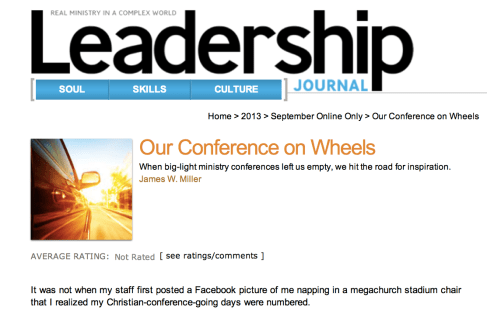
Christianity Today’s Leadership Journal published an article I wrote about our church staff’s new experiment in leadership training.

Conference on Wheels

“Our Conference on Wheels”

James W. Miller

It was not when my staff first posted a Facebook picture of me napping in a megachurch stadium chair that I realized my Christian-conference-going days were numbered.

It was when I realized they had a whole album of these pictures.

I love conferences. In my early days of ministry, The National Youth Workers’ Convention changed the direction of my ministry and my preaching. I marveled the first time I stepped onto Willow Creek’s campus for a Leadership Summit, and I grew because of my first Purpose-Driven Church conference. I still love Catalyst and Orange. Reading this, I think I almost needed a conference intervention.

While I’d still recommend big conferences for ministry development, my staff and I have gone in a new direction. This year we loaded up a caravan of cars and drove four hours into Las Vegas….

Read the article here.

Advance Praise for Hardwired

I’m so thankful to the scholars and ministry leaders who have given my new book Hardwired a thumbs up.  After the investment of years of work, it’s nice to have someone else enjoy it.  And when you write, you’re never sure that it will happen….

JWHardwired is for all of us who live with doubt and uncertainty about the Christian faith. With wisdom, insight and clarity Jim points the way for anyone struggling with insecurity and disbelief to firmly grasp the idea that what they already know is the perfect place to realize a belief in God. This is a book I will recommend to every young adult wrestling with core and fundamental truth. It is a book I will recommend to every mature and older adult looking for a path forward through doubt, frustration and seasons of distress. It is a book I will recommend to anyone open to the idea that God exists and that He loves them and wants them to know Him. In fact I recommend Hardwired to you. I am certain it will open your understanding of God and deepen your belief in God.”

Jon Wallace, President of Azusa Pacific University

TS“I like Hardwired a lot. It’s smart, confident and quite funny. Miller drills to the core of detached claims to neutrality about God. I can’t wait to give this book to friends of mine.”

Tim Stafford, author of Miracles and Senior Writer for Christianity Today

.

TC“A fascinating and highly readable argument for God. Miller avoids the complicated jargon of much contemporary apologetics, and argues in conversational style reminiscent of Lewis and Chesterton that many of our deepest held convictions about the world point unavoidably to a personal God. The book will be of great help to those struggling with doubt. I warmly recommend it.”

Thomas M. Crisp, Chair of the Department of Philosophy at Biola University and Associate Director of Biola’s Center for Christian Thought

JS“Miller’s book is going to provide a map for readers who are yearning to understand how we know what we know to be true regarding faith and life.  There will be lots of insight for who cherish the line by Pascal – ‘The heart has its reasons that reason knows not of.'”

Rev. Dr. Jim Singleton, Jr., Associate Professor of Pastoral Leadership and Evangelism, Gordon-Conwell Theological Seminary

SD“Here is a fresh and original look at religious unbelief. In Hardwired, James Miller surprisingly argues that we all—atheists, agnostics, and believers alike—latently believe that God exists and that we depend on God. The book is clever, well-written, and convincing. I recommend it highly.”

Dr. Stephen T. Davis, Russell K. Pitzer Professor of Philosophy, Claremont McKenna College

DG“Rather than gathering evidence that demands a verdict, James Miller plumbs the depth of the human heart, showing us that the things we take for granted provide a sure foundation for deep, abiding faith. The whole approach is surprisingly fresh and compelling. Add to that Miller’s gift for just-the-right analogy and his clear, spare style, and you’ll know why I’m excited to recommend this book.”

Dr. Diana Pavlac Glyer, author of The Company They Keep: C. S. Lewis and J. R. R. Tolkien as Writers in Community

AM“…he [Miller] has the mind of a scholar, the heart of a pastor, and the ability to synthesize those features in a way that few leaders can. In this book Jim challenges many of the intellectual assumptions of traditional apologetics, which start with what we don’t know, and suggests that the most compelling and heartfelt case for the Christian faith starts with what we do know. Just like in his preaching, he takes apologetics out of the ivory tower and brings it to the streets where people live.”

Adam S. McHugh, author Introverts in the Church: Finding Our Place in an Extroverted Culture

PC“James Miller’s book is a very readable reinforcement of the fact that God has placed eternity in each of our hearts. It helpfully supplements various contemporary apologetical arguments by highlighting the personal, practical, and existential themes familiar to all humans—themes that can touch the heart and move it in a Godward direction.”

Paul Copan, Professor and Pledger Family Chair of Philosophy and Ethics Palm Beach Atlantic University, West Palm Beach, Florida

JRHardwired has flipped my traditional thinking of Christian apologetics upside down with sound and logical intellect, peppered with Jim’s quiet humor and personal vignettes. Our hearts are indeed “God’s Positioning System” – the case for Christ has been and is made, we just need to discover it!

Dr. John Reynolds, Executive Vice President – Azusa Pacific University, California and Chancellor, Azusa Pacific Online University

DC“In a world of debate and challenge to the Christian way of thinking, this book is a breath of fresh air in giving guidance and principles of understanding of how faith really works and pulsates in one’s life. Offbeat, different, creative, it’s a new way of looking at how faith is given, nurtured and survives.”

Rev. Dr. Dan Chun, Pastor of First Presbyterian Church of Honolulu, co-founder of Hawaiian Islands Ministries

CC“Jim Miller does an excellent job of turning our questions upside down and helping us know how much we didn’t know we knew.  He suggests a major shift from trying to prove things to people to helping them realize what they already know.  He helps us examine our assumptions and discover what has been missing in our thinking.  This is an engaging and thought-provoking book.  I highly recommend it.”

Rev. Dr. Clark Cowden

Explore the book in paperback or ebook here:hw

Hardwired (Amazon)

Hardwired (Barnes and Noble)

Is There Hope For Apologetics?

by Dan Stringer

reposted from The Common Loon

July 31, 2013

The Common Loon BooksChurchTheology 4 Comments

HardwiredI remember attending a debate in college between a Christian and an atheist.

Before it started, the room was abuzz with anticipation, like a stadium before kickoff. After the competitors were introduced to applause and scattered boos, they each proceeded to argue forcefully for their belief system, trading punch lines and other rhetorical jabs. Along the way, they interrupted, misquoted and belittled each other’s views. They called each other names and triumphantly scoffed at how misguided the other person was. In their concluding remarks, both sides claimed to have scored the most points, which was curious given the absence of a scoreboard.

I don’t recall anyone being officially declared the winner that night, or if anyone left the room with different beliefs than when they entered. I wonder if the real losers were members of the audience, or at least those of us who had hoped for better.

Over a decade later, I now find myself as a pastor, a vocation predicated on the existence of God. Yet I still have mixed feelings when the subject of apologetics arises. Perhaps I’ve seen it done poorly too many times. Or maybe I’m turned off by the defensive, almost desperate, salesmanship that belittles opposing viewpoints. Or it could be that I can’t stomach the dissonance between apologists’ typical form (rhetorical flourishes and deductive “proofs” designed to score points for God) and their content (the message of God’s love, grace and hope for the world).

Apparently, my friend Jim Miller, also a pastor, has a few mixed feelings about apologetics too. In the opening chapter of his new book Hardwired: Finding the God You Already Know (Abingdon), Jim writes:

Most people who believe in anything, religious or otherwise, did not get there by listening to a debate, and meaningful beliefs do not often rest on academic research. That isn’t to suggest faith and reason are unrelated. There are those who think that God gave reason to humanity the way a father gives a BB gun to his son, telling him, “You can play with that thing all you want. Just don’t point it at me.” To the contrary. In fact, the Scriptures say that God intends for people to come looking for him. He isn’t afraid of our reasoning.

If God isn’t afraid of our reasoning, perhaps he intends for us to search without fear of what we might find (Matthew 7:7-11). While I’m generally not a huge fan of apologetics, I look forward to reading the rest of Jim’s book because he understands that a rational, academic case for God’s presence can only take you so far, especially when everyone uses a different scoreboard. A philosophy buff with an eye for the accessible, Jim doesn’t blast his readers with data and argumentation, but instead helps us catch glimpses of God in our everyday assumptions.

So maybe it’s not a stretch to hope for a better, redeemed approach to apologetics. Rather than trying to dissolve the conversation with a litany of airtight rebuttals to all possible objections, we can set our sights on becoming a different kind of people, the kind of faith community with a capacity to offer helpful responses in the context of authentic relationships when the big questions hit.

Who knows? We might even keep the conversation going.

The Ground

Image

I remember reading about a man badly injured in a car accident.  When asked about the vehicle that hit him, he said, “I didn’t see the truck, just the crash.”  Sometimes we’re so panicked about the crash, we miss what hit us.

The Greek poet Epimenides saw things that most people miss.  He was hailed as a prophet, and legends about him supersede history – that he slept for 50 years, that he lived for 300, that before he died his body appeared tattooed, and that he saw visions.  However, what little we have of his poetry doesn’t suggest mystical visions so much as common sense.  I wonder if prophets are sometimes just people who saw what hit them.Image

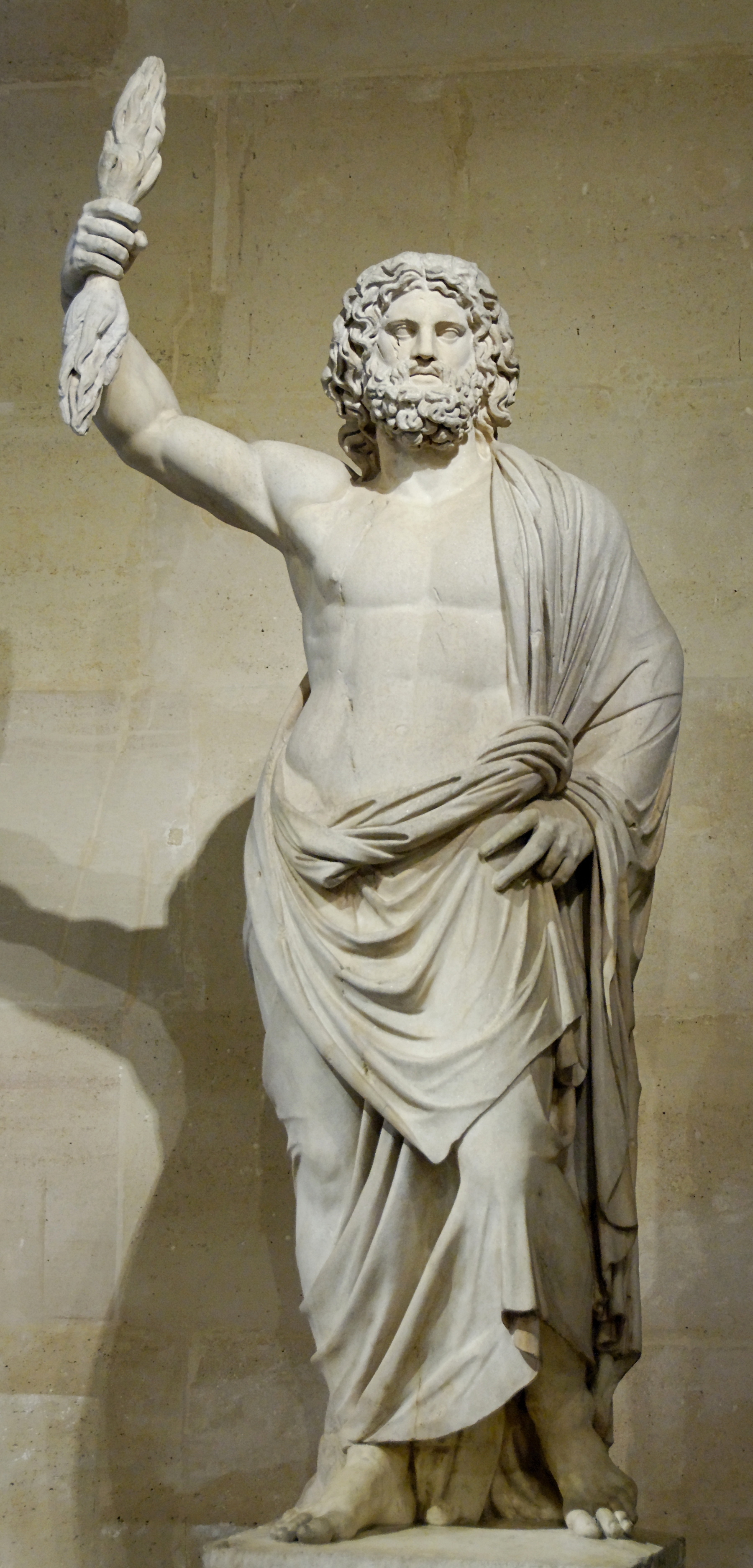
He wrote a poem called the Cretica, The Cretan.  It was a poem about Zeus, king of the gods.  In it, the king of Crete tells Zeus that the Cretans have lied by building a tomb to Zeus.  However, King Minos knows that Zeus is eternal and needs no tomb, because “in you we live and move and have our being.”

Two things interest me about the poem.  One, he doesn’t charge them with a mistake; he charges them with lying.  Given the nature of the issue, I’m not sure who they could be lying to except themselves.  Two, his proof is not data to be analyzed, but existence on the whole.  In you we live, we are active, we exist.  Without you, someone has to explain life arising from inanimate matter, motion, and a universe that has somehow come to be.

Hasn’t it always been the case that when one claims that God is dead, whether a Roman centurion stationed outside of Jesus’ tomb or Friedrich Nietzsche stationed on the doorstep of the 20th century, we’re taking part in a grand self-deception that is corrected by reality itself?  God is the ground on which we stand, and I cannot deny him any more surely than I can stay in mid-jump.  Without God, there’s no reason why there should be a universe rather than not, and no explanation for how something came from nothing.  Without God, there is no explanation for the constant motion in which life is immersed, motion which pushes us, as Sartre said, inevitably towards moral crisis and commitment.  And without God, there is no explanation for how inanimate matter produced consciousness and mental properties, as even atheist philosopher Thomas Nagel has admitted.

The Apostle Paul quotes Epimenides (Acts 17:28) when he engaged the Athenian philosophers on Mars Hill.  He’s proof-texting from their own library.  It’s as if to say, “You already know God is there.  Your own poets have said so.  Your own prophet would call you a liar for denying it.”

I think the charge of lying may be harsh, though technically correct.  I might use a different word for it.  It’s a coping mechanism.  The reality is that crashes are startling and leave us resentful of a fragile world in which they happen.  Denying the possibility of a good, overseeing father figure may be a way of voicing resentment.  It’s fear boiling over into rage.  But at the end of the deny, it’s still just a denial of reality.  Without God, there’s no one to be mad at.

What about Zeus?

A friend of mine is a pastor-in-the-making who is interning at a church and exploring all the questions of ministry that pastors-in-the-making get.  Recently he told me that someone had suggested that ancient cultures had invented goImageds, and Christianity was just one more invention.  That seems to me a shallow and unnuanced take, and I think reality is a little more complex.  It seems that if God had created us for himself, we would naturally be inclined to seek him out. After all, all creation points towards him (Psalm 19), and his existence is so clear that we are “without excuse” for not believing (Romans 1:20).  He is actually not far from any one of us (Acts 17:27), and he rewards our seeking (Matthew 7:7).  So given that we’ve been built with a GPS that points us back to him, it seems that a host of ancient gods would not be disproof of Christianity, but rather proof all the more.  If we’re made for God, it makes sense that we would reach out for him and try to grasp him, and where we can’t find him, we would make up substitutes.  The ancient pantheons are not grounds for dismissal of Christianity.  They’re only the groundwork for true revelation.  The fact that we guessed repeatedly and sometimes close doesn’t mean that Christianity’s similarities to other religions prove it false, only that Christianity in fact satisfies our deepest longings and proves to be the the bullseye around which we had been misfiring.  Ancient religions were simply set-up to the real thing and proof that we were hardwired for the God who would soon reveal himself to us.

These are the kind of speculations captured in Hardwired: Finding the God You Already Know.

Blessed Hypocrisy

You plop down on the beach, the kids go spiraling off to the water like dolphins in a boat’s wake, you take an overdue deep breath and stare at the horizon, and that’s the point at which you realize a thought has been hitchhiking in the boxcar of your prefrontal cortex.  It’s been there for a while, but you haven’t noticed it until now.

I remember in the 80s watching the scandals of the Bakkers and Jimmy Swaggart ripple through the late night comedians and into the minds and mouths of my schoolmates.  I was fairly cognizant of the fact that Christians were generally getting smeared.  I read Elmer Gantry for the first time back then.  And I remember saying, “We’re not all like that!”

Since then I picked up a little hitchhiker.

Now I listen to a rising generation dismissively writing off the church with the under-thought branding, “hypocrites.” But I know that the more they study history and the more they look in the mirror, the more they will regret holding anyone else up to that righteous standard.  Now I hear people accuse Christians of hypocrisy, and I’m inclined to answer, “Absolutely.  We’re all like that.”  Inside the church and out.  We’re all like that.

Proves we need a savior.

Euthyphro Redux

Socrates: Why the long face, Euthyphro?

Euthyphro: Our previous conversation has made me come to realize there can be no actual virtue, Socrates, nor a god.

Socrates: Gads!  Why not, friend?

Euthyphro: Because if virtue is good because the gods command it, it is merely their arbitrary will.  And if they command it because it is objectively good, then the gods themselves are subject to something greater than themselves.  Thus I conclude that there is no value, and probably no gods anyway.

Socrates: You’ve clearly left port without a sail, sad companion.  With what will you replace the gods and value then?

Euthyphro: With Nature, Socrates, and with Reason.  Nature has brought us into being over the long course of time, and Reason is the pinnacle of our being.

Socrates: That’s a thinker.  I wonder, though, if I might ask you a question about that?

Euthyphro: I’d kind of prefer that you not.

Socrates:  Is reason objectively accurate because it has been created by nature to be so, or did nature create it to be so because it’s objectively accurate?  If nature created it to be so because it’s objectively accurate, then something other than nature brought its objectivity into being.  If it is accurate because it is created by nature, then nature’s dictation of it is merely arbitrary, the bouncing around of particles, rendering it not actually objective.  Yet obviously reason works objectively, or else we couldn’t have this conversation.  From whence then, comes reason?

Euthyphro: You know I hate you, don’t you, Socrates?


“Therefore any evolutionary account of the place of reason presupposes reason’s validity and cannot confirm it without circularity.” – Thomas Nagel, Mind and Cosmos, p. 81.

On the baptism of my son

Koen,

Today I baptized you.  You were more excited about the party afterwards than the duty itself, but you had a particular interest in the proceedings.  You wanted it to happen in church instead of the pool next door – strange for an introvert – and for a moment you seemed to like the crowd.  We had rehearsed all the details.  It’s about Jesus forgiving your sins, and new life, and don’t goof around just because everyone is watching, and Papa might cry, and it doesn’t magically forgive you, it’s just a symbol, and hold your nose when you go backwards so you don’t get water in there.  It’s sort of a strange mix of cosmic theological truths and nitty gritty pragmatics.

Faith is kind of that way.  You can only imagine what the sovereign creator of the universe must want to say to us when we’re born.  “Now remember, I’ve already died for you for your forgiveness, stay close to me, look both ways before you cross the street, live by faith not by sight, say your prayers, and don’t swim right after you eat.” God has made us these fleshy spirits, and his will for us is a messy mix of cosmic truth and daily hygiene.

Part of the reason baptism is so beautiful because it is, as Augustine said it and no one has improved on his description since, a visible sign of an invisible grace.  It is the tangible washing of dirt mixed with the holy confirmation of cleansed sin.  It’s exactly what flesh and spirit need to speak the same language at the same time.  Sacraments are like phone wires from our bodies to our souls.

Fatherhood is a fleshy-spiritual kind of thing.  My deepest longings for you are that you would know Jesus, and that you would get married, that you would walk in peace, and that you would have good friends, that you would pray hard and that you would run fast.  I hope we learn to pray for each other as surely as we play catch.  And I’m touched that even if we weren’t related, we would still be best friends.  I have deep hopes for you, body and soul, and I’m thankful today that God came up with this amalgam of flesh-spirits that we are.  I wouldn’t want to miss out on either one.

Your dad can’t control all that happens to your body in a jagged world.  I can’t control Imageyour soul – because certain things can only happen in the conversation that you and God will have together, with me listening in through the door.  But I can drop you beneath the waters, accepting the reality that there is a part of all of us that must die, and then pull you back up to the life that I hope you will find.  I can raise you in a house where we pray, read the book, worship, and believe.  And I can point you in the direction of Jesus, who joined us in the messy package for spirit and flesh.

Love,

Papa

“Remember to fan into flame the gift that God gave you at the laying on of my hands.  God hasn’t given you a spirit of timidity, but a spirit of power, love, and self-disciple.  And don’t ever be ashamed of Jesus, or of his servants.  Instead, join me in enduring all things for the gospel, by the power of God.” -2 Timothy 1:6-8

Atheist Richard Dawkins “has lost”

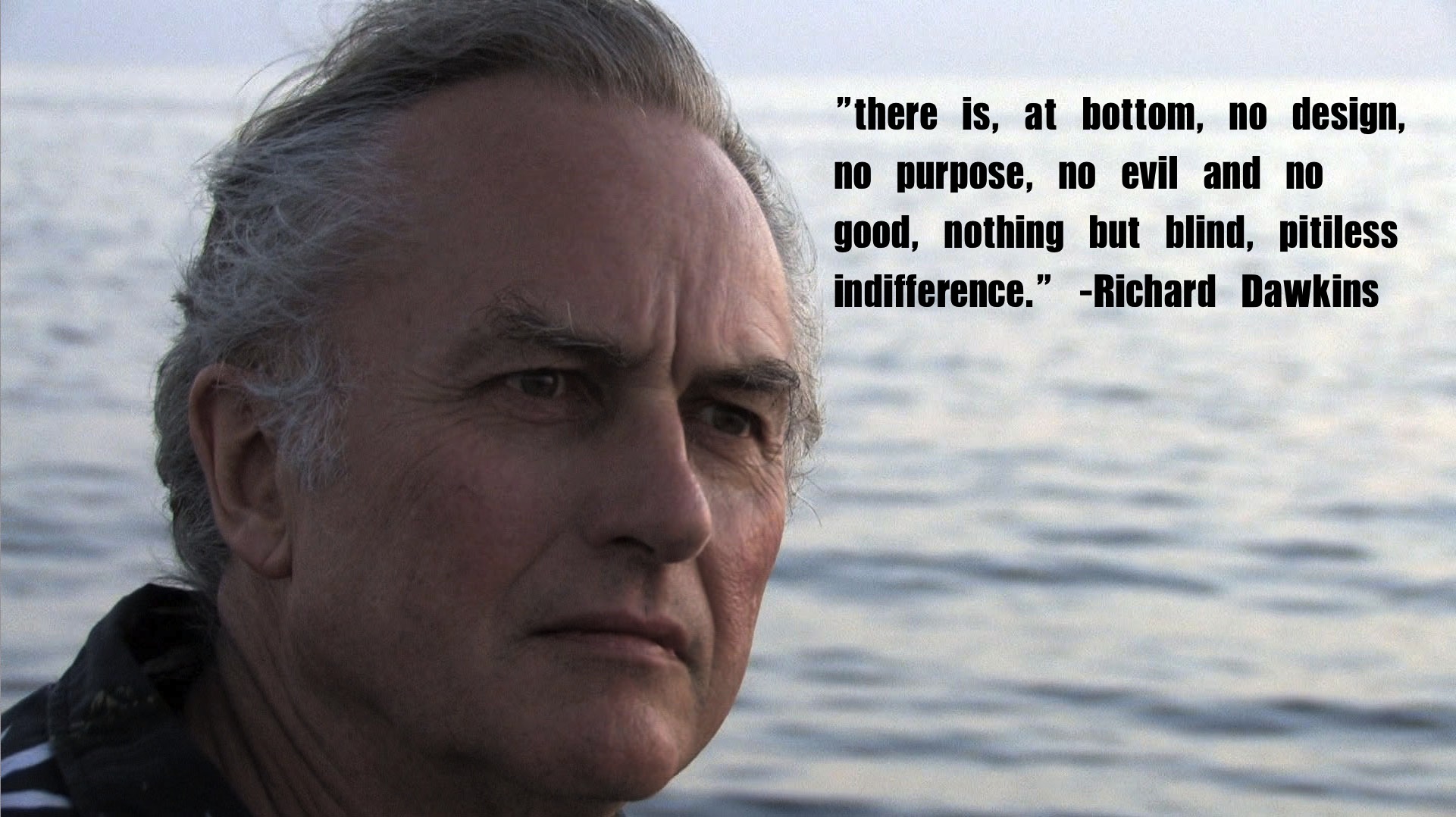
In a provocative commentary entitled “Richard Dawkins Has Lost: meet the new atheists,” writer Theo Hobson alludes to how compelling the moral argument is.  In recent posts, I’ve presented it’s strongest formulation, and despite nitpicking and name-calling, I think the argument has spoken for itself.  Hobson observes that modern atheists are wrestling with morality: “Rejecting religion is no sure path to virtue; it is more likely to lead to complacent self-regard, or ideological arrogance.” He goes on to describe how secular humanists today have become squeamish about Dawkins’ arrogance and venom, and instead are turning to more nuanced and subdued appeals for humanism.  Once such nuance is the casual admission that atheists are still desperate to find a foundational, unifying moral ground.


Studies have reported that “the single biggest predictor of whether someone will be charitable is their religious participation.”

Amoral Atheism

I’ve been discussing the moral argument for the existence of God lately which goes simply:

If God does not exist, objective morals do not exist.

Objective morals do exist.

Therefore, God exists.

A quick and standard rejoinder has been, “So you’re saying atheists can’t be moral?” Now on its face, the question is a straw man, and a poorly phrased one at that.  What the question should be is, “Does the moral argument imply that atheists cannot behave in socially well-adapted way?” Or in other words, “Can’t atheists be nice folks?” And of course the answer to that (irrelevant) question is “no.”

But it raises another question that is not addressed by the moral argument.  That question is, “Can atheists rationally commit to binding behavioral obligations that they are not free to violate without hypocrisy or deceit?” In other words, is there anything that rationally makes atheists be nice folks.  And the answer to that is a solid “no.”

ImageWithout God, the universe is a mysterious accident.  Life is an accident.  The fact that we can contemplate our existence and wonder about our purpose is a horrible disfigurement of human nature brought on by runaway genetic mutation.  Thinking about purpose in a world that has none can only lead to despair.  As a result, our deaths are meaningless conclusions to the senseless banging together of the particles that comprised our bodies.  If we die young, it is neither right nor wrong.  If our lives accomplish nothing, it is neither right nor wrong.  If we hurt others or are hurt ourselves, there is nothing fundamentally right or wrong about the hurting.  Wanting to improve humanity is a silly misfiring of genetic inclinations to preserve ourselves, all of which will be rendered utterly stupid when the universe eventually expands to the point of its inevitable heat death.

So must the atheist be nice?  By no means!  And it is not wrong for him to be mean, because in the atheist conception, there is no real right or wrong.  There is only impulse, social contract, and group think.

These questions would come a lot more clear if we would start defining morality as a logically obligatory set of behavior-governing principles, at which point we could say definitively that atheists cannot be moral.  They can only be nice.  And their reasons for doing so may as well likewise die an early heat death.

Can atheists be moral?  Not by this definition.  They can go along with the group will of the day, constantly open to the option of abandoning public consensus for the sake of personal gain or pleasure.  And the most casual study of human behavior will show how likely that possibility is.