It’s Time to Talk About This

Image

Published on the ECO blog – it’s time to talk about why we’re changing denominations.

A friend of mine recently told me that he wanted his church to join ECO, but, he admitted, “We haven’t even started talking about it yet.”

I’m noticing how fast my life is going by. A day ago my daughter was born, and today she’s ten. She’s more than half way to being out of the house. I still remember how to change diapers. I remember the rubbery skin of a pacifier. I remember waking her to have breakfast with me, us both wearing large, flowery hats at the table and eating chocolate for breakfast, because Mom wasn’t up yet, and because that’s what French people do, I told her. Now she’s old enough to

Read the rest here….

A Risky Faith

ImageToday my 7 year old son road the Indiana Jones ride at Disneyland, a tumultuous journey through fire, giant snakes, and piles of (plastic, but very realistic) skulls.  We praised him for being so brave.  His first words off the ride were, “What was it like?” That was because he covered his eyes the whole time.  I was proud of him for daring it all the same, and the day will come where he laughs his way through such things.  I still cover my eyes in the Haunted Mansion.

I wonder how many people live life with Jesus with their eyes covered.  They are brave enough to commit, but then once on the ride, the last thing they want to see is what it’s like to share their faith with someone, what it feels like to tithe, how hard it is to go to a developing nation and offer ministry, how painful it is to choose the road of humility over easy self-promotion.  All of that is pretty terrifying for me, and I’m sort of professionally wrapped up in this Jesus-following thing.  I suspect it’s scary for most people.  But how sad to finally see Jesus in the end, look him in the face, glance back over your shoulder to a life that was supposed to be lived in exciting, wild, risk-taking faith, and ask him, “What was it like?”

The ride is on.  The car has started rolling.  If you’ve chosen to ride with Jesus, don’t close your eyes – this is what life is all about.

Son of God Movie Review

Son of GodYesterday I was invited to Saddleback Church to preview the forthcoming movie Son of God, produced by the same people who created The Bible series for the History Channel last year, Mark Burnett and Roma Downey, who were both present for the screening.  I’d strongly recommend you put this on your list of movies to see when it releases on February 28th.

In terms of production value, it’s the best one of its genre.  The Jesus Film pales in comparison, looking almost like a homemade movie compared to Son of God.  The 1977 epic Jesus of Nazareth (over 6 hours long) was powerful for its time, but awfully hard to sit through.  The Passion of the Christ, which, coincidentally, released exactly 10 years ago on Feb. 25, 2004, did not tell the story of the life of Jesus, but really honed in on the pathos of his final week.  There really isn’t a modern day video retelling of the life of Jesus as good as Son of God.  More flamboyant retellings, like The Last Temptation and Jesus of Montreal, really fall outside the mainstream and look more like a sectarian reinterpretation of the story.

The movie doesn’t stray far from the biblical narrative, though it fleshes out some of the narrative behind the Roman occupation, and it emphasizes the way Jesus was an offense both to Romans and Pharisees.  Many of the lines are paraphrases of the words of Jesus and the biblical characters, but the movie isn’t indulgent in its adaptation.  It leaves a lot out, but after two and a half hours, it would have been hard to meaningfully include more and still accommodate the modern attention span.

For that reason, you need to see it.  Take your kids.  Take your unbelieving friends.  Take your small group and let it guide a discussion of which parts of the life of Jesus you tend to pay the most and least attention to.

The only criticism I have of the movie are just in the nature of the genre.  Many of the characters are white people with British accents and perfect teeth.  Of course, I don’t think American English would be any more authentic, and the only way around these cliches would be to do as The Passion and have the whole thing in Aramaic.  Some of the dialogue is oddly lilting, and the soundtrack is a bit melodramatic.  The costuming is a silly blend of immaculately clean robes in a rainbow of colors.  Still, the actor who plays Jesus, Diogo Morgado, is a nice variation on his predecessors.  Rather than pale and somber, he often appears amused.  You can’t help liking him from the beginning.  And to be honest, the cliches are at about the level of presentation that most Americans expect and even want from a story set in the ancient world.  We have the same caricatures when it comes to stories about ancient Greece, Rome, and Egypt.

So take the movie for what it’s meant to be.  It’s not simply entertainment, and it’s not intended to offer a new slant on the biblical narrative.  It’s fundamentally an evangelical tool for retelling the gospel again in a modern language.  And anytime Christ and culture meet, it’s a good opportunity for Christians to enter into conversation with a world that has heard different representations of Christianity and still wants to see the real thing.

hardwired cover


Please check out my book!  – – – – – – ->


Everyone Knows God Is There

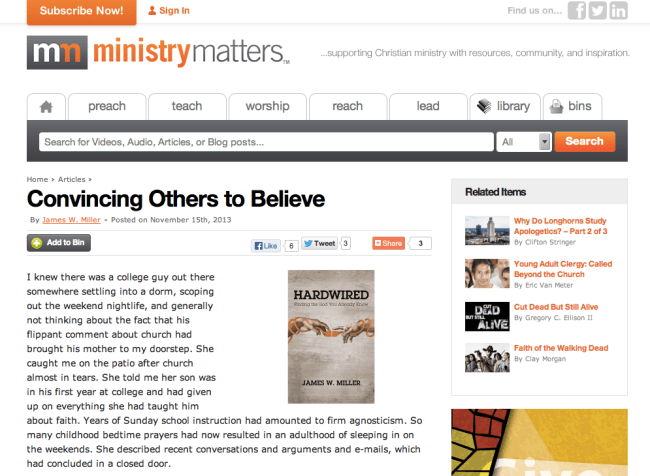
MMI knew there was a college guy out there somewhere settling into a dorm, scoping out the weekend nightlife, and generally not thinking about the fact that his flippant comment about church had brought his mother to my doorstep. She caught me on the patio after church almost in tears. She told me her son was in his first year at college and had given up on everything she had taught him about faith. Years of Sunday school instruction had amounted to firm agnosticism. So many childhood bedtime prayers had now resulted in an adulthood of sleeping in on the weekends. She described recent conversations and arguments and e-mails, which had concluded in a closed door.

“How do I convince him that there is a God?” she asked….


Read the rest here.

Interviewed for Truth Matters

Image

Recently I was able to interview James Miller, author of the new apologetics book Hardwired.

Me: What moved you to write Hardwired?

James Miller: I have a real passion for students who grow up in the Church but who aren’t prepared to answer the tough questions that will come their way in college.  My prayer is that Hardwired will help engage some of their deepest quandaries.  I already have two agnostic friends who are reading it.

Me: You wrote, “No one has to convince you that you’re home”. I believe that this sums up Hardwired. Could you briefly explain this statement?

JM: There’s a feeling of resonance…

Read the rest here.

Advance Praise for Hardwired

I’m so thankful to the scholars and ministry leaders who have given my new book Hardwired a thumbs up.  After the investment of years of work, it’s nice to have someone else enjoy it.  And when you write, you’re never sure that it will happen….

JWHardwired is for all of us who live with doubt and uncertainty about the Christian faith. With wisdom, insight and clarity Jim points the way for anyone struggling with insecurity and disbelief to firmly grasp the idea that what they already know is the perfect place to realize a belief in God. This is a book I will recommend to every young adult wrestling with core and fundamental truth. It is a book I will recommend to every mature and older adult looking for a path forward through doubt, frustration and seasons of distress. It is a book I will recommend to anyone open to the idea that God exists and that He loves them and wants them to know Him. In fact I recommend Hardwired to you. I am certain it will open your understanding of God and deepen your belief in God.”

Jon Wallace, President of Azusa Pacific University

TS“I like Hardwired a lot. It’s smart, confident and quite funny. Miller drills to the core of detached claims to neutrality about God. I can’t wait to give this book to friends of mine.”

Tim Stafford, author of Miracles and Senior Writer for Christianity Today

.

TC“A fascinating and highly readable argument for God. Miller avoids the complicated jargon of much contemporary apologetics, and argues in conversational style reminiscent of Lewis and Chesterton that many of our deepest held convictions about the world point unavoidably to a personal God. The book will be of great help to those struggling with doubt. I warmly recommend it.”

Thomas M. Crisp, Chair of the Department of Philosophy at Biola University and Associate Director of Biola’s Center for Christian Thought

JS“Miller’s book is going to provide a map for readers who are yearning to understand how we know what we know to be true regarding faith and life.  There will be lots of insight for who cherish the line by Pascal – ‘The heart has its reasons that reason knows not of.'”

Rev. Dr. Jim Singleton, Jr., Associate Professor of Pastoral Leadership and Evangelism, Gordon-Conwell Theological Seminary

SD“Here is a fresh and original look at religious unbelief. In Hardwired, James Miller surprisingly argues that we all—atheists, agnostics, and believers alike—latently believe that God exists and that we depend on God. The book is clever, well-written, and convincing. I recommend it highly.”

Dr. Stephen T. Davis, Russell K. Pitzer Professor of Philosophy, Claremont McKenna College

DG“Rather than gathering evidence that demands a verdict, James Miller plumbs the depth of the human heart, showing us that the things we take for granted provide a sure foundation for deep, abiding faith. The whole approach is surprisingly fresh and compelling. Add to that Miller’s gift for just-the-right analogy and his clear, spare style, and you’ll know why I’m excited to recommend this book.”

Dr. Diana Pavlac Glyer, author of The Company They Keep: C. S. Lewis and J. R. R. Tolkien as Writers in Community

AM“…he [Miller] has the mind of a scholar, the heart of a pastor, and the ability to synthesize those features in a way that few leaders can. In this book Jim challenges many of the intellectual assumptions of traditional apologetics, which start with what we don’t know, and suggests that the most compelling and heartfelt case for the Christian faith starts with what we do know. Just like in his preaching, he takes apologetics out of the ivory tower and brings it to the streets where people live.”

Adam S. McHugh, author Introverts in the Church: Finding Our Place in an Extroverted Culture

PC“James Miller’s book is a very readable reinforcement of the fact that God has placed eternity in each of our hearts. It helpfully supplements various contemporary apologetical arguments by highlighting the personal, practical, and existential themes familiar to all humans—themes that can touch the heart and move it in a Godward direction.”

Paul Copan, Professor and Pledger Family Chair of Philosophy and Ethics Palm Beach Atlantic University, West Palm Beach, Florida

JRHardwired has flipped my traditional thinking of Christian apologetics upside down with sound and logical intellect, peppered with Jim’s quiet humor and personal vignettes. Our hearts are indeed “God’s Positioning System” – the case for Christ has been and is made, we just need to discover it!

Dr. John Reynolds, Executive Vice President – Azusa Pacific University, California and Chancellor, Azusa Pacific Online University

DC“In a world of debate and challenge to the Christian way of thinking, this book is a breath of fresh air in giving guidance and principles of understanding of how faith really works and pulsates in one’s life. Offbeat, different, creative, it’s a new way of looking at how faith is given, nurtured and survives.”

Rev. Dr. Dan Chun, Pastor of First Presbyterian Church of Honolulu, co-founder of Hawaiian Islands Ministries

CC“Jim Miller does an excellent job of turning our questions upside down and helping us know how much we didn’t know we knew.  He suggests a major shift from trying to prove things to people to helping them realize what they already know.  He helps us examine our assumptions and discover what has been missing in our thinking.  This is an engaging and thought-provoking book.  I highly recommend it.”

Rev. Dr. Clark Cowden

Explore the book in paperback or ebook here:hw

Hardwired (Amazon)

Hardwired (Barnes and Noble)

Death by Explanation

ImageScientists can describe to you the project of finding a “universal theory,” something that explains the whole of existence in its most basic terms.  This generally involves some form of reductionism, usually collapsing the three great sciences into one another.  Biology is to be explained by chemistry, and chemistry is to be explained by physics.  In other words, the activity of our hearts and minds are the firings of neurons and the swirling of chemicals.  Those chemicals are fundamentally the interactions of molecules, which are the interactions of atoms, which are the interactions of protons, neutrons, electrons.  If you slice with a thinner razor, you come to quarks and leptons and bosons.  The universal theory aims at getting to the center of these Russian dolls and explaining how the little one, and the forces that hold them together, governs everything else.

This is a real effort in the sciences.  Darwinism is the greatest reductionist theory in existence, an alternative to a Designer.  Next, scientists are looking for a source for the big bang, trying to come up with a viable alternative to a Creator.  This is a real effort in the sciences – and it really isn’t going to work.

Renee Descartes tried to do the same thing with the mental world.  He tried to break thought down into its smallest, most basic parts.  If he imagined that the world around him didn’t exist, imagined even that the parts of his body didn’t exist, that with which he ultimately left was “I think therefore I am.” The criticism of his theory has always been, “Hey, where did this ‘I’ come from?  What’s the ‘I’ that’s doing the thinking?” In other words, you can’t really separate thinking from the person who is doing it, so it’s hard to say what the tiniest little atom is in the sequence of mental events.  You could try saying, “Thinking happens,” but that doesn’t really explain the fact that thinking is self-conscious.  Our thoughts are part of a bigger story, a narrative, and no one thought can be separated out by itself from the others.  Thoughts can’t be broken into atoms.

The same thing is true in the physical sciences.  The problem with atomistic theory is that nothing in the real world can be dissected down to constituent parts that are actually separated from one another.  The atoms are holding hands.  Physics is a narrative.  The fact that some atoms make up the point where my pencil ends and others make up the point where the paper begins constitutes a story about the atoms that the individual atoms can’t tell on their own.

Ultimately, materialistic, atheistic scientific efforts will keep hacking away at life looking for its smallest unit.  But science is trying to grab hold of mercury.  What it’s trying to contain will always slip away.  Atoms will never by themselves tell the story of existence.  The whole narrative is bigger than the sum of its parts.

The scientific reduction of biology into chemistry and physics tells us as much about life as dissection tells us about what it feels like to fall in love.

The Ground

Image

I remember reading about a man badly injured in a car accident.  When asked about the vehicle that hit him, he said, “I didn’t see the truck, just the crash.”  Sometimes we’re so panicked about the crash, we miss what hit us.

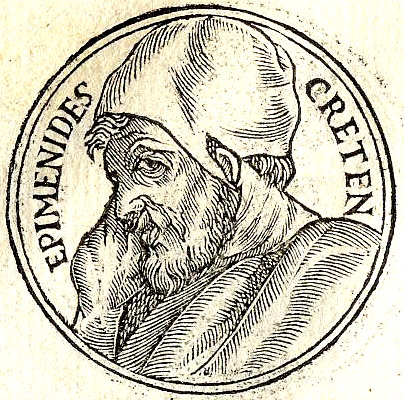
The Greek poet Epimenides saw things that most people miss.  He was hailed as a prophet, and legends about him supersede history – that he slept for 50 years, that he lived for 300, that before he died his body appeared tattooed, and that he saw visions.  However, what little we have of his poetry doesn’t suggest mystical visions so much as common sense.  I wonder if prophets are sometimes just people who saw what hit them.Image

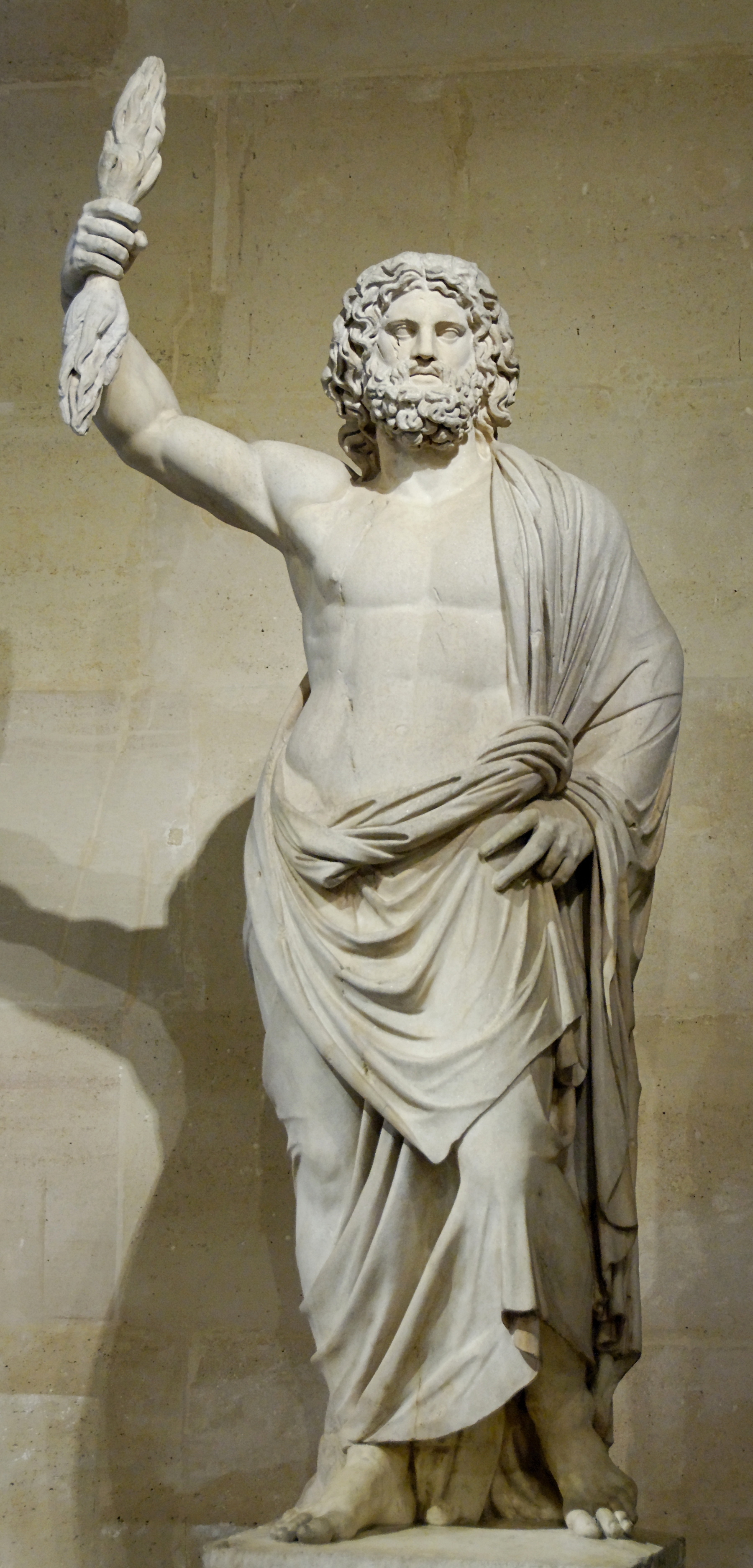
He wrote a poem called the Cretica, The Cretan.  It was a poem about Zeus, king of the gods.  In it, the king of Crete tells Zeus that the Cretans have lied by building a tomb to Zeus.  However, King Minos knows that Zeus is eternal and needs no tomb, because “in you we live and move and have our being.”

Two things interest me about the poem.  One, he doesn’t charge them with a mistake; he charges them with lying.  Given the nature of the issue, I’m not sure who they could be lying to except themselves.  Two, his proof is not data to be analyzed, but existence on the whole.  In you we live, we are active, we exist.  Without you, someone has to explain life arising from inanimate matter, motion, and a universe that has somehow come to be.

Hasn’t it always been the case that when one claims that God is dead, whether a Roman centurion stationed outside of Jesus’ tomb or Friedrich Nietzsche stationed on the doorstep of the 20th century, we’re taking part in a grand self-deception that is corrected by reality itself?  God is the ground on which we stand, and I cannot deny him any more surely than I can stay in mid-jump.  Without God, there’s no reason why there should be a universe rather than not, and no explanation for how something came from nothing.  Without God, there is no explanation for the constant motion in which life is immersed, motion which pushes us, as Sartre said, inevitably towards moral crisis and commitment.  And without God, there is no explanation for how inanimate matter produced consciousness and mental properties, as even atheist philosopher Thomas Nagel has admitted.

The Apostle Paul quotes Epimenides (Acts 17:28) when he engaged the Athenian philosophers on Mars Hill.  He’s proof-texting from their own library.  It’s as if to say, “You already know God is there.  Your own poets have said so.  Your own prophet would call you a liar for denying it.”

I think the charge of lying may be harsh, though technically correct.  I might use a different word for it.  It’s a coping mechanism.  The reality is that crashes are startling and leave us resentful of a fragile world in which they happen.  Denying the possibility of a good, overseeing father figure may be a way of voicing resentment.  It’s fear boiling over into rage.  But at the end of the deny, it’s still just a denial of reality.  Without God, there’s no one to be mad at.

What about Zeus?

A friend of mine is a pastor-in-the-making who is interning at a church and exploring all the questions of ministry that pastors-in-the-making get.  Recently he told me that someone had suggested that ancient cultures had invented goImageds, and Christianity was just one more invention.  That seems to me a shallow and unnuanced take, and I think reality is a little more complex.  It seems that if God had created us for himself, we would naturally be inclined to seek him out. After all, all creation points towards him (Psalm 19), and his existence is so clear that we are “without excuse” for not believing (Romans 1:20).  He is actually not far from any one of us (Acts 17:27), and he rewards our seeking (Matthew 7:7).  So given that we’ve been built with a GPS that points us back to him, it seems that a host of ancient gods would not be disproof of Christianity, but rather proof all the more.  If we’re made for God, it makes sense that we would reach out for him and try to grasp him, and where we can’t find him, we would make up substitutes.  The ancient pantheons are not grounds for dismissal of Christianity.  They’re only the groundwork for true revelation.  The fact that we guessed repeatedly and sometimes close doesn’t mean that Christianity’s similarities to other religions prove it false, only that Christianity in fact satisfies our deepest longings and proves to be the the bullseye around which we had been misfiring.  Ancient religions were simply set-up to the real thing and proof that we were hardwired for the God who would soon reveal himself to us.

These are the kind of speculations captured in Hardwired: Finding the God You Already Know.