A Risky Faith

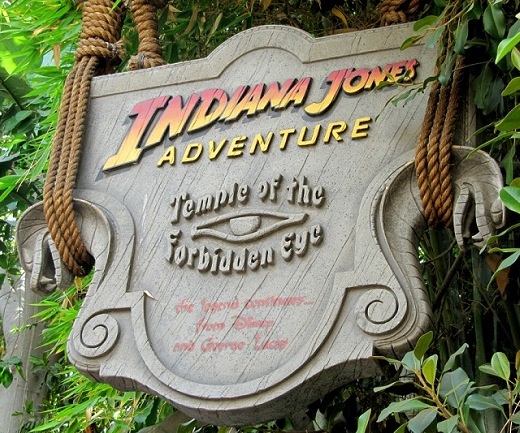
ImageToday my 7 year old son road the Indiana Jones ride at Disneyland, a tumultuous journey through fire, giant snakes, and piles of (plastic, but very realistic) skulls.  We praised him for being so brave.  His first words off the ride were, “What was it like?” That was because he covered his eyes the whole time.  I was proud of him for daring it all the same, and the day will come where he laughs his way through such things.  I still cover my eyes in the Haunted Mansion.

I wonder how many people live life with Jesus with their eyes covered.  They are brave enough to commit, but then once on the ride, the last thing they want to see is what it’s like to share their faith with someone, what it feels like to tithe, how hard it is to go to a developing nation and offer ministry, how painful it is to choose the road of humility over easy self-promotion.  All of that is pretty terrifying for me, and I’m sort of professionally wrapped up in this Jesus-following thing.  I suspect it’s scary for most people.  But how sad to finally see Jesus in the end, look him in the face, glance back over your shoulder to a life that was supposed to be lived in exciting, wild, risk-taking faith, and ask him, “What was it like?”

The ride is on.  The car has started rolling.  If you’ve chosen to ride with Jesus, don’t close your eyes – this is what life is all about.

Son of God Movie Review

Son of GodYesterday I was invited to Saddleback Church to preview the forthcoming movie Son of God, produced by the same people who created The Bible series for the History Channel last year, Mark Burnett and Roma Downey, who were both present for the screening.  I’d strongly recommend you put this on your list of movies to see when it releases on February 28th.

In terms of production value, it’s the best one of its genre.  The Jesus Film pales in comparison, looking almost like a homemade movie compared to Son of God.  The 1977 epic Jesus of Nazareth (over 6 hours long) was powerful for its time, but awfully hard to sit through.  The Passion of the Christ, which, coincidentally, released exactly 10 years ago on Feb. 25, 2004, did not tell the story of the life of Jesus, but really honed in on the pathos of his final week.  There really isn’t a modern day video retelling of the life of Jesus as good as Son of God.  More flamboyant retellings, like The Last Temptation and Jesus of Montreal, really fall outside the mainstream and look more like a sectarian reinterpretation of the story.

The movie doesn’t stray far from the biblical narrative, though it fleshes out some of the narrative behind the Roman occupation, and it emphasizes the way Jesus was an offense both to Romans and Pharisees.  Many of the lines are paraphrases of the words of Jesus and the biblical characters, but the movie isn’t indulgent in its adaptation.  It leaves a lot out, but after two and a half hours, it would have been hard to meaningfully include more and still accommodate the modern attention span.

For that reason, you need to see it.  Take your kids.  Take your unbelieving friends.  Take your small group and let it guide a discussion of which parts of the life of Jesus you tend to pay the most and least attention to.

The only criticism I have of the movie are just in the nature of the genre.  Many of the characters are white people with British accents and perfect teeth.  Of course, I don’t think American English would be any more authentic, and the only way around these cliches would be to do as The Passion and have the whole thing in Aramaic.  Some of the dialogue is oddly lilting, and the soundtrack is a bit melodramatic.  The costuming is a silly blend of immaculately clean robes in a rainbow of colors.  Still, the actor who plays Jesus, Diogo Morgado, is a nice variation on his predecessors.  Rather than pale and somber, he often appears amused.  You can’t help liking him from the beginning.  And to be honest, the cliches are at about the level of presentation that most Americans expect and even want from a story set in the ancient world.  We have the same caricatures when it comes to stories about ancient Greece, Rome, and Egypt.

So take the movie for what it’s meant to be.  It’s not simply entertainment, and it’s not intended to offer a new slant on the biblical narrative.  It’s fundamentally an evangelical tool for retelling the gospel again in a modern language.  And anytime Christ and culture meet, it’s a good opportunity for Christians to enter into conversation with a world that has heard different representations of Christianity and still wants to see the real thing.

hardwired cover


Please check out my book!  – – – – – – ->


Book Review: “Hardwired: Finding the God You Already Know” by James Miller

J.W. Wartick's avatarJ.W. Wartick - Reconstructing Faith

hardwired-jmIrreverent. That’s how I would describe Hardwired by James Miller in one word. Miller appeared unimpressed by Natural Theology, and perhaps even less impressed by current scholarly apologetics. Yet this is, unabashedly, an apologetics work. It’s just not the type that many readers would expect going in. Miller’s approach is presuppositional: that is, he sought to discuss the questions about faith by analyzing those things that people already assume or know.

Illustrative was his comment early on in the work. Miller was approached by a mother who was heartbroken over her son leaving the faith. She asked him, “‘How do I convince him there is a God?'” Miller’s answer is indicative of his apologetic method: “He already believes in God.” This startling statement forms the basis for the rest of the book. Miller’s approach revolved around showing people the God they “already know.”

How might one justify this outlandish…

View original post 1,379 more words

Muddy Morality

Image

This article was posted on the Download Youth Ministry blog, one of the most well-read youth ministry websites out there.

One of the most and least popular Sunday school classes I ever taught involved a lot of mud.  “Most” popular, I say, because the students always remembered it.  “Least” popular, because their parents weren’t all that happy with the results.

Early on Sunday morning, I walked out onto the church lawn with a hose.  This was one of those formal churches, where the girls where frilly dresses and the boys wore handsome suits.  On the front lawn of the church that day, I made a mud puddle.  And by “puddle,” I mean lake….

Read the rest here.

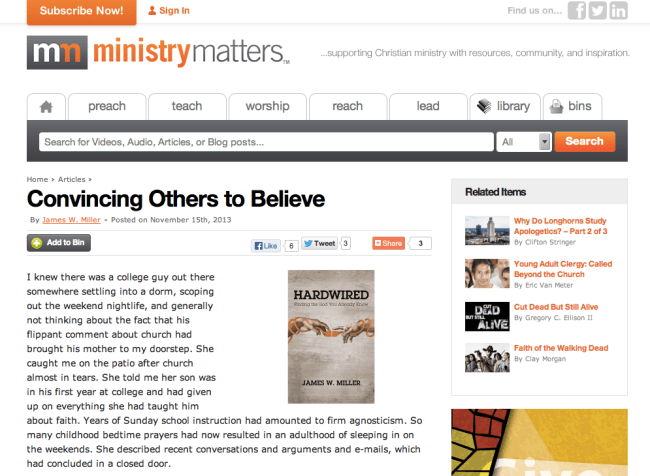
Everyone Knows God Is There

MMI knew there was a college guy out there somewhere settling into a dorm, scoping out the weekend nightlife, and generally not thinking about the fact that his flippant comment about church had brought his mother to my doorstep. She caught me on the patio after church almost in tears. She told me her son was in his first year at college and had given up on everything she had taught him about faith. Years of Sunday school instruction had amounted to firm agnosticism. So many childhood bedtime prayers had now resulted in an adulthood of sleeping in on the weekends. She described recent conversations and arguments and e-mails, which had concluded in a closed door.

“How do I convince him that there is a God?” she asked….


Read the rest here.

Certainly Agnostic

Image

Posted on the Christian Apologetics Alliance

When I offer an apologetics seminar that I call “Know Why You Believe,” I find that the skeptical attendees have a preferred label for themselves.  “So I’m an agnostic,” says the first person to raise his hand, and that is the preface to his question.  A few others nod their heads eagerly.

I’m not sure if I believe him or not.  But I’ve finally come up with a good, brief answer….

Read the rest here.

Interviewed for Truth Matters

Image

Recently I was able to interview James Miller, author of the new apologetics book Hardwired.

Me: What moved you to write Hardwired?

James Miller: I have a real passion for students who grow up in the Church but who aren’t prepared to answer the tough questions that will come their way in college.  My prayer is that Hardwired will help engage some of their deepest quandaries.  I already have two agnostic friends who are reading it.

Me: You wrote, “No one has to convince you that you’re home”. I believe that this sums up Hardwired. Could you briefly explain this statement?

JM: There’s a feeling of resonance…

Read the rest here.

The Bestselling Jesus

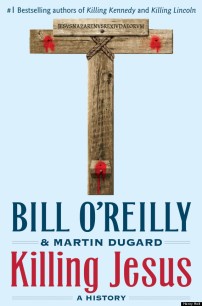
A review of Killing Jesus, by Bill O’ReillyImage
By James W. Miller

The Last Temptation of Christ witnessed lines of moviegoers and waves of bookbuyers when it was released, largely because Christians threatened to boycott it.  The Passion of the Christ made over $611 million dollars from the hands of the passionately faithful and the militantly opposed.  Zealot, a book that depicted the historical Jesus as something less than the Messiah of God, raced to the bestsellers lists this year, though critics say it offered no new twist on the historical retelling of the life of Jesus.  Bill O’Reilly’s new book, Killing Jesus, is not bound for that kind of glory, for one simple reason: it doesn’t say anything controversial.

Released on September 24th, Killing Jesus, by O’Reilly and cohort Martin Dugard, hovered around #4 on the Amazon bestseller list in the days leading up to it.  By the end of the first day, it was still at #3, standing behind the latest Stephen King and the fourth installment in a young adults science fiction series.  Then on his evening Fox TV show he proclaimed that his book is creating controversy, and that some people think he’s “going to hell for writing it.” Who are these critics?  A few unnamed letter writers.  O’Reilly had a priest and a pastor on the show.  He told them he was getting a lot of heat from evangelicals.  The pastor told O’Reilly that evangelicals “ought to love this book.” O’Reilly replied that “the anti-Christian people” don’t want anyone to read this book.  The priest told O’Reilly that people won’t like the book because it defends the Bible’s accuracy.  O’Reilly assured the audience that the book is footnoted with the facts.  The ordained yes-men assured him he was right.   “I learned a lot,” said the priest.

Finally made it to #2.

But honestly, there’s no controversy here.  The book alternates between a fairly straightforward retelling of the biblical story with only minor narrative expansion, and a fairly unsurprising retelling of the details of the Roman Empire.  As to the latter, the authors hone in on that which is most violent and most sexually depraved, without any particular exploration of the psychology of the Caesars.  The story runs from Herod’s slaughter of the innocents, through the assassination of Julius Caesar, through bloodthirsty stories of Roman military conquests to vile sexual exploits of the subsequent Caesars.  None of this contributes meaningfully to the story of the life of Jesus.  And apparently it’s not scary enough to top Stephen King.

What the book does rightly is to show insistently that Jesus’ life and teachings are inextricably interwoven with the claim to his deity.  This isn’t just a demythologized, historical Jesus narrative, despite the fact that the authors tend away from the miraculous (the disciples “claim” to have seen him walk on water).  And there is an evangelical quality to the book for that reason.  There may be some stragglers who don’t read the serious literature about Jesus but pick this one up from the airport newsstand and end up in some kind of serious exploration of faith.  The Lord works in mysterious ways.  If you just wanted some superficial historical details about the first century world, it’s a fairly painless way to get them.  But the book’s popularity won’t come from a serious literary merit.

Of course, the drawback is that the rising population of Millennials will no longer take the story of Jesus from the hands of Caucasian men in their 60s who talk more about their political agendas than their faith.

The two Catholic authors previously partnered on bestsellers Killing Lincoln, which was criticized for factual inaccuracies, and Killing Kennedy, which the New York Times called “gerund-happy” while accusing the authors of “word mangling.” Both of them stayed on the bestsellers lists for months, the first one for more than a year.  Killing Jesus will be a bestseller as well.  The O’Reilly Factor has around 3 million viewers, and if history serves, he’ll spend the coming months promoting it on a daily basis.  Plus, it’s just hard to get around the fact that Jesus is still a subject that everyone wants to hear about.  But the book won’t be remembered for contributing anything new to conversations about Jesus, either historical or theological.

hardwired cover  Check out Hardwired:Finding the God

  You Already Know (Abingdon 2013)