A Very Messy Christmas


CB.jpg

We like to wish each other a merry Christmas.  If we wanted to be real with each other, we would probably wish one another a messy Christmas, because to do so is more true to the biblical narrative and more true to the state of our lives.  Merry Christmess.  It would relieve the recipient of the burden of meeting the Norman Rockwell expectations  for family life in this season, achieving the proper level of Hallmark sentimentality, and imitating the magazine cover home decor.  Most of us would rather undo the top button of our jeans and watch football with the curtains closed.

The Christmas holiday is messy; let’s be honest.

The manger scenes on our front lawns are dishonest.  The wise men, who have just concluded an international journey on foot, are well-pressed and do not need a shower.  The shepherds, who are day-laborers, whom Aristotle referred to as the “most lazy” of all laborers, have the well-groomed gaiety of a barbershop quartet about to break out in song.  The baby, who was just born in a windy barn without medical assistance, well, “no crying he makes.” And Mary, who was not long ago threatened with divorce in light of premarital pregnancy, and Joseph, who finds himself in a generally unwanted arranged marriage, have on their faces the serene tranquility of a Buddha statue I saw in my neighbor’s garden.

Meanwhile, the houses behind our manger scenes are full of people who, by all accounts, are completely unworthy to approach such an immaculate gathering.

Christmas is messy.  The first one was messy, and the meaning behind it is messy.  God steps down into the mud and filth of the earth to join the species that had staged a rebellion against the Creator in the hopes of winning some converts back to the original side where, outrageously, they will be welcomed to return.  Christmas isn’t about a neat and tidy self-presentation.  It’s about being loved by the God who knows our mess so well that he joined it.

logo.jpgWhat if, rather than painting on our faces the rouge of artificial merriness, we settle for the messiness?  What if we accept one another’s messiness with grace? Christmas is not a time for appearances, it is a time for the authentic embrace of true humanity.  More than any other time, this season, we ought to love and accept those whose lives are a mess.

Movements and Monuments

New to your area and thinking about choosing a church?  There are a few things you’ll want to consider.

1.  Is it all about Jesus?

For Christians, this one goes without saying, but let’s say it anyway – a church needs to be motivated by the desire to make Jesus known.  You might be surprised at how many churches are not.  They think they’re motivated by Jesus, because, by and large, they’re talking about him.  But there’s a difference in talking about him as a connoisseur and talking about him as a missionary.  Imagine the difference between someone who talks about food at a culinary school and someone who talks about food at a homeless shelter.  The first is wrapped up in specifics that insiders will relish.  The second is primarily interested in getting food to people who are starving.  Followers of Jesus know that the world is starving without him, and the last thing we need is groups of insiders gathered to reinforce things that everyone in the circle already believes in.  Being about Jesus is being about making Jesus known.

freely-10121.jpg

2.  Is it a mission or a monument? 

Some churches are missions, and some churches are monuments.  A mission has a purpose.  It’s motivated by its purpose, it makes decisions based on its purpose, and it says no to things that distract it from its purpose.  A monument exists to preserve a moment in the past that most of its members cherish and remember.  A movement is always out to reach a lost world for Jesus.  A monument remembers a point in time, years ago, in which it was most successful.  There are lots of monument churches littering the American countryside.  Sadly, they’re soon to become another “m” word – museums.

3.  Does it make the Bible come alive?

There are churches that still think they live in an era in which people are just going to feel obligated to go to church.  They keep teaching the same messages, using the same vocabulary, and running the same programs.  The idea is that people used to feel obligated to go to church, and these are the programs they went to.  But that’s not the culture we live in anymore.  The population, by and large, especially young adults, do not wake up on Sunday morning feeling like they need to go to church.  If the church doesn’t the make the Bible come alive – relevant, vital, challenging, and counter-cultural – most people realize they will get more out of sleeping in than going to church.  Teach the Bible in ways that engage non-believers or start the countdown to closing your doors.

4.  Does it love across boundaries?

The kingdom of God is multi-racial, intergenerational, and graceful.  It loves lost people most of all.  It doesn’t shape itself around long-time insiders who want things the way they used to be with pastors who preach “peace, peace.”  Churches filled with the Holy Spirit love outsiders especially – non-Christians, adulterers, gays and lesbians, swindlers, the greedy, and the selfish.  Real churches of Jesus should be filled with former-thieves, former-philanderers, and former-dirtbags, plus all of their friends who are not quite yet former-anything.  Churches love people who don’t know Jesus so much that people who don’t know Jesus can’t avoid church.  The standard monument church makes non-Christians uncomfortable.  A church of Jesus should seem, to non-Christians, absolutely irresistible.

When you move to a new area, look for a church.  It’s a fun and fascinating way to get to know who is in the neighborhood.  I’ve been to tons of churches in my area and beyond, even though I’m already committed to a church.  Before you go and before you settle, look for a Christ-centered, biblical, loving church that is on a mission to introduce a lost world to Jesus Christ.

If you know someone who has moved to a new place and might be thinking about finding a church – think about forwarding a link to this blog to them!

-jim

Race, Police, Church

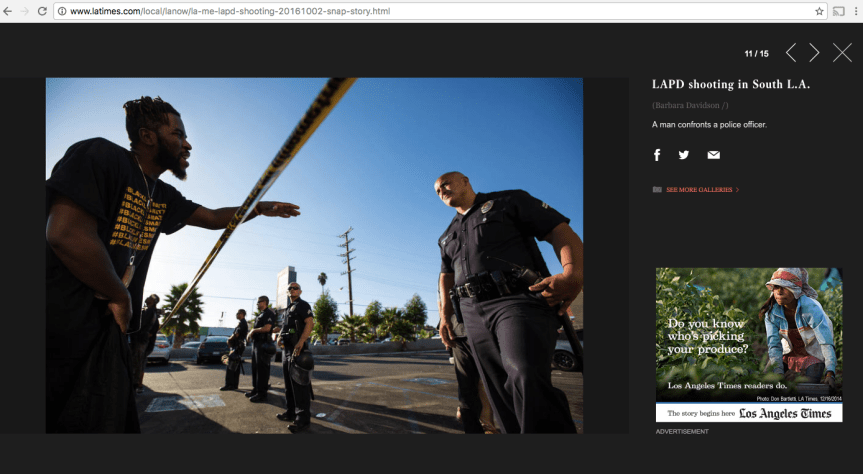
screen-shot-2016-10-02-at-10-01-45-pmAn African American man was shot and killed by police in El Cajon on Tuesday. There was a tasering death in Pasadena. A couple of weeks ago there were protests in North Carolina and uproar in Oklahoma. The story isn’t new, but it’s always heartbreaking.

I want to talk about this a little bit the way I think Jesus would talk about it. And I want us all to be able to talk about this in ways that Jesus would talk about it. And sometimes that means not saying what first comes to mind. In fact, most of the time. Most of the time it involves thinking before we speak.

I want to talk about how we love each other in a politicized, polarized, racially divided country.


I’m in an interracial marriage. Watching my kids explore the idea of race was strange. Earlier this year, my 9 year old son asked my wife, “Are we Democrats or Republicans?”

And my wife very cleverly answered, “You can be whatever you want to be.”

And he replied, quite seriously, “I think I’m going to be Asian.”10014983_10152432371003623_4737934191991154142_o.jpg

When he was younger, he had to think it through. At one point he said that we, he and I, were White, and Mom was Chinese. And I said, “No, I’m White, Mom’s Chinese, and you’re half,” or, we used the Hawaiian term, “hapa.” But in terms of identity, he has to figure that out.

It never occurred to me that he would have to figure that out.


A Black person once asked me, “What’s the experience of being white in America?” And I answered, “What do you mean?” And that was the answer. Growing up Black in America, you have to think about the fact that you’re Black. Growing up White, you don’t have to think about it.

The experience of being White in America is comfortable apathy.


I’m tutoring an African-American high school student as she prepares for the SAT and her college applications. And she’s writing an essay about what it was like to be Black in an all white neighborhood. She told me that she would be sent to the principal when she hadn’t done anything, and the principal would explain to her, “Well, you’re intimidating to the other kids.”

She told me, “They would call me articulate, and it didn’t feel like a compliment.”


I’m thankful that the demographics of my neighborhood is changing. I don’t want to live in an all-White neighborhood. I don’t want to my kids in an all-White school. I don’t want Real Life to be an all-White church. Know what the most common last name in the Real Life database is? Lopez. My guess is that in about 15 years, Glendora and the surrounding cities will be less than half White. That’s fine with me. I’m learning Korean right now. After that I think I’ll learn Chinese or brush up on my Spanish. Quando in Roma….


I have friends at church who are police officers. And I’m thankful for them. And I have a sense for what they’ve risked. One of them I met at Starbucks for the first time a few years ago, and he told me, “If you have to do my funeral, I just want you to know who I was.” Imagine having to think that way.

And I’m so thankful for the police officers who serve and protect us. I presided at a wedding for one of our officers today.

And when a police officer abuses power, I hate

the fact that all police officers are branded with the same image. They do that to pastors too. A pastor in the news has an affair and all of a sudden I can’t tell people what I do for a living for a few months.

They’re like, “What do you do?”

And I’m like, “Fire insurance.”

“Er…no. I work for an international cradle-to-grave non-profit organization that is the world’s leader in child care, elder care, education, hospitals, and grief care.”

“What’s it called?”

“Um…er…church. Are we still cool?”

Most police officers are good people trying to do right, just like you and me, and they suffer stress under pressure all the time, unlike some of us, and very rarely does anyone say thank you.


What the world needs from followers of Jesus is thoughtful, loving responses to a tense society.

Please please please don’t be a Christian that puts up flippant, vitriolic posts on Facebook. That is so unhelpful.

I met a guy a few years ago when I presided at his wife’s funeral. He didn’t have a church and he didn’t have a pastor. I was a friend of a friend. We really connected. We liked each other. He actually swung by my office to see me a couple of times. But when I invited him to church, he said, “Nope. I see what these Christians post on Facebook, and they’re the most unloving things I’ve ever seen.”

So listen people. Stop posting on Facebook like you think Jesus can’t read. And stop posting on Facebook like you think your primary audience are people you want to insult or people who already agree with you. Your words should be crafted for people who don’t know Jesus, who probably disagree with you on a lot of things, and who need you to love them anyway.

And just so you’re not worried – I don’t have any one post or person in mind when I say this, in case you’re sitting there going, “I think he means me…I posted yesterday.” If you’re thinking that, I wasn’t considering you specifically when I wrote this…but Jesus might have been.


I want to love and respect those who are brought up having to think about their identity because they are not in the majority. I don’t want to be dismissive of experiences I’ve never had. I want to make society safer for people who have never felt safe.

And I don’t want to disrespect police officers. There are corrupt police officers and broken socio-political systems. That’s the consequence of a broken, sinful humanity. Jesus told us to love our enemies, and that includes broken, sinful people of every profession, race, and social circle. But there are also police officers who are decent people trying to do what’s right while being hated for it.

It’s really just not mine to judge. It’s my place to love the way Jesus loved. That’s about it.

The Good News Can’t Wait

Last night I was walking through the hallways of a hospital, and since it was after hours, I had a personal guide leading me.  He worked the security desk.  We started talking about hospitals, and work, and then church.  He’s planning on coming to church with me on Sunday.

A few hours before I was sitting at Starbucks.  A student asked me a question about his homework.  We talked about literature, then sports, and then church.  I plan on seeing him Sunday as well.

I’m reminded of one of the more obscure teachings of Jesus, where a man comes to him and says, “I’d like to follow you, but I have to bury my father.” Jesus says, “Let the dead bury the dead, you just stick with me” (Luke 9:59-60).  That one always sounded a little insensitive to me.  He wants to have a funeral, and Jesus tells him not to bother?

Many scholars take the possible but not-necessary tact that the man’s father was still alive and he wanted to wait through the end, or that he meant he would go once his inheritance was secure, or that he was following the (sometimes) Jewish practice of waiting a year to bury the remains of the dead.  All of this mutes the actual words of Jesus to make them more palatable.  Jesus’ message is actually very simple.

The good news can’t wait!

Any kind of delay, serving as a disciple-at-large while someone else shoulders the work, batonpass-300x230.jpgisn’t part of the plan.  Jesus tells us to go reach the world now.  Talk about Jesus when we lie down at night and when we get up in the morning, when we sit at home and when we walk along the road.  Talk about Jesus when we’re going to the funeral, when we’re at the funeral, and when we’re standing around eating egg salad sandwiches afterwards.  Talk about Jesus instead of the business of normal life.  The Apostle Paul will even say it’s better not to get married if it gives you more time to talk to people about Jesus.

You know who stops talking about Jesus?  Dead people.  Spiritually dead people lateral that ball to a teammate so that they can go about normal life.  The act of following Jesus is like rising out of the baptismal waters to new life.  Nothing is better than that, and nothing is more important than that.  Do it today, not tomorrow.

The good news can’t wait!

Stuck

CTM.jpg“A couple of years ago I learned that three of my pastor friends around the country had resigned on the same day.  There were no affairs, no scandals and no one was renouncing faith.  But three good, experienced pastors turned in resignations and walked away.  One left church ministry altogether.

The details are as different as the pastors themselves, but the common thread is that they finally go worn down by trying to bring change to a church that was stuck and didn’t know what to do.  Their churches were stuck and declining, stuck and clinging to the past, stuck and lurching to quick fixes, trying to find an easy answer for what were clearly bigger challenges.

What all three churches had in common was that they were mostly blaming the pastor for how bad it felt to be stuck.”

Tod Bolsinger, Canoeing the Mountains, p. 12.

Pastor to Pastor

I’ve sat down with three different pastors this week.  They have wildly different personalities, life experiences, and circles of friends.  They don’t know each other and are only tied together by my own story.  One was a church planter.  One was a retired professor and pastor of large churches.  One watched God grow a church from a small and hopeful bunch to a booming metropolis.

What they share in common is war stories.  They thanklessly though still passionately sought vision for their churches and paid for it.  One rose higher.  Two fell and got up again.  All three are now vessels of grace because of it.

I love these three guys, and I love that they are so different.  One is whimsical and warm.  One is quiet and matter-of-fact.  One has the grizzly charm of a veteran.  All bow before the same God, and that God looks at all three in their diversity and is more than well pleased.

One told me about trying to plant a church and raise money on nothing but faith, only to have God deliver unexpected gifts on exactly the day they were needed.  God could do a better job of planning ahead, we both agreed.

One tells me when he calls, “I greet you in the majestic name of Jesus!” If it were anyone but him, I might think they were being corny.  But his voice is golden and bright, and has the sound of a General on the day after the armistice is signed.

All three prayed for me without me having to ask.

This week, here in sabbath rest, I got to experience something that I haven’t experienced in a long time as a pastor.  I received pastoring.  Pastoring is not so didactic as advice-giving, not so sentimental as nursing, and not so casual as hanging out.  It’s somewhere in between those three.  Pastors, especially the ones who have been around a long time, work a kind of magic that you don’t pick up on until you’ve walked away.  Suddenly you realize that you are comforted, or inspired, or perplexed, or even bothered, and you don’t know for sure whether or not they meant to do it, you only know that you are in a new and unexpected state.  There is very little in this world as comforting as telling a pastor your sorrows only to come up laughing together, as though you had dived into a pool you expected to be icy only to find out it was as warm as a bath.

The Holy Spirit and a pastor’s words can meld like epoxy and become active.  I’ve missed being able to receive this.  It makes me want to find a little church with dusty pews and an iconic steeple and volunteer to help.  When the last of my three friends offers to pray, I rest my head on my folded arms at the table and close my eyes.  I don’t catch exactly what he’s saying, but I feel the afternoon breeze blowing over my head and shoulders like kind hands, and when he is done, I am somewhere different than where we began.

Religious War

SBIt’s strange to me that, as apprentices of Jesus, his followers don’t seem to know what tools he did and didn’t put in their hands.  If a carpenter’s apprentice goes about his work with a plunger or a meat cleaver, we would have to wonder how closely he was paying attention when he was being mentored.  Jesus mentored a group of followers for three years, and four men saw fit to capture the highlights of those interactions.  Those four documents are now a manual for being an apprentice of Jesus.

What tools did he teach his disciples to use?  And specifically, what tools did he give them when they were in a fight?

Revenge, spite, flights of self-righteous indignation, grudges, gossip, and xenophobia are not on the list.  Those are not tools that Jesus ever used, and he didn’t teach his disciples to use them either.  Worse still, he actually banned them.  So when Christians go around using any of these tools, we have to wonder by whom they are being apprenticed.

When self-proclaimed Muslims carry out acts of terror, like the San Bernadino shooting a week ago, Christians have been taught how to respond during their period of understudy.  And the master carpenter put these tools in their hands:

“Love your enemy.”

“Do not repay evil with evil.”

“Repay evil with blessing.”

“Bless and do not curse.”

“Do not take revenge.”

“Do not overcome evil with evil, but overcome evil with good.”

“Let the one who is without sin cast the first stone.”

In the wake of horrible tragedy, self-professed Christians who speak in a way so as to undermine people groups, encourage xenophobia, and encourage a low din of resentment towards people who hold different or even counter ideologies are not following after the one under whom they claim to have studied.

The strongest tool that Jesus left in the hands of his followers was not power but surrender.  Jesus did not conclude on a throne but on a cross.  His method was not conquest but conversion.  We who follow Jesus can testify to a love that would not condone the evil of retribution by giving our lives away in love, especially to those who haven’t asked for it, don’t deserve it, and won’t say thank you.

The Intergenerational Church

I remember going fishing with my grandparents when I was a child in the Georgia mountains. The smell of pipe smoke rekindles the creekside image. We used to play checkers on the porch of his trailer as the sun went down, and he remembers a morning where I woke up and said, “Granddad, let’s go get pancakes and not tell Grandma!” Grandma later said it was all she could do to suppress her giggling when she heard it from the next room.

Now my son is the age I was then, and my parents have moved nearby. My dad does not look to me the way my grandfather looked to me when I was 8. If the four of us could stand side by side today, it would appear to be something like a time-lapsed picture. Seeing my dad and my son helps me orient my childhood memories from the perspective of what my grandfather might have been thinking and feeling. Today, instead of fishing, my son is explaining to my dad how to play Minecraft on Xbox.

There are a few activities we like to do together, mostly eating. When it comes time to go to the movies, we usually let the kids choose. Or if the kids go swimming, we’ll sit on the deck chairs and just talk. There’s a pleasant harmony of togetherness, even though our interests and energy levels are not the same.

lobby
This picture was taken in the lobby of my church.

As a pastor, I would say that one of the best things about the Church is that it is intergenerational. In fact, the church is a great place to adopt a family. For those who never knew their grandparents, it’s a great place to adopt a grandparent. For those who don’t have grandkids, it’s a great place to adopt a grandkid. There are sometimes big activities at our church that all generations come to, and you can tell that not all interests and energy levels are the same. For our Halloween festival this month, the kids will run around, trick-or-treat, and play carnival games. I’ll watch parents and grandparents mill around together as children immerse themselves in the games. We get to swap stories and meet some new friends.  It takes dozens of volunteers of all ages to make it an engaging event that welcomes people to our church who have never been before. And for a brief moment, we’re united across generations for a purpose and as a family.

Since the kids tend to have the most energy, and in most families tend to garner a lot of attention, there’s a challenge to doing things together. A woman from my church who is in her 70s asked me, “Where do I fit?” I told her that we need seniors to greet people at the door, to lead Bible studies, to teach classes, to teach Sunday school, to volunteer at VBS, to pray for the church, and to support the church financially. We need every generation to walk along side people who are hurting, counsel, coach, lead, preach, teach, go on mission, and reach the people who live next door. We need everyone, and we’re strongest intergenerationally.

We’ll have to realize as we gather that we won’t all have the same energy level. Some will be in the pool splashing. Some prefer to sit on the side. But without a family that spans the generations, we miss out on the richness of perspective and personality that best suits the family of God.